Sunday, August 25, 2013

100 Years of Walt Kelly

(Click any of the images to enlarge.)

August 25, 2013 marks the 100th birthday of Walt Kelly, one of the most important and influential cartoonists of the 20th century.

Kelly grew up in Bridgeport, Connecticutt, and started drawing at a young age.  In the mid-1930s, he contributed to the earliest years of the comic book industry, working for the company that eventually became DC comics.
More Fun Comics, 1936

From there, Kelly went to work for Walt Disney, first as a story artist and then as an animator in Ward Kimball's unit.  Kelly's animation can be seen in shorts like The Nifty Nineties and the features Pinocchio, Dumbo and The Reluctant Dragon.  Truthfully, Kelly gained more from Disney than Disney gained from Kelly.  There were many animators at Disney who were Kelly's superior, but Kelly's time at the studio working with Kimball and Fred Moore had an enormous impact on the quality of his art.


At the time of the Disney strike, Kelly left the studio and returned to the east coast.  Exempt from the World War II draft for health reasons, Kelly returned to comic books where he did a variety of material that showed off his versatility.  He did fairy tale material aimed at young children.  He did the comic book version of Our Gang (later known to baby boomers as The Little Rascals when the films reached TV) and made a conscious effort to draw the Buckwheat character (whose name Kelly shortened to Bucky) in a non-stereotypical manner.  There are four volumes reprinting Kelly's work on this strip.  Finally, he created the cast of Pogo for Animal Comics.

In the late '40s, Kelly went to work for the New York Star, a liberal daily newspaper that only lasted a few years.  He was the art director of the paper, doing editorial cartoons and putting Pogo into comic strip form.  When the paper folded after just a few years, Pogo was syndicated nationally in 1949 and by the early 1950s became a hit, especially with college students.  He continued to work on Pogo until his death in 1973.  In the interim, the strip was the subject of a network animated TV special The Pogo Special Birthday Special, directed by Chuck Jones and a 15 minute animated film, We Have Met the Enemy and He is Us, made by Kelly himself and his third wife Selby.  The strip was collected in a series of trade paperbacks that often included original material.

With all of this, Kelly additionally did a comic book series The Adventures of Peter Wheat, a giveaway comic for Krug's Bakeries and illustrated several books including The Glob by John O'Reilly and I'd Rather Be President by Charles Ellis and Frank Weir.
Kelly illustration from The Glob

Kelly had a fondness for drink and did not look after his health.  He developed diabetes and had a leg amputated as a result of the disease.  When he died in 1973, Pogo was continued by his widow Selby.  Later, it was revived by Doyle and Sternecky and finally by Kelly's daughter Carolyn.  Pogo is currently being reprinted in handsome volumes by Fantagraphics.

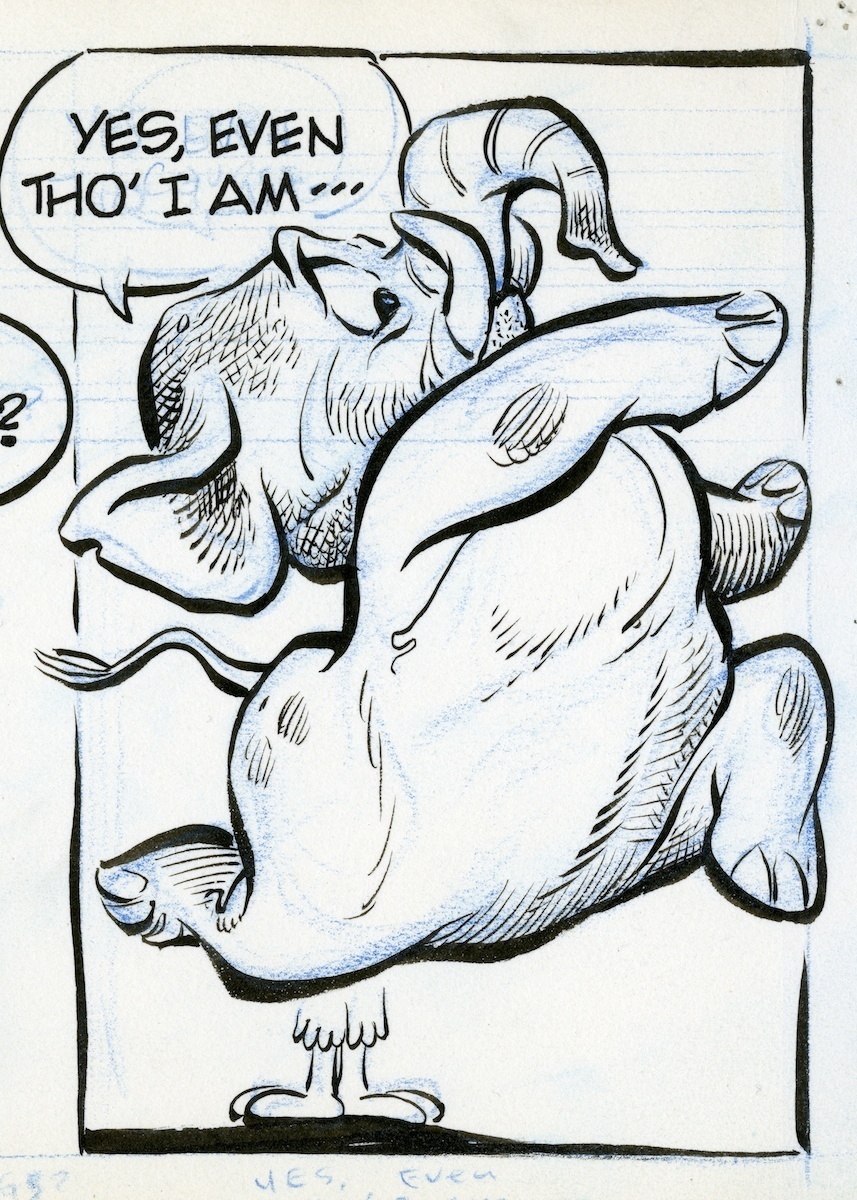
Kelly's work was typified by several things.  He created gentle fantasies aimed at children in his comic book work, where children and talking animals engaged in adventures that were free of the violence that dominated many comic books of the time.

He did raucous slapstick in the Our Gang and Pogo comics.
Sarcophagus MacAbre, undertaker

He loved playing with language, mangling words for comic effect and used different lettering styles to indicate the personality of his characters.  He was a poet who alternated between nonsense rhymes and wistfulness. 
Kelly caricatures Truman


Finally, he was an ace caricaturist and political satirist, taking on Senator Joseph McCarthy in the 1950s over his anti-communist witch hunting, and Lyndon Johnson, Spiro Agnew, J. Edgar Hoover, Nikita Khruschev and Fidel Castro in the 1960s.

Kelly's art was heavily influenced by his time in animation.  His designs were of the Disney school in their construction.

His characters acted; their body language explicitly communicated their emotional states.  They stretched and squashed freely.  This came from his knowledge of posing characters for animation.  Animation also influenced his slapstick gags.

Kelly's brush work is awe inspiring
 Finally, his use of the brush for inking is legendary and was the envy of every cartoonist who saw it.  His brush line was lush, supple and expressive, contributing a solidity and dimensionality to his drawings.

What's here is only a tiny sampling of Kelly's output.  If you want to see more images, check here.  If you want to know what Kelly material is available for sale, Ebay has a wide selection.

Illustrator Thomas Haller Buchanan has gone into much greater depth than I have here by putting together a whole online publication dedicated to Kelly on his 100th birthday.

Having gotten to the end of this brief survey of Walt Kelly's career, I realize that I've yet to include a drawing of Pogo himself, the character that Kelly is most known for.  So to end, here he is.
A 1963 Sunday page

Tuesday, August 13, 2013

Controversial Miyazaki II

Updated below.
“My wife and staff would ask me, ‘Why make a story about a man who made weapons of war?’” Miyazaki said in a 2011 interview with Japan’s Cut magazine. “And I thought they were right. But one day, I heard that Horikoshi had once murmured, ‘All I wanted to do was to make something beautiful.’ And then I knew I’d found my subject… Horikoshi was the most gifted man of his time in Japan. He wasn’t thinking about weapons… Really all he desired was to make exquisite planes.”
More on the controversy surrounding Hayao Miyazaki's latest film, The Wind Rises.  For an earlier post about this, go here.

Here's the trailer with English subtitles.  For those of you in Toronto, the film will be playing at the Toronto International Film Festival.

Wednesday, August 07, 2013

R.I.P Lou Scarborough

I met Lou when I was starting out in animation in New York in the 1970s and we both worked at Nelvana in Toronto the early 1980s.  He was a great artist, a great guy and he's gone too soon.  Jerry Beck has details.  Tom Sito has written a remembrance at FLIP.

Tuesday, August 06, 2013

Cartoonist Evan Dorkin on Rejection

Good advice for anyone doing creative work from Evan Dorkin, who has worked in comics and animation.

Was Disney's Pixar Purchase Worth It?

Go here for a very interesting financial analysis of how much Pixar is contributing to Disney's profits.  According to this article, Disney paid $2.2 billion too much for Pixar and it also questions the purchase price Disney paid for Marvel and Lucasfilm.

(link via James Caswell)

Sunday, August 04, 2013

TAAFI Roundup Day 3

In addition to Kevin Schreck's excellent documentary on Dick Williams, I also watched another shorts program.  I see that I mistakenly included comments on those shorts in my day 2 roundup, so I've nothing else to report about them here.


Mark Caballero

Mark Caballero, a stop motion animator who worked with Ray Harryhausen towards the end of Harryhausen's life, celebrated Harryhausen's work with some rare clips and behind the scenes photos.  Caballero's company, Screen Novelties, collaborated with Harryhausen to complete The Tortoise and the Hare, one of the fairy tales that Harryhausen did early in his career but abandoned.  Caballero revealed that Harryhausen actually did several new shots in the film, so it was probably the last animation he ever did.

TAAFI had originally intended to have Harryhausen as a guest and planned to give him the Life Achievement Award, but Harryhausen's death intervened.  TAAFI still wanted to do something to commemorate his career, so they worked with Harryhausen's foundation to have Caballero make his presentation and Harryhausen was given the award posthumously.


Top: Matt Mozgiel.  Bottom: Max Piersig.  Photos by Graydon Laing.

The Big Pitch was an opportunity for two creators to pitch a TV series idea to a panel of development executives, with the winner decided by an audience vote.  Matt Mozgiel and Max Piersig pitched their ideas.  Both deserve a lot of credit for guts.  Having pitched shows myself, I know the pressure that a creator is under when in a room with just a few people, but to do it in front of development people and a full auditorium takes real nerve.  Both acquitted themselves well, with the audience selecting Piersig the winner.

With all due respect to the participants, the whole idea of pitching an idea is absurd as the ability to pitch and the ability to create are wholly separate skills.  A great creator may be bad at pitching and someone good at pitching may not have the best ideas.  If a novelist is looking for a publisher, he or she submits a finished manuscript or an outline and sample chapter.  What's being judged is the actual work.  It's easy to imagine great writers unwilling or unable to pitch.  Someone like J.D. Salinger (The Catcher in the Rye) would never have put up with it.  Budd Schulberg (What Makes Sammy Run?) had a bad stammer.  What chance would he have had?

Pitching exists in TV due to the laziness of development people.  Rather than read a script, a bible or a storyboard, they want to be spoon fed a series concept and characters in just five minutes.  How absurd is it that a creator, who has probably laboured for an extended period of time to create a show concept, has only 5 minutes to make an impression?  And how many good shows have never seen the light of day because the creator wasn't good at pitching?

The last event of the festival was the awards.  If you want to know who won, you can find out here.

TAAFI was densely programmed with a wide variety of screenings and talks.  I'd be surprised if an attendee couldn't find something of interest in every time slot.  The festival also benefits from the venue.  The TIFF Bell Lightbox is compact making it easy to move from one screening to another.  The location is also good for a variety of food choices and is well served by mass transit.

With so much animation production for TV, games and effects done in Toronto, it's great that the city finally has a festival to celebrate it.  Ben McEvoy and Barnabas Wornoff have pulled together the entire animation community to make the festival work.  The second year was better than the first and it's heartening to know that the next festival is already being planned for June of 2014.  I will definitely be attending and look forward to whoever next year's speakers will be and hope that Ben and Barney find a feature as good as The Day of the Crows for us to watch.

For lots more photos of the events, visit TAAFI's Facebook page.

Friday, August 02, 2013

Persistence of Vision

Richard Williams

I will write an entry about TAAFI's third day, but Kevin Schreck's documentary Persistance of Vision, which screened at TAAFI, deserves an entry of its own.  The film is a chronicle of the making and unmaking of the Richard Williams' feature The Cobbler and the Thief.  Williams began the film as an adaptation of stories featuring the mullah Nasruddin written by Idries Shah.  A falling out with the Shah family led to the reworking of the story to eliminate the Nasruddin character and a cobbler became the new focus of the film.

Williams financed the film out of profits made from his studio's commercial work.  After the success of Williams' contribution to the animation of Who Framed Roger Rabbit, Warner Bros. agreed to finance his feature.  When Williams failed to deliver the film on time, Warner Bros. decided it was better to drop the project and collect the completion insurance, which put the ownership of the film in the hands of The Completion Bond Company.  At that point, the film had been in production for 24 years.

Stuck with a film they didn't want, the bond company took it away from Williams and had it completed in the cheapest, fastest way possible.  They hoped to salvage something financially by bowdlerizing the film to make it look like other animated features of the time.  The film, released as Arabian Knight, was a failure and Williams withdrew from active production to lecture, write The Animator's Survival Kit, and to work on personal projects.

That's a very bare outline of events, but the man at the center of it, Richard Williams, is a huge contradiction: he elevated the art of animation but was the author of his own misfortune.  Schreck's film explores both of these aspects of Williams' career by interviewing many people who worked on the film and using footage of Williams himself from interviews he gave over the years.


Left to right: Ken Harris, Grim Natwick, Art Babbitt, Richard Purdom, Richard Williams

Williams understood that the men who created character animation were getting on in years and that their art would die with them.  At his own expense, he brought animators Art Babbitt, Ken Harris, and Grim Natwick to his studio to train his staff.  These veterans of Disney and Warner Bros. gave their knowledge freely as well as contributing to the studio's output.  Williams himself was a perfectionist who demanded the best possible work from his staff.  While he was often a difficult boss, those who worked for him acknowledge the opportunity he gave them to grow as artists.


Left to right: Ben McEvoy, Kevin Schreck, Tara Donovan, Greg Duffell.  Donovan and Duffell both drew inbetweens on the Williams feature 17 years apart.

After the screening, Kevin Schreck made the comment that Williams had the sensibility of a painter working in film rather than the sensibility of a film maker.  That crystallized my thinking on Williams.  While he brought over veteran animators and idolized Milt Kahl, it's interesting that over the course of the production, he never brought in veteran story men like Bill Peet, Mike Maltese or Bill Scott.  He never consulted with directors like Wilfred Jackson, Dave Hand or John Hubley.  At no time did he hire a famous screenwriter or novelist.  He was interested in creating better animation, but he was uninterested in what the animation was there to serve.

Williams treated content as an excuse to create elaborate visuals, but he didn't much care what the content was and may not have been able to tell the difference between good and bad content.  In this way, he was perfectly suited to the commercials his studio turned out.  He was lucky that during that period, British ad agencies were writing literate and witty ads.  The combination of their content and his astounding artwork made his commercials the best in the world.

But when the content was mediocre, as it was in his feature Raggedy Ann and Andy or in The Cobbler and the Thief, the result was an elaborateness that wasn't justified. Character designs were overly complicated and had a multiplicity of colours.  Layouts used tricky perspectives.  The inevitable result was that artists could only work at a snail's pace, driving up the budget and jeopardizing delivery.  The detail overwhelmed the flimsy stories and the films collapsed under their own weight.

Someone in the documentary revealed that during the period when Warner Bros. was financing the film, Williams was still creating storyboards.  That was twenty years into the project.  It was obvious that Williams considered story an inconvenience; it had to be done so there would be something to draw.  In the panel discussion after the film, Greg Duffell recalled that there were mornings where Williams had to create sequences off the cuff in order to supply Ken Harris with work.  There was never a structured story, just sequences that tickled Williams' fancy. The visuals were what Williams cared about.

Schreck's film encompasses the heroic Williams and the self-destructive Williams.  Williams is animation's Erich Von Stroheim, making an impossibly long version of Greed.  Or maybe Williams is Captain Ahab, inspiring his crew to pursue the white whale but leading them all to destruction.  Williams set out to make a masterpiece, to show the world animation as it had never been done before.  Those parts of his film that survive are unlike anything else that's been done.  But being different and being worthwhile are not the same.  Williams chose to work in a medium where the audience expects a story that evokes emotions, but Williams saw story as a necessary evil instead of the heart of the project.

This documentary is a major work of animation history.  Schreck has been traveling with it to festivals all around the continent.  I don't know if the film will be picked up for distribution as clearing the rights to various clips would be expensive and time consuming.  For now, festivals may be the only way to see the film, so you'll have to seek it out.

Williams' career has undoubtedly been a benefit to the entire animation industry, but his success with audiences was greater when others created the content that was the basis for his work.

Wednesday, July 31, 2013

TAAFI Roundup Day 2

Dr. Stuart Sumida

The absolute highlight of TAAFI on Saturday was a talk by Dr. Stuart Sumida, a paleontologist by trade who consults with the animation business.  Dr. Sumida has consulted for Disney, DreamWorks and Arc Productions in Toronto, and it was Arc who suggested him as a TAAFI speaker.  His talk was on comparative anatomy, pointing out the difference between herbivores and carnivores, between animals and humans and then between men and women.  Those differences in structure had repercussions for how various creatures move.

 I think everybody in the audience learned something about anatomy from his talk.  I know that I did.  After his talk, I approached him to suggest that he lecture at Sheridan the next time he was in Toronto, but the associate dean of the animation program beat me to him.  I hope that Sheridan students have the benefit of his knowledge.

Not having heard of him prior to TAAFI, I did not register for his Sunday master class.  I will not make that mistake again should he return to Toronto.  If he appears at a festival near you, I urge you to attend.  You will not be disappointed.

The balance of my day was spent watching three shorts programs.  Shorts programs are always a mixed bag.  There's no question that I have a bias for narrative.  My general comment, not only about the shorts at TAAFI, is that many films are poorly paced and directed.  I often find myself wanting the films to move faster or be clearer as to what they are trying to communicate. The work embedded below is what I found online and that I felt had merit.  However, few of the films are serious and still entertaining.  That may be asking too much, but it's a direction that I'd like to see animation pursue.

I enjoyed the anarchy of Got Me a Beard and I thought The Right Place was well crafted, though I wish the craft was applied to something other than a scatological joke.  Fester Makes Friends is the latest in a series of Fester cartoons.  They are dopey and politically incorrect, but they remind me of cartoons of the 1930s that throw decorum to the wind.

There was a 21 minute film called Priests whose animation and design were rather spare, but had a great script that dealt with various religious contradictions as well as the relationship between two priests.

Jazz That Nobody Asked For was another anarchic piece that I enjoyed.  The Bravest Warriors is a web series by Pen Ward, the creator of Adventure Time.  I was never able to get my head around Adventure Time and admit that it's probably a generational thing, but I found The Bravest Warriors to be clever.

The last shorts program I saw that day was student shorts.  Four of them were from Sheridan, so I can't be objective about them.   Happily Ever After was from Israel and had potential but he ending was a disappointment.  Double Occupancy from Germany was very solid for a student film, but there were missed acting opportunities.  The two characters could have been developed further.  Probably the stand-out was I am Tom Moody.  What's embedded below is only a portion of the entire film, which is a sensitive look at a character at war with himself.

Jazz that nobody asked for from Benny Box on Vimeo

Tuesday, July 30, 2013

Parallel Posters


If you think that the movies coming out of Hollywood are all alike, take a look at the similarities of the posters that advertise them.

(link via Boing Boing)

TAAFI Roundup Day 1

Anyone who has attended an animation festival knows that the cascade of talks and films tend to blur together.  In addition, TAAFI had three sessions running simultaneously each day.  It's possible for someone to have attended and experienced a completely different festival, so don't take this as a definitive review of TAAFI, merely my own personal impressions.


David Silverman

David Silverman, a director on The Simpsons, gave the keynote address on the series.  Someone asked about table reads and punching up the script and Silverman revealed that the script was punched up at least four times, the final time after footage was already in colour.  He mentioned that people suggested more efficient ways of working, but his attitude was that the show was the most successful animated series in history, so why mess with a good thing?

This was followed by a state of the industry panel.  Ben McEvoy, one of TAAFI's founders moderated and asked if the broadcasting was dying, with so many people cutting their cable subscriptions.  Predictably, the broadcasters on the panel said no.  Whether they believe this or were trying to project confidence, I don't know.

Later, there was a panel "From Napkin Sketch to Green Light," about pitching shows and getting them to air.  Someone on the panel said it could take five years to go from pitch to a show, and I thought to myself that if broadcasting wasn't dying now (and I think it is), who knows where it would be in five years?  Pitching shows to conventional broadcasters and cable channels now is a questionable proposition, as their financial model is deteriorating rapidly.

I have an axe to grind here, but it was clear from this panel that ideas should not be fully developed, as broadcasters like to shape shows to their needs, and a broadcast executive emphasized that even if he liked a pitch, he still had to sell it to those higher up in his company.  The combination of these two things is the reason that I personally discourage people from pitching shows.  Any creator worth his or her salt is going to want to explore their idea and nail things down.  This is precisely what broadcasters don't want.  There are legitimate reasons, such as needing a show to be suitable to a particular demographic, but there is also the vanity of business people who think that their ideas are as good as anybody's.  If this was true, they wouldn't need to take pitches and would create their shows in-house.  Furthermore, after contorting an idea to please a development executive, the executive doesn't have the authority to put the show into production but has to convince the bosses, who are likely to contort the show even more.  While this ugly process proceeds, the creator is being paid peanuts in development money while the broadcast people are on salary.

The game is stacked heavily against creators, which is why I encourage people to get their work to an audience in a more direct fashion: as prose or as comics distributed on the internet.  Besides establishing ownership of the property (something you would have to give up to a production company or broadcaster), it allows a creator to thoroughly explore the idea and develop it without interference.  Finally, should the property attract an audience, that gives the creator increased leverage in dealing with broadcaster interest.

The business we're in is very simple, really.  It's all about attracting an audience, the larger the better.  That audience gets monetized though advertising, subscriptions, pay-per-view, merchandise, etc. and that's what finances the whole shebang.  If you've built an audience, that makes you and your property valuable.  People who want access to your audience will come to you.  Pitching will be unnecessary and instead they'll be making you offers.

There was a panel on funding yourself which I had to miss as it ran concurrently with a panel I moderated on portfolios and self-promotion.  I really wanted to see it.

My panel had Lance Lefort of Arc, Darin Bristow of Nelvana, Patti Mikula of XMG Studio and Peter Nalli of Rune Entertainment talking about the best way to organize your material when applying for work.  These days studios prefer links to any physical media.  Reels should be short with the best material up front.  Applicants should know about the companies before applying so that they know they're showing suitable material.  Resumes should be no longer than 2 pages and cover letters a single page.  All stressed that attitude was as important as skills, as they were looking for people who would fit into existing teams and be pleasant to work with.

The day ended with three talks.  Mark Jones and Sean Craig of Seneca College talked about how the school had worked on professional productions, particularly those made by Chris Landreth.

Jason Della Rocca gave a fabulous talk relating Darwinian evolution to the changing nature of the media.  As I have an interest in evolutionary psychology and business, it was right up my alley.   He talked about how people assume that the present environment extends infinitely into the future without disruption and how inevitable disruption catches people off guard.  He talked about the importance of variation in an uncertain environment as the only way to discover what would work in new conditions.  Failure was a necessity in order to gain knowledge but the failure had to be small enough as to not destroy an enterprise.  Della Rocca mentioned that Angry Birds was the fiftieth project of the creators and that nobody remembered the previous forty nine.  He talked about how the highest quality inevitably came from those who put out the greatest quantity, precisely because that quantity (including failures) gave them more information about what worked in a given environment.  The talk could be boiled down to "fail fast and cheap."  Right now, Hollywood is betting everything on tentpoles that cost $100 million plus (meaning "slow and expensive") and even Lucas and Spielberg are warning that movies are vulnerable to a financial collapse as a result.

Greg Duffel explaining spacing charts

The last speaker of the day was veteran animator Greg Duffell, who talked about timing.  In the past, directors would time entire films down to the frame as a way of guaranteeing synchronization with music that was being written while the animation was being done.  Duffell talked about how this had fallen by the wayside and that what animation directors do today bears very little resemblance to what they previously did.  Duffell gave a longer version of this talk to the Toronto Animated Image Society several years ago and I wish that TAAFI had allowed more time for this important talk.

Coming up will be reflections on days two and three of the festival.

Friday, July 26, 2013

The Day of the Crows


Courtesy of TAAFI (Toronto Animated Arts Festival International), I have just seen a terrific animated feature from France.  It's original title is Le Jour des Corneilles and it was co-produced by France, Canada and South Korea.  It is a drawn feature made for less than $10 million U.S. and is easily one of the best animated features I have seen in the last several years.

The film opens with two characters, a father and son who live in a forest.  The father is a gruff barbarian who treats his son with disdain.  The time period is impossible to determine.  It could be a fantasy setting or could be any time in the historical past as there is nothing beyond the natural world to provide a clue.  When the father is injured, the son ventures beyond the forest for the first time to find help, and we then learn that the film is set during the first World War.

The son has grown up isolated from anyone except his father and forest animals.  At this point, the film becomes reminiscent of Francois Truffaut's The Wild Child, where the feral son has to adjust to life in civilization.  As the film continues, it reveals the backstory of who the father is, how he came to live in the forest and what has determined his relationship with his son.

When I watch animated features made in North America, I always know where they're going.  I hope for surprises or twists to break the film out of the predictable story structure that Hollywood continually falls back on.  In this film, I had no idea where it was going and I loved the film for that.  The characters were intriguing, their background was a mystery and the ultimate resolution was not guessable until it arrived.
Director Jean-Christophe Dessaint (left) with TAAFI director Ben McAvoy
The artwork is beautiful, the characters are well developed and the direction and pacing by , who was present at the screening, were excellent.  I was sitting between Jerry Beck (an old friend) and David Silverman of The Simpsons (who I met today) and the three of us loved the film.  I said to Jerry that this film could easily be the wildcard Oscar nomination for animated feature this year.  Each year, after the major animation studios have been stroked with nominations, the animation branch usually gives a film a nomination based purely on its quality.  This film deserves that nomination this year.  I don't believe that the film has a North American distributor yet, but this is the kind of film that Gkids has picked up in the past and I hope that they, or somebody else, grabs this film.

Apparently, it is already available in Blu-ray with English subtitles, though I don't know where it can be bought.  The amazon.ca DVD listing says that it is bilingual, but there is no indication if it is dubbed or subtitled.  In any case, if it is playing in a festival near you or turns up on Netflix or a cable channel, I highly recommend it.  While the film is still child-friendly (though not for very young children), it has enough adult content that it is a satisfying experience.

It shows clearly that drawn animation is far from exhausted as a medium and it shows how much can be done for a relatively low budget.  More and more, I know that the most interesting animated features are not coming from  North America. 

Wednesday, July 24, 2013

Controversial Miyazaki

I would look forward to any new film directed by Miyazaki, but I'm especially curious about The Wind Rises.  It's about Jiro Horikoshi, the designer of the Zero, the Japanese fighter plane that was used extensively in World War II.  The subject matter is far from films like Totoro and very far from North American animated features in theatres this summer.

What's also interesting is that the film is politically controversial in Japan (this article is now behind a login and password.  Using bugmenot.com, I got in using a login of what@yourmom.dom and a password of updude).  Miyazaki has written that that it was "a truly stupid war," which has angered Japanese nationalists who want to change Japan's constitution to allow for military aggression.

I'm wondering what company, if any, will pick up distribution for North America.  A Disney too afraid to release Song of the South hardly seems a candidate.  While Gkids has released Ghibli films, this subject matter is not aimed at their usual audience.  Perhaps some other indie distributor will pick up the film.  As there is a dearth of animated features specifically aimed at adults, I hope someone does.

Needless to say, I won't be holding my breath waiting for a North American animated feature that tackles Viet Nam, Iraq, drone warfare or the national security state.  While I can point to live action features that have questioned government policy or the official interpretation of history, North American animation is too timid.  Mustn't upset the kiddies.

(link via The Comics Reporter)

Monday, July 15, 2013

Fleischer Gag Cartoons

Check these out.  Gag cartoons from various Fleischer artists: Willard Bowsky (pictured), Tom Golden, Gordon Sheehan, Orestes Calpini, Tom Moore, George Germanetti, and Jack Ozark.  All seem to revolve around Dugan's cake, so there must have been a party where this cake was served.

Tuesday, July 09, 2013

A History of Computer Animation

Moving Innovation: A History of Computer Animation by Tom Sito is a sprawling chronicle of the development of cgi.  That sprawl is both a blessing and a curse.  The blessing is that Sito makes it clear how many people, institutions and companies each contributed to the development of computer animation over decades.  He has interviewed many of the pioneers and looked at many of the individuals, institutions and companies that doggedly pursued the dream of images and animation created on computers.

The curse is that this wide-ranging approach has made the book's organization clumsy.  Rather than work chronologically, Sito devotes chapters to contributions by government, academia, business, gaming and individual artists, so the book keeps doubling back on itself.  Certain films, people and events pop up repeatedly, muddying the historical sequence.  A timeline in the appendices would help clarify the history.

Hearing the pioneers speak about their own ambitions and accomplishments provides an intimate look at an art and technology as it was struggling to be born.   The path was not a smooth one; the failures were as common as the breakthroughs.  There's a cgi graveyard filled with people and companies who chased their dreams before the hardware, software and economics were in place to make those dreams come true. 

While certain well-known figures, such as George Lucas, Steve Jobs, Ed Catmull and John Lasseter, are present, so are many who are unknown to the general public in spite of their importance: Alvy Ray Smith, Jim Blinn, Charles Csuri, Alexander Schure, John Pennie, Robert Abel, Bill Reeves, David Evans, Ivan Sutherland, Seymour Cray, and James Clark.  Each of these people and the others chronicled in the book made contributions that changed the course of the field.  Each worked to create better looking images or to make computer animation flexible enough to communicate ideas and entertain audiences.

While Tom Sito is a traditional animator who has also done storyboards and directed, he has no hands-on experience with cgi.  That lack of familiarity shows in various ways throughout the book.  The development of hardware, particularly the rise of Silicon Graphics followed by the development of video cards for consumer PCs, had huge a impact on the proliferation of cgi and its ability to produce more complex images.  Similarly, viable off-the-shelf graphics software put cgi into the hands of artists who didn't know how to write software.  Sito doesn't fully recognize the impact that each of these things had on the growth and success of the industry.

He also doesn't fully grasp cgi concepts.  His description in the glossary of forward and inverse kinematics is "formulas used in 3D animation," which says nothing about their most common use in moving characters' arms and legs, let alone defining the difference between them.

Historical errors also creep in.  The TV series ReBoot ran on the ABC network, not the Disney Channel.  The animation for the TV series Captain Power and the Soldiers of the Future was not produced by Omnibus.  The studio did a sample to try to land the project, but lost it to Arcca Animation.

There will undoubtedly be more histories of computer animation written in the future, some that will go into greater depth on certain topics.  However, in Moving Innovation, Tom Sito has begun to map the territory, making it easier for those future authors to understand how the pieces fit together and who the important players were.  While not perfect, Moving Innovation is a good introduction to how computer graphics grew and have spread throughout almost all areas of computing and our daily lives.

Monday, July 08, 2013

The Decline of Disney

Jaime Weinman on recent Disney events:
"But some people will miss the tradition that Walt Disney created—people who have animated for Disney, and people who aspire to. “I feel like the latest news of layoffs has shaken up a lot of animators, especially students,” says Bobby Chiu, founder of Toronto’s Imaginism Studios. “They’re all a little nervous.” And of course so will some fans. While a future dominated by Star Wars and Iron Man might make Disney more profitable, it could also mean a future where Disney releases movies that could have been made by any studio—and in many cases, used to be made by other studios. In the Lion King era, Disney was the studio that every company tried in vain to rip off. But today, “the average person can’t tell the difference between a Disney movie and a DreamWorks movie, or even a Sony movie,” says [Tom] Bancroft."

Friday, July 05, 2013

Stunted Growth

“Because there’s bad guys, and Mater, and Lightning McQueen, and SPIES!” 
- Max (age 5)

Slate recently published an article comparing how children and adults rated Pixar features.  The children focused on different things than the adults did.  The above quote refers to Cars 2, not any adult's favourite Pixar film.

The article exposes the paradox that is the family film.  It must be acceptable for small children and still keep the attention of parents.  It's a compromised enterprise from the start and I think it's the major obstacle preventing animated features from maturing.

I have nothing against children's entertainment, but imagine if every medium other than animation had to conform to the same standard.  What if every book written had to be acceptable for a five year old?  What would be the attraction for adults?

While animation fans and professionals insist that animation is a medium and not a genre, Hollywood treats it exactly like a genre.  Animated features made for the North American market are the equivalent of books read to children at bedtime.  They're all cut from the same cloth: comical fantasies suitable for young children.  They differ in terms of their characters and settings, but the content is sharply proscribed.  The majority of adults would never choose these films as entertainment for themselves; they tolerate them only because of their children.  When alone, adults are far more likely to tune in HBO than pull a Pixar film off the shelf.

For all the advances on the technical side, the computer animated features in theatres this summer would fit comfortably into the 1990s in terms of their stories.  Computer animation may have displaced drawn animation as the technique of choice, but it has fully embraced the content of animated features dating back to Snow White and the Seven Dwarfs.

Economics, as usual, control the situation.  Contemporary animated features cost anywhere from $75-200 million.  With budgets that high, nobody is willing to take a chance and so long as most of the films are profitable (and let's not forget the additional revenue from merchandise), there's no incentive to change.

Japan and Europe haven't fallen into the same trap as North America.  Their animation budgets are lower and the range of content is far wider than North America will accept.  When these films are imported, they receive critical praise but barely register at the box office.  Hollywood has trained the audience well. 

Steven Spielberg is negotiating with John Steinbeck's estate for the right to remake The Grapes of Wrath.  I'll bet that Spielberg would think it a ridiculous idea to do the remake in animation.  Most people would.  And that's the point.  If animation is a medium, it should be able to tackle any subject matter.  Animation will never develop or attract or keep great directors unless they are free to express whatever they want to, whether it's suitable for a five year old or not.

The family film will bring a lot of joy to audiences and make a lot of money for studios, but it will also keep animation a second class medium.  Pixar let Andy grow up.  Too bad the studios won't grow up themselves.

Thursday, June 20, 2013

Merchandising Moolah

Last September, Forbes published a list of the 20 most lucrative merchandising properties for the preceding year:

1. Disney Princess (Disney) $1.60 billion in 2011 retail sales
2. Star Wars (Lucasfilm) $1.50 billion
3. Pooh (Disney) $1.09 billion
4. Cars (Disney) $1.05 billion
5. Hello Kitty (Sanrio) $800 million
6. Mickey & Friends (Disney) $750 million
7. WWE (WWE) $700 million
8. Toy Story (Disney) $685 million
9. Peanuts (Iconix, Peanuts Worldwide) $600 million
10. Sesame Street (Sesame Workshop) $515 million
11. Disney Fairies (Disney) $435 million
12. Thomas the Tank Engine (Hit Entertainment) $390 million
13. Garfield (Paws Inc.) $370 million
14. Dora the Explorer (Nickelodeon) $330 million
15. SpongeBob (Nickelodeon) $330 million
16. Spiderman (Marvel/Disney) $325 million
17. Ben 10 (Cartoon Network) $295 million
18. Angry Birds (Rovio) $250 million
19. Batman (DC/Warner) $245 million
20. Barbie (Mattel) $242 million

The above figures represent retail sales.  That money is split between retailer, manufacturer and licensor.  As the Forbes article states, the average license fee is 8.7% of the wholesale price (retail price is generally 30-40% higher).  As stated in the article, some Disney license fees are as high as 15%.  Companies like Disney are not only the licensor but also the retailer when it comes to their theme parks and Disney stores.  Mattel is both licensor and manufacturer when it comes to Barbie.

Now that Disney has bought Marvel and Lucasfilm, it has the top four spots, five of the top six, and eight of the top sixteen.  Nickelodeon has two spots and Warner, which owns DC and Cartoon Network, also has two.

This is where the real money is in animation.  Disney controlled properties grossed more than $7.4 billion dollars.  That's why Disney made Cars 2 and why it is releasing Planes (and the already announced Planes sequel) to theatres.  This is why there will be more Tinkerbell DVDs.  While Star Wars fans went years searching for anything new relating to the property, they are about to be buried in more than they can possibly consume.

This is also why a studio investing tens of millions of dollars in an animated feature aims it at the family market.  If the film can become a franchise, like Toy Story, the money keeps rolling in even in years when there is little to no new animation done.  Assuming that the wholesale price was 60% of the $685 million and assuming that Disney received 10% as a license fee, Toy Story merchandise brought Disney $41.1 million in gross revenue for a single year.  While there are costs associated with licensing, primarily office overhead, lawyers, art directors and/or artists,  there had to be millions in profits.  And that's just one of Disney's licensing revenue streams. Using similar numbers, the Disney Princess line brought in $96 million.

Why risk making an animated property for adults when animation aimed at children might have a wealthy afterlife through merchandising?  So long as this is the economic basis of animation, the situation will not substantially change.

Wednesday, June 19, 2013

The Prophet

Deadline Hollywood is reporting that Salma Hayek is producing an animated version of Kahlil Gibran's book The Prophet.  It is an omnibus film with the wrap-around material being directed by Roger Allers (The Lion King).  Allers wrote the script as well.

The various sequences are being directed by Tomm Moore (The Secret Of Kells), Joan Gratz (Mona Lisa Descending A Staircase), Bill Plympton (Guard Dog and Your Face), Nina Paley (Sita Sings The Blues), Joann Sfar (The Rabbi’s Cat), Paul and Gaetan Brizzi (Fantasia 2000), Michal Socha (Chick) and Mohammed Harib (Freej).

The film is due for completion in the spring of 2014.

Friday, June 07, 2013

TAAFI Shorts Selection

The Toronto Animated Arts Festival International has released its selection of shorts to be screened in July.  The list is here.

Sunday, June 02, 2013

Written in Water

Disney recently released its animation schedule through 2018.  There are two and sometimes three films a year slated for release.  There are people, like Charles Kenney, who fear that we're looking at a glut of animated films that will wear out their welcome at the box office.  I agree with that, but I also think that it is inevitable.  The nature of capitalism is for companies to keep making what sells until it stops selling.  Once that happens, they move on to whatever is selling next.  If that's not animation, we're out of luck.  For those who might be skeptical, I can point out that westerns and musicals, both of which were commonplace in past decades, are now rare.  Animation could suffer the same fate.

Whatever happens, it's important to realise that Disney's schedule is written in water.

All predictions are based on current conditions continuing into the future, and that rarely happens.  For proof, we only have to go back to the start of this year.  After DreamWorks' Rise of the Guardians underperformed at the box office, there were layoffs and a schedule shuffle.  Peabody and Sherman was delayed and Me and My Shadow was taken off the schedule all together.

There will be no difference if a Disney film underperforms.  There's nothing like a write-off to get an executive to reexamine the plan and hedge his or her bets.

There's another elephant in the room that nobody is mentioning.  Robert Iger retires as CEO in 2015 and as chairman in 2016.  Iger was a marked departure from Michael Eisner.  While Iger is open to criticism for his decisions, his tenure has been free of the feuds that Eisner had with Jeffrey Katzenberg, Michael Ovitz and Steven Jobs.  Iger's successor, whoever that may be, will undoubtedly bring different ideas and priorities to the job.  Those differences may have to do with animation, including the status of Pixar, John Lasseter and releasing films in 3-D.

Ed Catmull, the president of Pixar, is currently 68 years old.  He'll be 70 by the time Iger steps down and he or the studio may decide to call it quits.  That may also result in changes to what happens to Disney animation.

No changing of the guard takes place without a change in the status quo.  While Disney and other studios can plan their release schedules for as far into the future as they like, the truth is that changing personnel and box office results are variables that they can't control.  As they say, past performance is no guarantee of future results.  If it was, we'd be watching Lion King 8 by now.

Monday, May 27, 2013

Visualising The Rite of Spring

May 29 marks the 100th anniversary of the premiere of Igor Stravinsky's "The Rite of Spring."  That's a piece that should be familiar to animation professionals and fans as it was one of the segments in Disney's Fantasia.

The above video is by Stephen Malinowski, a musician and computer programmer who has been attempting to visualize complex musical scores.  Watch it full screen for the best effect.

Here is an NPR interview with Malinowski, where he talks about his process.
"People usually respond to sound in a unitary way. It's the reason why you can't follow more than one conversation at a time at a party, for example. But with vision, your brain is trained to comprehend multiple things at once: you can take in many more elements simultaneously. In music, there's often much more going on than you can grasp in that moment of hearing. When you have a visualization, your eyes lead your ears through the music. You take advantage of your brain's ability to process multiple pieces of visual information simultaneously."

Tuesday, May 21, 2013

An Independent Success

The video embedded above has been viewed almost 42 million times. That's a number larger than the population of many countries, including Canada.

If you're not aware of it, Simon's Cat has been around for about 5 years and is a series of cartoons like the above by Simon Tofield on YouTube.  In addition to his animation, Tofield has authored eight books featuring the character.

Now, he has sold worldwide distribution rights to Entertainment One, and their goal is to broadly merchandise the character.

Merchandising has always been gravy money in the animation business.  Somebody pays you to produce products featuring your character.  While there are some costs associated with it, such as quality control, it's less expensive than animation and more profitable.  Licensing a character is as close as you can get in animation to printing money.  (That's why The Simpsons is still on the air even though its ratings have fallen substantially over the years).

 Look at what Tofield has done.  The series is designed to be just linework, no colour or gray tones.  All the films are pantomime so that they can be understood around the world.  There is no music except over the opening and closing credits.  They videos are based on an animal that's familiar to everyone.  The videos are short and there is no standard length, so they are as long as they need to be, not padded like TV animation to fill a predetermined slot.  It's built on a continuing character and the animation focuses on behavior, not stock poses or timing.

Not every idea is going to catch on with audiences, but here is proof that a single person with an idea and the ability to design to fit his production limitations can create a success and keep ownership of it.

Thanks to the internet, there were no gatekeepers.  There were no broadcasters changing the idea to make it more popular (as if they know how); no studio to take the rights away from Tofield and offer him what's called monkey points.  Monkey points are a percentage of profits, but when the studio is doing the book keeping, somehow there never are profits no matter how successful a property becomes.

Tofield had an idea and a way to get it to the audience.  That opportunity is available to everyone.  While the results will vary, it's more proof that pitching ideas to studios or broadcasters isn't necessary for success.

(Thanks, Paul Teolis)

Friday, May 03, 2013

Bing Crosby's 110th Birthday

May 3 is Bing Crosby's 110th birthday.  While most people these days only know Bing Crosby for singing "White Christmas" or the duet he did with David Bowie, he was unquestionably one of the leading figures of popular culture for a good 30 years.  He was a success in recording, radio, movies and TV.  He was parodied in animation in cartoons like Bingo Crosbyana, Swooner Crooner, and Catch as Cats Can, but he lent his voice to animation on several occasions.  He sang for Paul Whiteman in the animated segment of the feature King of Jazz in 1930.  As well, he narrated Disney's version of The Legend of Sleepy Hollow and as spokesman for Minute Maid orange juice he voiced an animated caricature of himself.

Wednesday, May 01, 2013

Stop Motion Atoms

Stop motion animation can be done with anything that you can move one frame at a time.  But atoms?  IBM can do it.

 
"Obviously, this sort of stop-motion is a little more complex than your latest Vine. Every second millions of particles land on a typical surface, so this work had to be completed in a vacuum. And because atoms are feisty at room temperature, IBM used a scanning tunneling microscope to reach temperatures of -268 degrees Celsius (or 4-5 degrees Kelvin)—a point so close to absolute zero, most matter loses its hustle. To push and pull the atoms into place, scientists used a needle so sharp its point ends in a single atom. (Like the Earth and the moon, the needle doesn’t so much “touch” the atom as it does influence it.)"

Read more about it at Slate.

Tuesday, April 30, 2013

The Other Walrus and the Carpenter


Alice in Wonderland is one of those books that has been adapted many times for film. Paramount released a live action version in 1933 with an incredible cast: Gary Cooper, Cary Grant, Jack Oakie, W.C. Fields, etc. For all the star power, the film is not very good.

The Walrus and the Carpenter segment in the film is animated, produced by Hugh Harman and Rudy Ising.  It's also not particularly good, but it is somewhat rare and the film is going to be on Turner Classic Movies on Friday, May 3 at 8 p.m. Eastern time.

The whole film is a curio, but if you haven't seen it, it's worth watching once.

30 Seconds of Eric Goldberg Animation

Eric Goldberg did some drawn test animation for Wreck-It Ralph. Below is Eric speaking and showing 30 seconds of his animation.  You probably want to go full screen for a better view. (Link via Bleeding Cool)

Steven Soderbergh on the State of Cinema

Excerpts from Steven Soderbergh's  keynote address to the 56th San Francisco International Film Festival.  Read the whole thing here.  It's long, but worthwhile.
"The simplest way that I can describe it is that a movie is something you see, and cinema is something that’s made. It has nothing to do with the captured medium, it doesn’t have anything to do with where the screen is, if it’s in your bedroom, your iPad, it doesn’t even really have to be a movie. It could be a commercial, it could be something on YouTube. Cinema is a specificity of vision. It’s an approach in which everything matters. It’s the polar opposite of generic or arbitrary and the result is as unique as a signature or a fingerprint. It isn’t made by a committee, and it isn’t made by a company, and it isn’t made by the audience. It means that if this filmmaker didn’t do it, it either wouldn’t exist at all, or it wouldn’t exist in anything like this form.

"...The idea of cinema as I’m defining it is not on the radar in the studios. This is not a conversation anybody’s having; it’s not a word you would ever want to use in a meeting. Speaking of meetings, the meetings have gotten pretty weird. There are fewer and fewer executives who are in the business because they love movies. There are fewer and fewer executives that know movies. So it can become a very strange situation. I mean, I know how to drive a car, but I wouldn’t presume to sit in a meeting with an engineer and tell him how to build one, and that’s kind of what you feel like when you’re in these meetings. You’ve got people who don’t know movies and don’t watch movies for pleasure deciding what movie you’re going to be allowed to make. That’s one reason studio movies aren’t better than they are, and that’s one reason that cinema, as I’m defining it, is shrinking.

"...And unfortunately the most profitable movies for the studios are going to be the big movies, the home runs. They don’t look at the singles or the doubles as being worth the money or the man hours. Psychologically, it’s more comforting to spend $60 million promoting a movie that costs 100, than it does to spend $60 million for a movie that costs 10. I know what you’re thinking: If it costs 10 you’re going to be in profit sooner. Maybe not. Here’s why: OK. $10 million movie, 60 million to promote it, that’s 70, so you’ve got to gross 140 to get out. Now you’ve got $100 million movie, you’re going spend 60 to promote it. You’ve got to get 320 to get out. How many $10 million movies make 140 million dollars? Not many. How many $100 million movies make 320? A pretty good number, and there’s this sort of domino effect that happens too. Bigger home video sales, bigger TV sales, so you can see the forces that are sort of draining in one direction in the business.

"...In 2003, 455 films were released. 275 of those were independent, 180 were studio films. Last year 677 films were released. So you’re not imagining things, there are a lot of movies that open every weekend. 549 of those were independent, 128 were studio films. So, a 100% increase in independent films, and a 28% drop in studio films, and yet, ten years ago: Studio market share 69%, last year 76%. You’ve got fewer studio movies now taking up a bigger piece of the pie and you’ve got twice as many independent films scrambling for a smaller piece of the pie. That’s hard. That’s really hard."

Monday, April 29, 2013

A Cat in Paris

I finally caught up with this film on DVD and I'd say it's a mixed bag.  The best thing about it is the design, which seems influenced by Lorenzo Mattotti.  It's a relief to see a drawn feature that isn't imitating a too-familiar animation style.

The next best thing is the direction, which is taut.  The suspense works well and the chase scenes are exciting.

The story, however, is typical of a TV cop show.  It's literally cops and robbers stuff.  The only ambiguity is the cat burglar, whose personality is never developed well enough to explain why he's stealing in the first place or why a child's welfare is enough to cause him to change his plans.  The real villain, Costa, is pure cardboard.  He's exactly the kind of villain that animation too often falls back on: someone who is nasty with no explanation and surrounds himself with incompetent, comedy-relief henchmen.

The woman police officer is the only character who is really motivated.  Besides needing to catch criminals for her job, she has a personal stake in catching Costa, who murdered her husband.

If all the characters had been developed to the same level, the film would be more interesting.  The graphics, direction and pacing certainly make watching it a pleasant experience and Europe continues to show that drawn animation has possibilities that North America has ignored.  But the film itself doesn't live up to its design.

This is the directors' first feature.  Jean-Loup Felicioli and Alain Gagnol are currently working on Phantom Boy, due for release in 2015.  While the story is another cops and robbers tale, there's enough promise in A Cat in Paris that I'm looking forward to it. 


Tuesday, April 23, 2013

Sometimes "They" Are Other Artists

As a sort of follow-up to my last post, I'd like to point you to an excellent piece by animation veteran Steve Moore over at the FLIP blog.  It's a great look at studio politics in the present day and a warning about the rose-coloured glasses that animation artists often wear.

I'd point out, especially to students about to enter the workforce, that the large studios many students aspire to are often the most political.  They are filled with excellent artists and those artists are also highly ambitious.  It's the combination of those two qualities that got them there.  That causes the political maneuvering for choice spots, whether it's job titles or the juiciest shots, to be extreme.

Smaller studios are generally lower pressure places.  As an individual represents a greater portion of a studio's workforce, it means that individuals are treated better.  Should someone leave,  there's a larger hole in the project.  Smaller studios are also places where you can make mistakes without the spotlight being on you.  Smaller studios tend to work with smaller budgets and have smaller audiences, so the inevitable mistakes early in a career don't attract as much attention.

The "Frank and Ollie trajectory," as Moore describes it, was always a rare occurrence.  It's good to remember that as much pride as you might take from your employer's name, it's most likely a temporary association.

And just so you don't think that Moore's opinion is the exception, read what Steve Hulett of The Animation Guild has to add.

Friday, April 12, 2013

They Don't Want You

In the last several months, there have been major layoffs at visual effects, gaming and animation companies.

They don't want you.  They want your skills because they can profit from them.  But if they can get your skills from software or find somebody with your skills (or almost your skills) who will work cheaper, they'd prefer that.

When the project is finished and they're done with your skills, you're expendable.  If the projects they pick lose money, you pay by losing your job.

If they can find a government stupid enough to use taxpayers' money to subsidize them (when they are already profitable), they'll relocate.

If they need to buy skills from another company, they'll do it as cheaply as they can, even if it means they put the company out of business.

And if they see other skills that will make them more money than yours, they no longer want your skills.

Any why?  Because they have money and that makes them think they are smart.  But they're not as smart as they think.  And they know (and they're right) that money attracts skills like a magnet, so as long as they have money, they don't have to worry about finding skills.

Their money comes from the audience: you and me.  So long as we give them money, they won't change.  As long as the skills chase the money, nothing will change.  But if the skills can get their money from the audience, everything will change.

Monday, April 08, 2013

Beck's Back

There's no question that Cartoon Brew is one of the most widely read animation sites on the web.  When its authors Amid Amidi and Jerry Beck decided to split, leaving Amid in charge of Cartoon Brew, there was a question of where Jerry Beck would turn up next.

He first revamped his Cartoon Research site.  Jerry's love for animation history is well known and he has additional authors such as Jim Korkis and Fred Patten contributing to that site.

But Jerry has never been stuck in the past and now he's launched Animation Scoop, a site for news and discussion of contemporary animation.

So where I once checked out Cartoon Brew regularly, I now have three sites to check.  As Amid and Jerry are both hosting guest contributors, the animation blogosphere is now richer than ever for news and opinion.

I wish everyone continued success.