Monday, November 20, 2006
Forties Freleng article
Jaime Weinman reprints a 1946 article on Friz Freleng from the Kansas City Star, Freleng's home town paper.


Thursday, November 16, 2006
Gabler on Biography
Neal Gabler on his approach to writing biographies, including his latest on Walt Disney.
The Death of DVD
Sean Cooper writes about the future of home media and why he thinks that the two competing high def DVD formats are both going to fail. I think the logistics of pushing high def video through cables to your computer are going to take longer to solve than Cooper does, but this isn't the first time I've read about DVD being the last physical format for distribution. It's only a matter of time before we're storing hard drives on our shelves instead of DVDs.
Tuesday, November 14, 2006
Keith Lango Prescribes
I've already mentioned the series of articles Keith Lango is blogging about how large cgi features are organized and how that organization often gets in the way of good looking images. In his latest post, he offers possible solutions to these problems.
Keith's experience at several studios means that he has a well-rounded view of production. He's not married to a single pipeline model. The broadness of his perspective is one of the strengths of his recommendations.
Even if you disagree with his thoughts or think that you have a better solution, Keith has done us all a service. Pointing out the trouble on screen and how organization creates those problems means that studios can no longer ignore it. Alex Toth once talked about a stain on a white dinner jacket. Once you are aware of it, it's the only thing you see. Keith has pointed out the stain and we can't take our eyes off it.
Any studio looking to graduate to longer productions should think hard about Keith's points. Those studios already involved in longer productions should use them as a way of examining their procedures.
We're all constrained by budgets and deadlines. We're also all constrained by human frailty, whether it's studio politics, questionable clients or just plain stubbornness. It's always amazing to me how much talent is in even the worst studios; it's usually something other than talent that is responsible for poor results on screen.
Don't underestimate the effects of pipeline organization. Pipelines are there to get a film finished, but they are often more concerned with volume than they are with flexibility. Keith has made some constructive suggestions that I hope will be debated at production meetings all over the world.
Keith's experience at several studios means that he has a well-rounded view of production. He's not married to a single pipeline model. The broadness of his perspective is one of the strengths of his recommendations.
Even if you disagree with his thoughts or think that you have a better solution, Keith has done us all a service. Pointing out the trouble on screen and how organization creates those problems means that studios can no longer ignore it. Alex Toth once talked about a stain on a white dinner jacket. Once you are aware of it, it's the only thing you see. Keith has pointed out the stain and we can't take our eyes off it.
Any studio looking to graduate to longer productions should think hard about Keith's points. Those studios already involved in longer productions should use them as a way of examining their procedures.
We're all constrained by budgets and deadlines. We're also all constrained by human frailty, whether it's studio politics, questionable clients or just plain stubbornness. It's always amazing to me how much talent is in even the worst studios; it's usually something other than talent that is responsible for poor results on screen.
Don't underestimate the effects of pipeline organization. Pipelines are there to get a film finished, but they are often more concerned with volume than they are with flexibility. Keith has made some constructive suggestions that I hope will be debated at production meetings all over the world.
Monday, November 13, 2006
The Pointer and the Click Track
The ever-generous Hans Perk has posted a video of the Mickey Mouse cartoon The Pointer which includes an audio and visual representation of the click track used to time the cartoon. He has also included the animator identifications with each shot, so you can watch animation by Frank Thomas, Ollie Johnston, John Lounsbery, Norm Ferguson and others.
I showed this to my animation lecture class of over 100 students. I had previously discussed the use of the metronome and I've also been talking about beats in terms of walks and runs. The Pointer doesn't rely on music as heavily as Thru the Mirror, another cartoon that Hans has posted with an accompanying click track, but you can still see the animation working with the beats on walks, runs and even hand gestures.
This is an incredibly powerful tool for organizing the timing of a cartoon and guaranteeing that your animation will synch tightly to a music track. Hans and ASIFA-Hollywood have brought this approach back from the dead and we owe them a debt of gratitude.
Don't just look at this stuff and file it away. USE IT! Your films will be better for it.
I showed this to my animation lecture class of over 100 students. I had previously discussed the use of the metronome and I've also been talking about beats in terms of walks and runs. The Pointer doesn't rely on music as heavily as Thru the Mirror, another cartoon that Hans has posted with an accompanying click track, but you can still see the animation working with the beats on walks, runs and even hand gestures.
This is an incredibly powerful tool for organizing the timing of a cartoon and guaranteeing that your animation will synch tightly to a music track. Hans and ASIFA-Hollywood have brought this approach back from the dead and we owe them a debt of gratitude.
Don't just look at this stuff and file it away. USE IT! Your films will be better for it.
Brad Bird on Animation
The N.Y. Times Magazine had an article entitled "How to be Funny." Comedy and the N.Y. Times are something of an oxymoron; they don't call the newspaper "the gray lady" for nothing. However, they solicited contributions from stand-up comics, writers, etc, and did include one contribution from our neck of the woods.
How to Draw Funny Pictures
By Brad Bird, creator of“The Incredibles” Because animation is a relatively complicated process, and because it is not spontaneous, it is often mischaracterized as purely mechanical. In reality, and at its best, the art of character animation exists somewhere between silent comedy and dance. Its success depends on finding a physical expression that is recognizable yet beyond what occurs in real life.
Fred Astaire had unusually large hands and learned how to use them in a way that made his dance more dynamic; he’d fold his hands for most of a routine, then flash them out for accents at key points. Their sudden increase in size made those moves pop in a way that other dancers couldn’t match. Animators use tricks like this all the time in ways that the audience never sees but always feels. Bugs Bunny, imitating the conductor Leopold Stokowski in concert, will violently raise his arms in onetwelfth of a second (two frames of film). Every part of his body will be rock-still — save for Bugs’s quivering hand.It is impossible for a living being to do this, but not for Bugs. He is truly Stokowski, more Stokowski than Stokowski was himself, because Bugs is the impression of Stokowski: his power, his arrogance, his supreme control over his musicians, perfectly boiled down to its essence. We laugh because it is completely unreal and utterly truthful in the same moment.
Friday, November 10, 2006
More Click Tracks
Hans Perk has posted another piece of animation accompanied by a click track. This time, it's the Mickey Mouse cartoon, Thru the Mirror. Hans has taken the beats off the original bar sheets and put visual and audio beats over a copy of the film.
Take a look at it soon, as YouTube has been fairly aggressive lately in removing copyrighted material. Clearly, this is not an attempt to rip Disney off, this is an attempt to explain the studio's work processes and educate a new generation of animators.
(Mike Sporn beat me to linking to this, but it's so important that it deserves the redundant link.)
Take a look at it soon, as YouTube has been fairly aggressive lately in removing copyrighted material. Clearly, this is not an attempt to rip Disney off, this is an attempt to explain the studio's work processes and educate a new generation of animators.
(Mike Sporn beat me to linking to this, but it's so important that it deserves the redundant link.)
Thursday, November 09, 2006
You Are a Tool
Shawn Kelly of Animation Mentor has written a column that accurately describes the animator's role in a large production. Animation students who currently have creative freedom are advised to read it (and perhaps weep). Having personally created a TV series, I found that I was still a tool of broadcasters and distributors.
Richard Williams once said that the golden rule was that the guy with the gold makes the rules. Unless you're financing your own work, you're going to be answering to somebody.
Richard Williams once said that the golden rule was that the guy with the gold makes the rules. Unless you're financing your own work, you're going to be answering to somebody.
Wednesday, November 08, 2006
Click Tracks
Hans Perk has posted a clip from Quark and the Highway Robber from the '80's. The great thing about this clip is that the click track is audible, and you can watch the animation and see how it relates to a musical beat.
For those who don't know, a director (with or without a musical director) will set a tempo for a sequence. In the case of the above clip, Hans set a 12 beat (a beat every 12 frames) for the start of the sequence and switched to a 10 beat as the action heated up.
By laying down the beat, the director can make sure than actions take place in such a way that when the music is added later, the action will work with the music. The musical director composes music (or takes music out of a library) that is timed to the same beat that the director has specified. When recording, the musicians will hear the click track to make sure that the music is played at the proper tempo.
Carl Stalling, who composed for Disney, Iwerks, Van Beuren, and was the major musical influence at Warner Bros. is credited with the invention of the click track.
This Quark clip is very different from cartoons from the early 1930's, where the visuals tried to hit just about every beat. The Quark clip shows that working to a beat is not a straightjacket; it's a convenience. It provides enough structure to give the director a way to time action coherently and guarantees that the music track will fit the action tightly.
This is a useful tool even within the budget constraints of a TV series that is going to build a library of music cues rather than use original music for every episode. If the director and composer plan things well enough, the director can work to a beat with the knowledge that there's an appropriate piece of music to accompany the action. This also speeds up the creation of the music tracks, as the music librarian can go straight to the appropriate piece of music.
If you're a director, an aspiring director or a student, the clip is worth looking at.
For those who don't know, a director (with or without a musical director) will set a tempo for a sequence. In the case of the above clip, Hans set a 12 beat (a beat every 12 frames) for the start of the sequence and switched to a 10 beat as the action heated up.
By laying down the beat, the director can make sure than actions take place in such a way that when the music is added later, the action will work with the music. The musical director composes music (or takes music out of a library) that is timed to the same beat that the director has specified. When recording, the musicians will hear the click track to make sure that the music is played at the proper tempo.
Carl Stalling, who composed for Disney, Iwerks, Van Beuren, and was the major musical influence at Warner Bros. is credited with the invention of the click track.
This Quark clip is very different from cartoons from the early 1930's, where the visuals tried to hit just about every beat. The Quark clip shows that working to a beat is not a straightjacket; it's a convenience. It provides enough structure to give the director a way to time action coherently and guarantees that the music track will fit the action tightly.
This is a useful tool even within the budget constraints of a TV series that is going to build a library of music cues rather than use original music for every episode. If the director and composer plan things well enough, the director can work to a beat with the knowledge that there's an appropriate piece of music to accompany the action. This also speeds up the creation of the music tracks, as the music librarian can go straight to the appropriate piece of music.
If you're a director, an aspiring director or a student, the clip is worth looking at.
Tuesday, November 07, 2006
Animated Soviet Propaganda
The Animation Guild Blog has an entry and links to a new DVD release of animated Soviet propaganda. If you follow this link, you can see a half hour documentary from the set dealing with American imperialism that includes clips from many films. The complete set includes four half hour documentaries and six hours of animated films.
Having seen a fair amount of American propaganda cartoons from World War II, it's fascinating to see the U.S. viewed from another ideological viewpoint. The films excerpted in this documentary view America as a racist and corrupt society where money can buy a dog a place in congress or where rich people can amuse themselves in a shooting gallery by using live people as their targets.
Other parts of the set focus on fascist barbarians, capitalist sharks and the Soviet shining future. You can order the set here, and the page includes a two minute trailer and a mosaic of images from the films.
Having seen a fair amount of American propaganda cartoons from World War II, it's fascinating to see the U.S. viewed from another ideological viewpoint. The films excerpted in this documentary view America as a racist and corrupt society where money can buy a dog a place in congress or where rich people can amuse themselves in a shooting gallery by using live people as their targets.
Other parts of the set focus on fascist barbarians, capitalist sharks and the Soviet shining future. You can order the set here, and the page includes a two minute trailer and a mosaic of images from the films.
Monday, November 06, 2006
John Ford
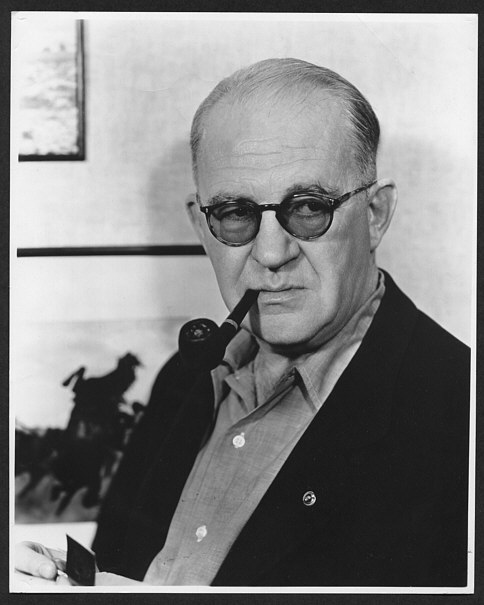 This has nothing to do with animation, but I'm indulging myself.
As much as I love animation, my favorite filmmaker, bar none, is John Ford. While there are many movies I like and watch repeatedly, I return to Ford's films more than those of any other director.
TCM (which I unfortunately can't get in Toronto) is having a 22 film retrospective of Ford's work. I think that these days Ford is an acquired taste; he's terribly different from contemporary directors and his films are now at least 40 years old and suffer from changes in social attitudes (many of which needed changing). But if you can respond emotionally to Ford's work, you enter a universe where everything is an expression of his personality and every film echoes and reverberates against every other.
If you're not familiar with Ford, try the Bogdanovich documentary Directed by John Ford airing Tuesday evening. After that, dip into Stagecoach, They Were Expendable, Fort Apache, She Wore a Yellow Ribbon, Rio Grande, The Long Voyage Home, Wagon Master, The Last Hurrah and Judge Priest.
YouTube and Copyright
Over at Mark Cuban's blog, there's a very interesting speculation about how Google is dealing with the copyright problems they're inheriting with the purchase of YouTube.
I had talked earlier about YouTube being in a position to try and reform the copyright laws to allow for greater freedom to use copyrighted material. Copying is going to happen anyway, so why not figure out a way for copyright holders to profit from it? However, if the above speculation is true, Google preferred to buy off the media conglomerates (and screw creators) rather than fix a broken system.
I had talked earlier about YouTube being in a position to try and reform the copyright laws to allow for greater freedom to use copyrighted material. Copying is going to happen anyway, so why not figure out a way for copyright holders to profit from it? However, if the above speculation is true, Google preferred to buy off the media conglomerates (and screw creators) rather than fix a broken system.
Another Business Model
Everybody is trying to figure out new business models right now. The audience is dispersing and nobody knows how things are going to shake out.
Craig Mazin's site The Artful Screenwriter has a two part article on how the talent agencies and some screenwriters are beginning to see their new places in the world. You can read the first part of the article here and there's a link at the top to the second part.
In Mazin's view, writers are better off finding private investment to make their movies. The investors are less interested in creative than they are in making a profit. Mazin talks about Sacha Baron Cohen's next deal (made before the wide release of Borat), where he raised $25 million in private equity and then turned around and sold the film to Universal for $42 million, not only making an instant profit but owning a significant piece of the film, which will pay off in DVD and TV sales. In other words, why not become a partner rather than an employee?
There's no way of knowing if this business model will become the standard, but there's obviously potential for animation. Everyone who has worked in production in the last 15 years has stories about enormous financial waste due to poor management. We know that animated features can be made less expensively than the big studios can make them. I hope that somebody with an audience-friendly idea can find enough private investment to try this approach out.
Craig Mazin's site The Artful Screenwriter has a two part article on how the talent agencies and some screenwriters are beginning to see their new places in the world. You can read the first part of the article here and there's a link at the top to the second part.
In Mazin's view, writers are better off finding private investment to make their movies. The investors are less interested in creative than they are in making a profit. Mazin talks about Sacha Baron Cohen's next deal (made before the wide release of Borat), where he raised $25 million in private equity and then turned around and sold the film to Universal for $42 million, not only making an instant profit but owning a significant piece of the film, which will pay off in DVD and TV sales. In other words, why not become a partner rather than an employee?
There's no way of knowing if this business model will become the standard, but there's obviously potential for animation. Everyone who has worked in production in the last 15 years has stories about enormous financial waste due to poor management. We know that animated features can be made less expensively than the big studios can make them. I hope that somebody with an audience-friendly idea can find enough private investment to try this approach out.
Friday, November 03, 2006
Animation Oscars
Over at the Risky Biz blog, Anne Thompson offers up her opinions on which films will be nominated for the Best Animated Feature oscar. There will possibly be five nominees this time, rather than three, due to the high number of releases this year. That will make it tougher for any one film to garner votes.
It's a pretty safe bet that Cars and Ice Age 2 will get nominations (though Thompson doesn't include Ice Age 2 in her nominees), but the others are not so certain. I would think that Flushed Away, Monster House, Happy Feet, Over the Hedge and Open Season are in the running. A Scanner Darkly has a good shot at a nomination for being so different from everything else released this year. Curious George stands a chance based on name recognition and holding up the banner for drawn animation.
Each of the above films has its fans, but I don't think there's a consensus in the industry or in the audience as to what film should win.
It's a pretty safe bet that Cars and Ice Age 2 will get nominations (though Thompson doesn't include Ice Age 2 in her nominees), but the others are not so certain. I would think that Flushed Away, Monster House, Happy Feet, Over the Hedge and Open Season are in the running. A Scanner Darkly has a good shot at a nomination for being so different from everything else released this year. Curious George stands a chance based on name recognition and holding up the banner for drawn animation.
Each of the above films has its fans, but I don't think there's a consensus in the industry or in the audience as to what film should win.
More Keith Lango
Keith Lango continues his excellent series on production, this time focusing very perceptively on pipeline differences between drawn and computer animation and how those pipelines have an impact on the resulting images. This is a tremendously important set of articles and I urge everyone to go have a look.
Thursday, November 02, 2006
MGM Cartoons
The Greenbriar Picture Shows blog has an article on collecting MGM cartoons in 16mm, which gives something of the history of the MGM cartoons on TV. The piece also reproduces some posters for the cartoons as well as some behind-the-scenes publicity material. There's a picture of the MGM ink and paint department, a photo of Carman Maxwell (the original voice of Bosko at WB) with Fred Quimby, Hugh Harman with cameraman Jack Stevens, and a page of photos including musical director Scott Bradley, background artist Joe Smith and sound effects creator F. McAlpin.
Wednesday, November 01, 2006
Keith Lango On What Makes an Image Work
Cartoon Brew noted this earlier, but Keith Lango is continuing an excellent series of blog entries where he takes sample stills from recent animated features and discusses where they succeed and where they fail. His focus is on colour and composition and he argues that the nature of cgi production pipelines are working against the creation of good imagery.
All the articles are still on his main page. Start with the entry for October 29 and read forward. Keith isn't done with this yet, but it's already a must-read for those working in animation and anybody else trying to get a better appreciation for how images are put together.
All the articles are still on his main page. Start with the entry for October 29 and read forward. Keith isn't done with this yet, but it's already a must-read for those working in animation and anybody else trying to get a better appreciation for how images are put together.
Crunch Time
Over the next four to six weeks, I have way too many responsibilities. I'm afraid that posting on this blog may be less frequent than it's been and rather than contribute much in the way of original content I'll be pointing you to things of interest elsewhere.
I won't be able to read Neal Gabler's new Disney bio until December or January at the earliest, but Tom Sito has checked over the section relating to the 1941 strike at Disney and offers comments on his blog. For those unfamiliar with it, Tom posts historical items of interest each day in addition to various bits of animation news.
Tom's own book, Drawing the Line, is about the labour movement within the animation industry. I won't have time to read that book either until my crunch is over, but I am very much looking forward to it.
I won't be able to read Neal Gabler's new Disney bio until December or January at the earliest, but Tom Sito has checked over the section relating to the 1941 strike at Disney and offers comments on his blog. For those unfamiliar with it, Tom posts historical items of interest each day in addition to various bits of animation news.
Tom's own book, Drawing the Line, is about the labour movement within the animation industry. I won't have time to read that book either until my crunch is over, but I am very much looking forward to it.
Subscribe to:
Posts (Atom)

 Posts
Posts

