There was a time when U.S. networks would buy programming from independent producers. Then they got greedy and had the rules changed so that they could create and own their own programming. That pretty much killed the independent producers and should have led to a happy ending for the networks.
That wasn't the case, though. They faced increased competition from cable, including channels that they owned or shared an owner with. One result was that Saturday morning kid shows became less profitable. Fox ended up leasing out its entire Saturday morning to 4Kids Entertainment. CBS leased out their Saturday mornings to Nelvana and more recently to Discovery Kids. Both Fox and CBS decided that a small, steady profit for Saturday morning was better than risking losses on shows that they created or bought.
That's now spreading to prime time. The N.Y. Times is reporting that NBC is buying a block of programming from Thom Beers, who has had success with cable series such as Deadliest Catch and Ice Road Truckers.
So far, this is limited to the old networks, not newer cable channels, but there's no reason that this won't eventually spread. Networks lobbied hard for the opportunity to own the programming they broadcast and when they won it, they realized that they weren't particularly good at creating shows, especially in a more competitive environment. Now, while the law hasn't changed, the networks are at least partially in retreat. Power is useless if you don't know how to wield it to your own advantage.
Beers got the nod for two reasons. His programming cost $500,000 an hour as opposed to the network reality shows costing at least $1.5 million per hour. Also, his Ice Road Truckers finale garnered an audience of 5 million viewers, proving that Beers knows how to attract eyeballs. NBC is in business with Beers to cut its costs and for the audience they think he'll bring with him. While you might expect that NBC would own the programming outright, they're only taking 50% of it. Beers' company will keep the other 50% and control international rights.
I keep hammering on this point in this blog because I think it's critical for people who are starting out in the animation industry. The old business model is faltering. It may never disappear entirely, but the fragmentation of the audience and the increased number of distribution channels is weakening it and presenting alternatives.
Corporations are businesses. Their concern is profit and return on investment. They have no emotional attachment to their products and services. When those products and services are no longer in demand, corporations discontinue them and move on to something else. Because the corporations have money, marketing and distribution, creative people orbit around them hoping to sell their ideas. These corporations need product and as they have the money to buy it, they become magnets for hopeful creatives.
There are only two reasons why a corporation would do business with you. The first is that they have a specific need that they think you can fill. The second is that they think they can make money from you. The first situation is the average job. They need an animator, storyboard artist, etc. so somebody gets hired to fill the need. It may even include buying a show idea to fill a time slot or satisfy a demographic. When the need no longer exists, the person is cut loose. The second situation is when a corporation hires a person with an independent reputation and hopes to benefit financially from it. This is why DreamWorks hired Jerry Seinfeld to make an animated feature. DreamWorks hoped that Seinfeld's TV and stand-up audience would pay to see the movie and buy the DVD. This is also why authors like J.K. Rowling and Stephen King are sought after for adaptations of their work.
The vast majority of people in the animation industry fall into the first category and it's one with a limited future. It will pay the bills (sometimes generously), allow for developing skills and occasionally someone will achieve a measure of control. Because corporations only have financial, not emotional investments, when they are looking for properties, they will look for what (or who) has already been successful before they look at their own employees. The irony, of course, is that the corporation is responsible for their employees' lack of success in the wider market because they've limited the employees' contributions. The corporation doesn't care that the playing field isn't level; for them it's all about minimizing risk and maximizing return on investment.
Creators, regardless of what they create, have an emotional investment in their work. When creating on spec they have to, as there's no motivation but the hope of future reward. Putting in the necessary hours to solidify an idea into a tangible form requires commitment and the thing that sustains a creator is a belief that the work has value, not necessarily limited to financial value.
A problem results from the gulf between financial and emotional investing. Corporations don't have a sentimental attachment to product; it's only a means to a profit. Creators generally have a strong emotional attachment to their ideas, and are not willing to bend them out of shape simply because someone requests it. Many creators have suffered while an idea has been refashioned against their wills.
Another problem is that creators often sell their ideas outright. The sale may come with assurances that the creator will have a part in the ongoing production and will be consulted, but even if the corporation lives up to its promises, eventually the product will no longer be lucrative enough to continue. At that point, the property dies (except for reruns or re-issues) and the creator is severed from the property. The creator may have ideas to regenerate the property, be convinced that there's still income to be made from it, or may just want to keep it going out of love for it, but usually the creator's relationship with the property is over.
So what to do? NBC's latest move is a reminder of how the industry is shifting. Creators need to move from filling a need and being discarded when the need no longer exists to creating something that generates its own audience. The web provides that opportunity.
Opportunity is no guarantee of success. The emotional investment that creators make often blinds them to the true viability of their ideas. The saying that "love is blind" refers to creative work as much as it does to romance. Just as romantic euphoria might blind you to a partner's shortcomings, not every idea you have is worth pursuing. While you may take great personal satisfaction from it (which is enough justification for creating it), it may have no appeal to an audience larger than one. The low cost of distribution on the web is way to determine if an idea has wide appeal.
If it does, work it for all it's worth. This doesn't necessarily mean that you should give up your day job and invest all your money in it, but keep working to build up the audience. If you can get it sufficiently large, instead of you pursuing the money, the money (in the form of corporate interest) will pursue you. When that happens, do not, under any circumstances, sell the idea. No amount of money will compensate you for your emotional investment. Maintain ownership. License your idea. That way, when the corporation loses interest and drops it, you'll still have it. Maybe there's not enough juice left in it to satisfy a corporation, but there's likely enough to earn you a living while you're developing further ideas.
And history shows, unfortunately, that even people who produce a hit don't always produce a second. Siegel and Shuster never again created anything as popular as Superman. Harvey Kurtzman created three humour magazines after creating Mad and none of them had the success or the staying power of his biggest hit. If you are lucky enough to create something that generates income, it may be your only success. Why sell it?
You have the possibility now of reaching an audience without gatekeepers in the way. The financial rewards may never come or they may come more slowly than by selling your idea, but by owning your creations, you control how they'll be used and continue to profit from them. Your chances of making a deal with a large corporation are better if you have an audience attached to your idea. Finally, you'll protect your emotional investment. The best ideas are highly personal and suffer the most in a corporate environment. If this whole, overly long essay can be boiled down to one thought it's this: Work to develop your own audience and then don't sell your idea, license it.
Monday, December 03, 2007


Sunday, December 02, 2007
Larry Lessig on Copyright
Copyright has turned into a double edged sword. Its purpose is to protect people and corporations from having their work duplicated without compensation. Eventually, this work is supposed to pass into the public domain where it becomes everyone's property. However, these days the bulk of copyrights are controlled by multinational corporations who are in no mood to let assets slip from their control.
The last copyright law in the U.S. prevents anything copyrighted after 1923 and still under copyright at the time the law was passed from going into the public domain until 2023. Larry Lessig is a lawyer and university professor who challenged the constitutionality of the law in front of the U.S. Supreme Court. Unfortunately, the court ruled against him.
Much as they'd like to, governments and corporations can't stop the world from changing and culture has the nasty habit of evolving without needing anyone's official permission. Below is a 20 minute video of Lessig discussing why governments and corporations are behind the times and how mash-ups are a vibrant form of contemporary culture. Lessig is still looking for ways to make the copyright laws more balanced as he fears that in their current state they will restrict the creation of culture and make us intellectually poorer.
This video is one of many resulting from the TED conferences. The topics are wide ranging and some are scientifically complex, but the speakers generally are good at explaining things to a lay audience and there's lots of provocative material here.
The last copyright law in the U.S. prevents anything copyrighted after 1923 and still under copyright at the time the law was passed from going into the public domain until 2023. Larry Lessig is a lawyer and university professor who challenged the constitutionality of the law in front of the U.S. Supreme Court. Unfortunately, the court ruled against him.
Much as they'd like to, governments and corporations can't stop the world from changing and culture has the nasty habit of evolving without needing anyone's official permission. Below is a 20 minute video of Lessig discussing why governments and corporations are behind the times and how mash-ups are a vibrant form of contemporary culture. Lessig is still looking for ways to make the copyright laws more balanced as he fears that in their current state they will restrict the creation of culture and make us intellectually poorer.
This video is one of many resulting from the TED conferences. The topics are wide ranging and some are scientifically complex, but the speakers generally are good at explaining things to a lay audience and there's lots of provocative material here.
Friday, November 30, 2007
Kaj Pindal's 80th Birthday Celebration

Left to right: Kaj Pindal, Ellen Besen, Marc Glassman
(Click any image to enlarge.)
Last night I had the pleasure of attending an 80th birthday celebration for Kaj Pindal held at the Toronto office of the National Film Board of Canada. The evening was hosted by animator Ellen Bessen and cultural impresario Marc Glassman and started out with a retrospective of Kaj's work, showing clips from many of his films with Kaj constantly being invited to the microphone to provide background information for each piece.(Click any image to enlarge.)
The retrospective included work from Kaj's early days in Europe, including Inkwell Fantasy, a pastiche of Max Fleischer's Out of the Inkwell, and Stentoft, a film made in Sweden for a bank that could have passed for a '40's Walter Lantz cartoon directed by Dick Lundy. It also included some of Kaj's home movies of his trolley and visits with Ward Kimball.
Of course, many of Kaj's films for the NFB were featured as well as work he did with Derek Lamb in and out of the NFB.
Friends were invited to speak about their memories of working with Kaj on many projects. Børge Ring sent the following letter.
My name is Børge Ring. I am 6 years older than Pindal . I am a lifelong friend of Kaj and of the girl from Copenhagen named Annie who chose to join him in living a life and raising a family.At Midnight tomorrow Kaj will be 80 years old. I have written a Birthday speech to be held at his birthday party. But somebody in Washington leaked my script to Ellen Besen, and I hear that she is mean enough to divulge the contents prematurely.
My speech says:Friends.....There once was a man at the National Film Board of Canada. who was awful...... ......He was dictatorial. He was ponderous and abrasive. People said about him: "Nobody at National Film Board can get along with him....not even Kaj Pindal."So now you know.Kaj,You and I are fellow animators and we are lifelong friends.We are buddies and we are soulbrothers. We have been that ever since you and Simon and Bjørn and I sat at the feet of David Hand back in 1949 asking his ears off: How do you do this and how did you do that?Dave had supervised the production of Disney's BAMBI and he had kept some of the animation from the film. But he would never let us see the drawings. You asked him "why not?" He said: "Because when you guys start flipping the stuff you are going to get entranced by little things like the graceful movement of a hoof.. And what you need to learn right now, is How to tell a story properly."Dave saw our previous films and ripped them apart. "Look..Your animation is not the worst part of it. It's all the rest.. Don't be so anxious to animate. There is SOOO much to be done before you go into that"......Do you rermember we didn't call him Dave or Mister Hand? He preferred to be DH to us. He called you "Junior". Simon stayed Simon and I got named "Yakkie."Years later we were spread in all directions. David Hand had gone to Alexander Films in the USA. Bjørn and I went to Amsterdam and you and Simon had moved to Sweden.National Film Board invited you to come to Canada and make a technical film about combustion engines, something you were also good at. You accepted the invitation,performed well and National Film Board decided to keep you in Canada as their Animator Laureate in combusting rnachinery, hot water and steam locomotives.
But you combusted heftily in protest. "I am a fun animator, I am good at pixies. Let me at it, let me at it."Your persistence wore them down, and they let you at it.Their faces changed when they saw the first results, and The National Film Board of Canada added the inventive aspects of Kaj Pindal's talents to their already formidable palette of film makers.You are a truly authentic artist and over the years your very original work has so often been described and praised in words and writing and I am not going to revisit all the applause. We all know and rejoice.You and I have kept in contact all these many years. Being animation nuts we talked about the craft all the time whenever we were together.We disagree, (and do so to this day) about certain production procedures but on the whole we see things the same way.During the early 70es both of us worked at Richard Williams' London studio because you had talked Dick into hiring me.You were very much against the Disney studio system with its love of perfection through specialisation. Being a Disney chauvinist at the time I was all for the system. To me it was one of the charms of the Richard Williams studio on Soho Square.Dick ,as we know, loved perfection in all things. At one time Ken Harris had animated a scene of the Pink Panther The famous oid feline was seen from behind with tophat and a walking cane. It's tail posed vertically with a small curl at the end. Animated on twos it moved ever so slightly up and down to the rhythm of Mancini's music. Nothing else moved and the body was on a hold.Williams secretly abducted Ken's celluloids of the scene and was busy inbetweening the panther tails to make them animate on ones. I asked him why he did that. With Ken working in the next room Dick whispered: "Ken is a Warner Brothers man and they do everything on twos."Dick had discarded Ken's sensible hold of the body and personally transported it as trace backs onto all the tail cells in order to have the scene on one single cell level.He said he didn't trust his inkers to make the tracebacks perfect.Next morning we all saw the scene projected. The Panther's body never flinched. Turning to his inkers Disk said quietly: "This was a traceback on ones". Kaj winced at the remark and I couldn't resist the temptation to tease him later that morning. On the way upstairs I stopped briefly at his open door and asked him sweetly: "Did you see those tracebacks this morning?" feigning that they somehow confirmed the studio system.Film Board's friendly Pindal took the bait, grabbed his desk with white knuckled hands and sputtered towards the doorway and me: "Yaa-aah..him ferry goot animator. Him a drawing can let stand still on ones."Kaj, you loved pranks and occasionally the two of us behaved like the Katzenjammer Kids. A certain group in the studio were fervent vegetarians and used to take their lunch in a vegetarian restaurant with glasswalls. Kaj and I went over to the Danish shop in Conduit street and bought ten meatballs in a tall paperbag. We ate them standing outside the glass wall near the inside table of the sectarian health seekers..During the 80es we sometimes had occasion to work together on feature films in Paris and Cologne or Copenhagen .Early on we had made a pact to try and meet once a year either in Europe or in Canada festival or work situation Derek Lamb had Kaj lure me over to Toronto for 3 days to pick up homework animation of some of Kaj's designs for a UNICEF production named "Karate Kids".Derek Lamb was a gifted, somewhat paternal man of great sensitivity Like many artists before and after him, he felt insecure about his real values. Kaj and I hadn't met for some while and we spoke Danish together all the time and laughed a lot,Derek became uneasy."They are probably talking about me in their damned mother -tongue."When we sensed that, we switched back to English..I drew a small comicstrip of Kaj and me lifting Derek Lamb up on a throne carrying the inscription "Agnus Dei" (God's Lamb) while we sing "For he is a jolly good fellow".On the second frame Derek looks relieved."Maybe they weren't talking about me after all". On the third frame he walks along smiling. Then he stops abruptly and demands: "WHY NOT?"Kaj, your mother came from a dynasty of railway people Your father was a fine arts painter. You inherited from her a love of steam trains and railroads, a passion you shared with your friend and fan Ward Kimball. But like Ward you opted for the thing you do best, which is: Being an authentic comic animator with keen intelligence and several strings to his bow.Happy Birthday,Kaj.
Several presentations were made to Kaj, including a card from the students and faculty of Sheridan College's animation program, which featured a caricature of Kaj by Peter Emslie. Another presentation was made by student Allesandro Piedimonte of a sculpture of Kaj that he'd made.
 Allesandro and Kaj
The reception afterwards gave everyone a chance to talk to Kaj and Annie as well as catch up with old friends and compare notes on animation happenings around Toronto.


Annie and Kaj Pindal
Wednesday, November 28, 2007
Oscar Politics
I don't consider the Oscars anything more than a marketing opportunity. Certainly, I never assume that because a film has won the award in a category it actually represents the "best" in that area for the year.
The N.Y. Times has an article on the dilemma facing Disney over positioning Ratatouille. Do they go for a best picture Oscar, as the film has been financially successful and so well-reviewed, or would that risk winning the award for best animated feature?
The N.Y. Times has an article on the dilemma facing Disney over positioning Ratatouille. Do they go for a best picture Oscar, as the film has been financially successful and so well-reviewed, or would that risk winning the award for best animated feature?
So if you have any doubts about the Oscar as a standard of excellence, remember that the best picture nominees will most likely feature live actors and be rated R, regardless of what other kinds of films are out there. Knowing that, should Disney shoot for the big award and most likely lose, or should they stay within the animation sandbox where their chances are better? Does Disney shoot for the big payday or take the smaller one? Increased revenue will be the inevitable result of an Oscar win and that's what will drive the decision.Members could vote for the film in both categories. But Oscar campaigners assume that many would choose just one — a dangerous situation, given the small voting pool and the razor-thin margins that can determine a winner. Such a split could leave even a film as widely admired as “Ratatouille” — A. O. Scott, co-chief film critic for The New York Times, called it “a nearly flawless piece of popular art, as well as one of the most persuasive portraits of an artist ever committed to film” — without a prize. Meanwhile a strong competitor like, say, “Persepolis,” about growing up in Iran, might slip into the animated winner’s circle.
The studios’ reluctance to advance their animated wares as candidates for best picture is enforced by a perception that actors, the academy’s largest branch, with about 20 percent of the membership, are reluctant to honor movies without live performances. Additionally, the academy has a definite allergy to family fare, like the G-rated “Ratatouille”: 28 R-rated films have been nominated for best picture in the last 10 years, while only two PG-rated movies — “Finding Neverland” and “Good Night, and Good Luck” — have. And none with a G rating have made the cut.
Monday, November 26, 2007
Writer-Entrepreneurs
Patrick Goldstein, entertainment columnist for the Los Angeles Times, has an excellent article on the idea of writer-entrepreneurs. More evidence that the ground is shifting away from established business models.
Writers who create something rare -- a story with great, original characters that movie stars will cut their price to play -- have a real value," says Mandate production chief Nathan Kahane. "But that value doesn't get unlocked in the studio system. If writers are willing to share our risk, then we're willing to give them a lot of control and share in the profits too."(link via Cinematech)
THIS kind of entrepreneurial formula couldn't have existed in the era when the studios had a stranglehold on every facet of the business, notably talent, money and distribution. But those days are gone. The stars became free agents long ago. In the last few years, with billions of private-equity dollars flooding the business, the studios have lost their lock on financing too.
All that's left is marketing and distribution. It's hard to equal the way studios launch their summer popcorn extravaganzas with a $40-million marketing blitz. But as more entertainment migrates to the Internet, where distribution is basically free to anyone with a computer, the studios will lose that monopoly as well.
"The world is about to change," Frank says. "Anyone with an Apple computer can make a movie now -- it's never been a more democratic medium. The studios should be very afraid. Once the independent financiers start going directly to writers, things could change really fast.
fps Charity Auction

For the fourth year, the fps animation site is running a charity auction through November 30. This year's beneficiary is The Cancer Research Society. The auction includes some rare or hard to find items such as crew baseball cap from Meet the Robinsons, a 1926 edition of Animated Cartoons by E. G. Lutz, and some memorabilia from the 2007 Ottawa International Animation Festival. There's even software, such as Softimage XSI and Toon Boom Studio Express. Go here for a list of items and links to the ebay pages for each.
Sunday, November 25, 2007
"We became a hand, not a head."
I want to draw your attention to two interesting posts at Midokok's Korea and Animation blog. The first is an interview with an inbetweener named Skitsch, who is responsible for the title of this entry. Besides working in animation, she's attempting to build her reputation outside animation as an artist due to what she sees as the limitations of the local animation industry.
Another interview worth reading is with Park Min. He talks about the economic situation in the Korean industry and the impatience of newcomers who want to jump quickly into directing.
What I find interesting about both of the above is that these complaints are not unique to Korea. Artistic frustration with the industry's limitations are common throughout the world, as are complaints about budgets. While animation artists on different continents are isolated from each other, the truth is that they all victims of the same industrial structure that doesn't take full advantage of the creativity of employees.
Another interview worth reading is with Park Min. He talks about the economic situation in the Korean industry and the impatience of newcomers who want to jump quickly into directing.
What I find interesting about both of the above is that these complaints are not unique to Korea. Artistic frustration with the industry's limitations are common throughout the world, as are complaints about budgets. While animation artists on different continents are isolated from each other, the truth is that they all victims of the same industrial structure that doesn't take full advantage of the creativity of employees.
Sunday, November 18, 2007
More on Motion Capture and Beowulf
The differences between motion capture and animation are wider than people think. It's not simply a question of technique.
With motion capture, motion exists in the real world. It gets sampled and then applied to a computer character. With animation, the motion does not exist in the real world. It is constructed and only exists when the images are rapidly displayed, creating the illusion of motion. That describes the process.
There are several differences philosophically, however. Motion capture seeks to convince an audience through the accumulation of detail. When it falls short -- when it is criticized for looking like a waxworks -- it is due to insufficient detail in the motion. Therefore, the goal of motion capture is to increase detail to the point where it is indistinguishable from live action. As Ken Ralston says,
If animators look down on motion capture technicians, it is because of the relationship that these two groups have with essence. If there is an essence in a motion captured performance, it comes from the actor. The job of the motion capture technicians is to accurately reproduce it. Any animated additions they make are a result of the technology's shortcomings or the director's change of heart. By contrast, an animator, if successful, creates the essence of the motion. This is no small distinction. There is a world of difference between reproduction and creation.
By the time Beowulf kills Grendel, we know that lust leads him to lie. His account of the swimming race is verbally different from the evidence offered on screen. He claims to have lost due to sea monsters, but the visuals indicate that he lost due to a sexual dalliance with a mermaid. It is clear that Beowulf also lusts after the queen. Based on what the audience has already seen, it isn't necessary for Grendel's mother to promise Beowulf a crown. He would have sex with her for no other reason than her beauty.
When Beowulf returns from the cave, claiming to have killed Grendel's mother, he learns the truth from the king before the king commits suicide. Now Beowulf should understand that his lust has led him and his kingdom towards further disaster. Does Beowulf agonize over this? No. He doesn't return to Grendel's mother until after the kingdom is attacked. Does he rein in his lust as a result? No, he takes a mistress. There is no self-awareness in Beowulf's actions, only in his dreams of more monsters.
When Anthony Hopkins' king confronts Grendel, neither can kill the other. While they are enemies, their blood relationship complicates their situation and renders action impossible. When Beowulf confronts the dragon who is his son, he has no emotional conflict as to what he must do. The only emotion between Beowulf and the dragon is hatred.
Beowulf's lack of self-knowledge (not realizing how lust overwhelms his best interests and destroys his integrity) and lack of complexity (no qualms over the need to kill his only son) are what make him, and the resulting film, so empty-headed. The question is not whether Beowulf is successful as an example of motion capture; the question is whether he is a fully realized character. The answer to this question is not the level of detail reproduced; it is the nature of the character's essence.
Some may be tempted to blame the script by Neil Gaiman and Roger Avary, but I blame Robert Zemeckis. Any director who understands a scene can add subtext to it by directing the performances, choosing who the camera should be looking at and how a character should be reacting at any given moment. Beowulf is a character with little self-knowledge, even as he dies. The other characters in the film are cut from the same cloth. This is why the technique, even if flawless, is worthless in this case. Ultimately, the detail must lead us to some essence, but Beowulf hasn't any.
With motion capture, motion exists in the real world. It gets sampled and then applied to a computer character. With animation, the motion does not exist in the real world. It is constructed and only exists when the images are rapidly displayed, creating the illusion of motion. That describes the process.
There are several differences philosophically, however. Motion capture seeks to convince an audience through the accumulation of detail. When it falls short -- when it is criticized for looking like a waxworks -- it is due to insufficient detail in the motion. Therefore, the goal of motion capture is to increase detail to the point where it is indistinguishable from live action. As Ken Ralston says,
Trust me, when you’re sitting in dailies talking about Anthony Hopkins’s armpit hair for an hour, you know there’s a lot of effort that goes into every pore of the skin, into every eye and eyebrow. It’s a massive puzzle that has to be broken apart and then put back together again.By contrast, good animation seeks to eliminate unnecessary detail in order to arrive at the expressive essence of a motion. Motion capture concerns itself with addition; animation with subtraction.
If animators look down on motion capture technicians, it is because of the relationship that these two groups have with essence. If there is an essence in a motion captured performance, it comes from the actor. The job of the motion capture technicians is to accurately reproduce it. Any animated additions they make are a result of the technology's shortcomings or the director's change of heart. By contrast, an animator, if successful, creates the essence of the motion. This is no small distinction. There is a world of difference between reproduction and creation.
* * *
(Spoilers below.)By the time Beowulf kills Grendel, we know that lust leads him to lie. His account of the swimming race is verbally different from the evidence offered on screen. He claims to have lost due to sea monsters, but the visuals indicate that he lost due to a sexual dalliance with a mermaid. It is clear that Beowulf also lusts after the queen. Based on what the audience has already seen, it isn't necessary for Grendel's mother to promise Beowulf a crown. He would have sex with her for no other reason than her beauty.
When Beowulf returns from the cave, claiming to have killed Grendel's mother, he learns the truth from the king before the king commits suicide. Now Beowulf should understand that his lust has led him and his kingdom towards further disaster. Does Beowulf agonize over this? No. He doesn't return to Grendel's mother until after the kingdom is attacked. Does he rein in his lust as a result? No, he takes a mistress. There is no self-awareness in Beowulf's actions, only in his dreams of more monsters.
When Anthony Hopkins' king confronts Grendel, neither can kill the other. While they are enemies, their blood relationship complicates their situation and renders action impossible. When Beowulf confronts the dragon who is his son, he has no emotional conflict as to what he must do. The only emotion between Beowulf and the dragon is hatred.
Beowulf's lack of self-knowledge (not realizing how lust overwhelms his best interests and destroys his integrity) and lack of complexity (no qualms over the need to kill his only son) are what make him, and the resulting film, so empty-headed. The question is not whether Beowulf is successful as an example of motion capture; the question is whether he is a fully realized character. The answer to this question is not the level of detail reproduced; it is the nature of the character's essence.
Some may be tempted to blame the script by Neil Gaiman and Roger Avary, but I blame Robert Zemeckis. Any director who understands a scene can add subtext to it by directing the performances, choosing who the camera should be looking at and how a character should be reacting at any given moment. Beowulf is a character with little self-knowledge, even as he dies. The other characters in the film are cut from the same cloth. This is why the technique, even if flawless, is worthless in this case. Ultimately, the detail must lead us to some essence, but Beowulf hasn't any.
Friday, November 16, 2007
B.O. Wulf

Beowulf is a weak film whose motion capture technique and stereoscopic 3D will distract reviewers and audiences from realizing how empty it is. Director Robert Zemeckis is far more involved with his camera than his characters. Some may mistake Zemeckis use of motion capture as a quest for realism, but it's not. Motion capture is just a way for Zemeckis to exert more control over the film; the problem is that control is a disadvantage in the hands of a second-rate director.
The story is about powerful men who are seduced by evil but who can't admit to their failings. This can be the stuff of great drama, but the film rarely rises beyond a high school production of Macbeth. Instead of Zemeckis burrowing into his characters and providing them with conflicting needs and desires, they succumb all too easily. While they are eventually forced to confront their sins, they never feel the full weight of them.
Zemeckis uses motion capture for two reasons. One is to avoid going on location and the other to give him increased freedom with the camera. Neither reason justifies the effort involved.
Locations inform an actor's performance. Lawrence of Arabia would not be the same film if it was shot on a soundstage, unless you believe that the desert heat, the great expanse and the sand that gets blown into every crevice and orifice did not influence the performances. For all of Zemeckis's obsession with skin pores, body hair and saliva, he hasn't bothered to show the breath of characters when they are standing in the snow.
Zemeckis is more besotted with stereoscopic 3D and a computer animated camera than a first year film student. He can't resist throwing things at the audience or using mile-long camera moves. The camera is constantly calling attention to itself, never more so than in the sequence where Beowulf decides to fight Grendel while naked. Besides being questionable from a tactical standpoint, this results in some of the most contrived camera compositions imaginable. While the audience should be getting emotionally involved in the battle, it's constantly distracted by the ways that Zemeckis uses the camera and props to hide Beowulf's genitals. In one shot, Zemeckis hides them behind a sword stuck in the floor, one of many obvious pieces of sexual symbolism sure to raise snickers from the twelve year olds who are the film's target audience.
While debates about motion capture and the relative success of it in this film will dominate the discussion, it's a pointless argument. Had the technical work been flawless, convincing the audience that they were watching flesh and blood creatures on the screen, it would not compensate for the fact that Beowulf is a colossally dumb movie. The characters are so simplistic, the drama so uninvolving, the direction so crass that no technique could elevate this film beyond mediocrity.
Compare the flight of arrows in this film to that of Olivier's Henry V. Compare the battle scenes with Eisenstein's Alexander Nevsky. Compare the monsters to those in Peter Jackson's The Lord of the Rings. Compare the complexity of the characters with George Stevens' Shane. In every case, Zemeckis falls short and by a wide margin.
What's going to kill this kind of film making is that reputable actors will avoid it like the plague. Anthony Hopkins and John Malkovich should be horrified with the results. No one will equate their "performances" in Beowulf with films where these actors appear in the flesh. Why would performers concerned with their reputations lend themselves to a process that doesn't present them at their best?
There will be debates as to whether this film is animated or not. Should it be eligible for the Best Animated Film Oscar? Let the debate rage, but I won't bother with it. A film like Beowulf is a waste of time regardless of how you classify it. Technique and novelty are never enough; they're just distractions that eventually lose their appeal. I demand more from movies than skin pores, big camera moves and spears pointed at my nose. A movie should have a heart and a mind, and Beowulf has neither.
Tuesday, November 13, 2007
UPA Feature Clip
Jaime Weinman writes about this clip from the Fox musical The Girl Next Door (1953), featuring a couple of animated sequences done by UPA. I was completely unaware of this film, which is now available on DVD.
UPA also contributed animation to a feature called The Four Poster, a film I've never seen. Does anybody know if the film is available on DVD or if there are clips from it on line?
Monday, November 12, 2007
More on South Korea
As South Korea has recently been a topic here, I thought I'd point out an article at Salon.com by Andrew Leonard talking about the animation industry there and the government's role in the development and maintenance of it.
Sunday, November 11, 2007
Winsor McCay's Influence
Click this link for a slideshow by Joshua Glenn tracing the visual influence Winsor McCay had on various movies.
Man the Lifeboats
The Writers Guild of America, which represents writers for feature films and TV series, is currently on strike. The strike is already affecting daily programming like Leno, Letterman, etc. and will be affecting just about everything in the U.S. by January if the strike continues.
Animation writing falls under two separate unions, the Writers Guild and The Animation Guild. Generally, it's the prime time series like The Simpsons that are covered by the WGA while kidvid on channels like Nickelodeon and The Cartoon Network is covered by TAG.
Mark Evanier, a member of both writers organizations, is going to great lengths on his blog to answer reader questions and explain the guild's position. His blog is an excellent place to start if you're interested in the issues behind the strike.
When the system is running (not necessarily working, but running), people stay quiet about problems as nobody wants to jeopardize income by alienating people. However, one of the interesting byproducts of the strike is that truth about the system leaks out. It's amazing how dysfunctional the system is, but it explains a lot about what we get to watch. There has been a systematic reduction of competition, greater executive meddling in creative endeavors and increased alienation of creators whose work is the foundation for the entire system.
Marshall Herskovitz (with parter Ed Zwick) is the creator of TV series like Thirtysomething and My So-Called Life. In this article, he writes about how the change of rules in the 1980's has led to the demise of independent production companies and led to six companies controlling just about everything on TV. Herskovitz and Zwick have determined, even with their track record, that the game is rigged and they've decided to take their ideas elsewhere. They're are doing an end run around the big six by producing Quarterlife for the web.
For more evidence that the game is rigged, there's this article by Todd Alcott about the gatekeepers he has to deal with in order to get a movie into production. With the consolidation of the entertainment business, the number of gatekeepers has proliferated. After all, if there are only a handful of big media companies, they're going to get deluged by projects and somebody has to field them. The problem is that the gatekeepers are not qualified and their only contribution is to add friction to the process; they stop it or slow it down. As detailed in Desperate Networks by Bill Carter, which I wrote about here, TV's biggest hits are often turned down by gatekeepers whose job is to discover hits. Mostly, TV hits make it to air though dumb luck.
The great paradox is that the struggle for growth and to dominate an industry leads to stagnation, which sows the seeds of collapse. Detroit thought it owned the auto business until competition from outside took it down. Marvel and DC fought over a shrinking market as if it was the only pool of comics readers, then manga turned up and showed them how much they were missing. The recording industry collapsed when technology made it possible for people to bypass the restrictions of albums and allowed indie bands to reach an audience without a recording contract.
Today's N.Y. Times has an article questioning whether conglomerates are in financial danger.
There's no easy answer for people who work in animation. We all need a paycheque from somewhere and these days it likely comes from, directly or indirectly, a large media corporation. But that shouldn't blind us to the fact that the media ship is taking on water. Like Marshall Herskovitz, it's time to start building our own boats.
Animation writing falls under two separate unions, the Writers Guild and The Animation Guild. Generally, it's the prime time series like The Simpsons that are covered by the WGA while kidvid on channels like Nickelodeon and The Cartoon Network is covered by TAG.
Mark Evanier, a member of both writers organizations, is going to great lengths on his blog to answer reader questions and explain the guild's position. His blog is an excellent place to start if you're interested in the issues behind the strike.
When the system is running (not necessarily working, but running), people stay quiet about problems as nobody wants to jeopardize income by alienating people. However, one of the interesting byproducts of the strike is that truth about the system leaks out. It's amazing how dysfunctional the system is, but it explains a lot about what we get to watch. There has been a systematic reduction of competition, greater executive meddling in creative endeavors and increased alienation of creators whose work is the foundation for the entire system.
Marshall Herskovitz (with parter Ed Zwick) is the creator of TV series like Thirtysomething and My So-Called Life. In this article, he writes about how the change of rules in the 1980's has led to the demise of independent production companies and led to six companies controlling just about everything on TV. Herskovitz and Zwick have determined, even with their track record, that the game is rigged and they've decided to take their ideas elsewhere. They're are doing an end run around the big six by producing Quarterlife for the web.
For more evidence that the game is rigged, there's this article by Todd Alcott about the gatekeepers he has to deal with in order to get a movie into production. With the consolidation of the entertainment business, the number of gatekeepers has proliferated. After all, if there are only a handful of big media companies, they're going to get deluged by projects and somebody has to field them. The problem is that the gatekeepers are not qualified and their only contribution is to add friction to the process; they stop it or slow it down. As detailed in Desperate Networks by Bill Carter, which I wrote about here, TV's biggest hits are often turned down by gatekeepers whose job is to discover hits. Mostly, TV hits make it to air though dumb luck.
The great paradox is that the struggle for growth and to dominate an industry leads to stagnation, which sows the seeds of collapse. Detroit thought it owned the auto business until competition from outside took it down. Marvel and DC fought over a shrinking market as if it was the only pool of comics readers, then manga turned up and showed them how much they were missing. The recording industry collapsed when technology made it possible for people to bypass the restrictions of albums and allowed indie bands to reach an audience without a recording contract.
Today's N.Y. Times has an article questioning whether conglomerates are in financial danger.
“Across the board, people are wondering if their companies are too big and unwieldy and unfocused,” says Jeffrey A. Sonnenfeld, senior associate dean for executive programs at the School of Management at Yale.To paraphrase Arthur Brisbane, animation is a just barnacle attached to the media ship. The writers strike provides more evidence that the media ship is taking on water. The writers argument is that by not rewarding the crew sufficiently, the ship will sink even faster.Of course, just as fashion styles come and go, so has the favored model for the American corporation. In the 1960s and 1970s, conglomerates like ITT and Gulf + Western were all the rage. But in the 1980s, investors began to complain about poor performance and an obvious lack of synergy (Gulf + Western owned everything from sugar plantations to movie studios), and the conglomerates were broken up.
By the late 1990s and the early part of this decade, it seemed like the conglomerate was making a reappearance. Now in the wake of the departure of Mr. Parsons [of Time Warner], Mr. Prince [of Citibank] and Mr. O’Neal [of Merrill Lynch], the question of whether size matters in corporate America is up for debate again. “We’re at an inflection point,” says Mr. Sonnenfeld. “If the economy weakens, it might be more likely these giants will be broken up.”
There's no easy answer for people who work in animation. We all need a paycheque from somewhere and these days it likely comes from, directly or indirectly, a large media corporation. But that shouldn't blind us to the fact that the media ship is taking on water. Like Marshall Herskovitz, it's time to start building our own boats.
Friday, November 09, 2007
South Korean Animation
Except for those people who have worked as overseas supervisors, there's not a lot of knowledge in North America about what actually goes on in the Asian studios where animation is produced.
There's a blog by Midodok about animation in South Korea. While the reporting is fairly lightweight, it's still nice to get a better sense of what the studios and artists are like.
South Korea has a high school devoted to teaching animation, so animation is considered to have some importance there. I would love to know how South Korean animation artists view working on North American and European projects and what work they do for their own local market.
There's a blog by Midodok about animation in South Korea. While the reporting is fairly lightweight, it's still nice to get a better sense of what the studios and artists are like.
South Korea has a high school devoted to teaching animation, so animation is considered to have some importance there. I would love to know how South Korean animation artists view working on North American and European projects and what work they do for their own local market.
Wednesday, November 07, 2007
Bazooka Joe = Mickey Mouse?

Courtesy of The Beat, here's an article from USA Today catching up on Michael Eisner. One of his latest business deals was the acquisition of the Topps trading card company, makers of baseball cards and cards from other sports. One of Topps other products is Bazooka bubble gum, included in which are comic strips featuring the character of Bazooka Joe.
According to Eisner,
"Bazooka Joe could be the next big hero," Eisner, 65, says. "I'm not saying it's going to be Raiders of the Lost Ark," which he oversaw as CEO of Paramount Pictures. "But that would be the goal. Bazooka Joe is my new Mickey Mouse."I love this because it perfectly crystallizes the different viewpoints of business people and creative people. I would have to think long and hard to come up with a cartoon character who has less personality than Bazooka Joe. Except for the name (reminiscent of a war weapon) and the eye patch, what could anyone possibly say about the character? Creatively, he's practically a blank slate.

From a business perspective, though, Bazooka Joe has name recognition. Everybody has sampled that awful bubble gum and read those mediocre comic strips. When business people sit down to make deals, that name recognition makes Joe a better financial bet than an original property that nobody's ever heard of. The fact that Joe is a cipher is besides the point.
Creators attempt to bring their characters to life; to imbue them with a soul. What concerns a creator in the development of a character is its unique characteristics. What makes this character different from all others? The irony is that a successful character achieves an existence independent of its creator, which makes it a commodity that can be bought and sold.
For business people, a character's value is not internal to the character, only in how much demand exists for it. Business people don't see the relationship between what's inside a character and the resulting demand. That's why we've gotten so many terrible character revivals in recent years.
For business people, a character is just a vehicle. James Bond or Batman can be embodied by several different actors. Comic book characters can be inhabited by several different writers and artists. For Michael Eisner, Bazooka Joe is a vessel with name value. If he can figure out the right way to fill that vessel up (and the only measure of success is profit), he's done his job for his shareholders and himself.
Will Bazooka Joe resemble Superman, Bart Simpson, or Winnie the Pooh? Bazooka Joe will resemble whoever Eisner's team decides is the most lucrative. And he will find a team, because creative people need Eisner's money to be able to afford something better than bubble gum. So while business people and creators are constantly thrown together, the gulf between them never gets any smaller.
Michael Sporn Reminder
 From Sporn's film of Abel's Island, adapted from the book by William Steig.
Sunday, November 04, 2007
Plot Rot
I often think that beginning film makers (including animators) have been crippled by high school English teachers. We've all been forced to do book reports and one of the elements we report on is plot. Plot is a series of events that make up the story. It's an easy thing to grasp and English teachers like it because it proves that we read the material, but the reliance on plot is death to creating stories. Instead of thinking about characters, their motivations and their objectives, creators often think about events: first this will happen and then this happens.
The on-screen result is stories that don't ring true. The characters feel as if they're being pulled along by the plot rather than causing it. Events, isolated from emotions, aren't very interesting.
I've recently become aware of Post Secret, an art project by Frank Warren. He asks people to anonymously create and mail him postcards (many include art) that contain a secret that they've never told anyone. He's got a blog that will show you some examples. He's also created four books with the postcards.
These secrets all come from an emotional place. They represent desires, fears, embarrassments and other emotions so powerful that people feel the need to hide them. Only the guarantee of anonymity allows people to expose these secrets. Reading the first of the books, I couldn't help but imagine films and characters. See if you agree:
"I married someone I don't love because I wanted to wear the dress."
"I waste office supplies because I hate my boss."
"I used to fertilize a ring in our lawn every time I mowed it. It grew. My parents still think it was aliens."
"When I was a young teenager I used to babysit my next door neighbour's son. When he was asleep I would go into their bedroom and go through their bedside drawers. I found a packet of condoms. I put a pin through the middle of each of them and thus ensured myself another 5 years of babysitting."
"I paid an 'F' student $50 to write my valedictorian speech. And it was way better than mine could ever have been."
"He wasn't cheating on you. But since you chose to blame me anyway...he will be."
"Once I was asked by a doctor if I was hearing voices. The voice inside my head shouted: TELL HIM NO!"
A film made from any of the above (comedy or drama; the quotes work well for either) would be more interesting to me than the majority of animated films I've seen lately. Don't start with plot. Start with a human need and grow your plot from it. And if you're stuck for an idea, you could do worse than reading these secrets.
The on-screen result is stories that don't ring true. The characters feel as if they're being pulled along by the plot rather than causing it. Events, isolated from emotions, aren't very interesting.
I've recently become aware of Post Secret, an art project by Frank Warren. He asks people to anonymously create and mail him postcards (many include art) that contain a secret that they've never told anyone. He's got a blog that will show you some examples. He's also created four books with the postcards.
These secrets all come from an emotional place. They represent desires, fears, embarrassments and other emotions so powerful that people feel the need to hide them. Only the guarantee of anonymity allows people to expose these secrets. Reading the first of the books, I couldn't help but imagine films and characters. See if you agree:
"I married someone I don't love because I wanted to wear the dress."
"I waste office supplies because I hate my boss."
"I used to fertilize a ring in our lawn every time I mowed it. It grew. My parents still think it was aliens."
"When I was a young teenager I used to babysit my next door neighbour's son. When he was asleep I would go into their bedroom and go through their bedside drawers. I found a packet of condoms. I put a pin through the middle of each of them and thus ensured myself another 5 years of babysitting."
"I paid an 'F' student $50 to write my valedictorian speech. And it was way better than mine could ever have been."
"He wasn't cheating on you. But since you chose to blame me anyway...he will be."
"Once I was asked by a doctor if I was hearing voices. The voice inside my head shouted: TELL HIM NO!"
A film made from any of the above (comedy or drama; the quotes work well for either) would be more interesting to me than the majority of animated films I've seen lately. Don't start with plot. Start with a human need and grow your plot from it. And if you're stuck for an idea, you could do worse than reading these secrets.
Saturday, November 03, 2007
Animation ID Has Moved
Thad K. has moved his blog Animation ID to here. Update your links and bookmarks.
If you haven't been there lately, Thad recently posted animator id's for the Chuck Jones cartoon Scaredy Cat with Porky and Sylvester. It's worth checking out.
If you haven't been there lately, Thad recently posted animator id's for the Chuck Jones cartoon Scaredy Cat with Porky and Sylvester. It's worth checking out.
Friday, November 02, 2007
Pinocchio Part 31C
While there were supervising animators used on Pinocchio, they animated fewer shots of a character than you might think. Ward Kimball was the supervisor for Jiminy Cricket. A fast count shows 285 shots of Jiminy, of which Ward Kimball animated only 47, or 16.5 %. Kimball's animation is most visible in the early sections of the film where Jiminy first enters Geppetto's workshop and Pinocchio comes to life. After Pinocchio's release from Stromboli's birdcage, Kimball's shots don't appear again until Pinocchio and Lampwick are playing pool on Pleasure Island. Then his animation doesn't show up again until the film's final shots, with Jiminy talking to the wishing star.
Bernie Wolf does 40 shots of Jiminy. Don Towsley does 51. Woolie Reitherman does 46. John Elliotte does 42. The shot count doesn't necessarily reflect footage, but it does give an indication that Kimball's contribution, on screen at least, was a minority of Jiminy.
There are roughly 186 shots of Geppetto, admittedly many of them only hands or feet as he's interacting with pets or clocks. Of these, Art Babbitt animated 67, or slightly more than a third of all shots. Bill Tytla animated 23 Geppetto shots, all in the opening sequences.
How much did the supervising animators contribute to other animators' shots? Did the supervisors supply poses or timing? Were they responsible for the hand-outs, where they would go over what was needed in each shot with another animator before that animator would start work? Would they call for changes on other animators' work before it was viewed by the sequence director and the overall directors?
I'm sure that involvement varied by supervisor and by which animator they were supervising. I doubt that Art Babbitt had to work as carefully with Bill Tytla on Geppetto as he did with Bill Shull, Walt Kelly or Don Patterson. Did the supervising animators give as much attention to action scenes as they did to personality scenes?
While Ward Kimball and Art Babbitt were interviewed multiple times, I don't recall reading anything detailing how they worked a supervisors. I certainly wish more of that information was available in print.
This is probably my last post on Pinocchio, at least as part of this series. I want to thank Hans Perk and Michael Sporn again for supplying the animator draft. While I've never had any contact with Alberto Becattini, I owe him a thanks for his database of animators. Many of the less well-known animators and effects animators on Pinocchio were new to me and Becattini's database allowed me to make intelligent guesses as to first names.
For those of you with long memories (or have bothered to access my archives), you'll know that I did mosaics for shorts before tackling Pinocchio. I think that I'll be returning to the shorts for at least a while, though I wouldn't rule out another feature sometime in the future. One other thing I very much want to try is to analyze individual animated shots. I don't know if words are sufficient to explain everything happening on screen, but I want to take a stab at it.
Bernie Wolf does 40 shots of Jiminy. Don Towsley does 51. Woolie Reitherman does 46. John Elliotte does 42. The shot count doesn't necessarily reflect footage, but it does give an indication that Kimball's contribution, on screen at least, was a minority of Jiminy.
There are roughly 186 shots of Geppetto, admittedly many of them only hands or feet as he's interacting with pets or clocks. Of these, Art Babbitt animated 67, or slightly more than a third of all shots. Bill Tytla animated 23 Geppetto shots, all in the opening sequences.
How much did the supervising animators contribute to other animators' shots? Did the supervisors supply poses or timing? Were they responsible for the hand-outs, where they would go over what was needed in each shot with another animator before that animator would start work? Would they call for changes on other animators' work before it was viewed by the sequence director and the overall directors?
I'm sure that involvement varied by supervisor and by which animator they were supervising. I doubt that Art Babbitt had to work as carefully with Bill Tytla on Geppetto as he did with Bill Shull, Walt Kelly or Don Patterson. Did the supervising animators give as much attention to action scenes as they did to personality scenes?
While Ward Kimball and Art Babbitt were interviewed multiple times, I don't recall reading anything detailing how they worked a supervisors. I certainly wish more of that information was available in print.
This is probably my last post on Pinocchio, at least as part of this series. I want to thank Hans Perk and Michael Sporn again for supplying the animator draft. While I've never had any contact with Alberto Becattini, I owe him a thanks for his database of animators. Many of the less well-known animators and effects animators on Pinocchio were new to me and Becattini's database allowed me to make intelligent guesses as to first names.
For those of you with long memories (or have bothered to access my archives), you'll know that I did mosaics for shorts before tackling Pinocchio. I think that I'll be returning to the shorts for at least a while, though I wouldn't rule out another feature sometime in the future. One other thing I very much want to try is to analyze individual animated shots. I don't know if words are sufficient to explain everything happening on screen, but I want to take a stab at it.
Wednesday, October 31, 2007
Bob Jaques
 In this 1982 photo, that's Bob Jaques in the center. Behind him on the left is Dan Haskett and to the right is Chris Armstrong.
I'm late mentioning this, but I wanted to dig up a visual to go with talking about Bob's new blog. I met Bob at Nelvana in Toronto in 1980 or '81. While I had come from New York and had worked in the New York animation industry, I was far more enamored of animation that had been made in L.A. To be honest, I looked down my nose at a lot of the people working in N.Y. animation.
My only excuse is that I was young and stupid. I came to realize that the difference between N.Y. and L.A. had more to do with opportunity than with talent. One of the people who wised me up was Bob.
Bob had stared at the Fleischer and Famous cartoons long and hard. Comparing what he saw on the screen with the sparse animator credits on those cartoons, he had methodically figured out how to recognize the styles of just about every animator. Bob was the one who opened my eyes to the brilliance of John Gentilella, an animator whose work was as good as anybody in California and done under much less friendly conditions.
Bob now has a blog dedicated to identifying the animators on the Popeye cartoons. As these cartoons are finally becoming available on DVD, his timing couldn't be better. (Bob has also done some audio commentaries for future Popeye DVD releases). New York animators never received the attention of their L.A. counterparts and were rarely interviewed. It's great that Bob is sharing his knowledge, filling in gaps in our understanding of the Fleischer/Famous animators.
My only excuse is that I was young and stupid. I came to realize that the difference between N.Y. and L.A. had more to do with opportunity than with talent. One of the people who wised me up was Bob.
Bob had stared at the Fleischer and Famous cartoons long and hard. Comparing what he saw on the screen with the sparse animator credits on those cartoons, he had methodically figured out how to recognize the styles of just about every animator. Bob was the one who opened my eyes to the brilliance of John Gentilella, an animator whose work was as good as anybody in California and done under much less friendly conditions.
Bob now has a blog dedicated to identifying the animators on the Popeye cartoons. As these cartoons are finally becoming available on DVD, his timing couldn't be better. (Bob has also done some audio commentaries for future Popeye DVD releases). New York animators never received the attention of their L.A. counterparts and were rarely interviewed. It's great that Bob is sharing his knowledge, filling in gaps in our understanding of the Fleischer/Famous animators.
Pinocchio Part 31B
 Click to enlarge.
Beyond that, though, there's not much difference outside of what a clean-up artist would normally do to a rough. Will mentions how doughy the hands look in the rough, but except for getting rid of fingernails and slimming down the right thumb, the finished frame doesn't change the hands significantly.
There's not a lot more to say about this, but I do think the direct visual comparison is interesting.
Sunday, October 28, 2007
Guy Delisle
As someone with a life-long interest in comics, I make sure to keep fairly up to date with what's going on in the field of graphic novels. When I started Pyongyang by Guy Delisle, I had no idea it was written by someone who was working in North Korea as an animation supervisor for a Western production. I've just finished Shenzhen by Delisle, about his time in the Chinese city supervising another animated TV series.
Both books are far more travelogues than than they are concerned with animation. They fall into the genre of visitors to new environments who document how life differs from what they are used to. Delisle is an entertaining guide to the two cities. As as he spent months working and living in each, the reader gets a fuller appreciation for the locales than if he was just a tourist who dropped in for a week.
Still, there is interesting material about how animation production proceeds under these circumstances. As I've never worked in Asia, I have no idea how typical Delisle's experiences are but I can't help regretting how TV animation is produced. I can only imagine, based on Delisle's cultural dislocation, how it must be for Asians to be working on Western projects, dealing with languages and cultures they're not familiar with, having to take orders from a foreign boss who can't communicate with them directly and answering to someone who has no understanding of their lives.
Has anyone from Asia written about the experience of working on Western TV animation? If so, can someone please let me know?
If Delisle's writings are accurate, they are proof that animation made for television is created under such broken conditions that an animated performance is an impossibility.
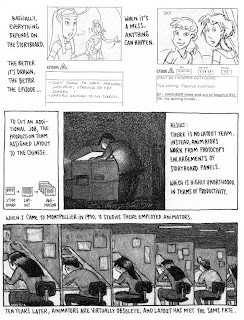

Both books are far more travelogues than than they are concerned with animation. They fall into the genre of visitors to new environments who document how life differs from what they are used to. Delisle is an entertaining guide to the two cities. As as he spent months working and living in each, the reader gets a fuller appreciation for the locales than if he was just a tourist who dropped in for a week.
Still, there is interesting material about how animation production proceeds under these circumstances. As I've never worked in Asia, I have no idea how typical Delisle's experiences are but I can't help regretting how TV animation is produced. I can only imagine, based on Delisle's cultural dislocation, how it must be for Asians to be working on Western projects, dealing with languages and cultures they're not familiar with, having to take orders from a foreign boss who can't communicate with them directly and answering to someone who has no understanding of their lives.
Has anyone from Asia written about the experience of working on Western TV animation? If so, can someone please let me know?
If Delisle's writings are accurate, they are proof that animation made for television is created under such broken conditions that an animated performance is an impossibility.
Excerpted from Shenzhen (Click to enlarge)
Friday, October 26, 2007
Pinocchio Part 31A
Pinocchio has successfully rescued Geppetto from inside the whale, but has seemingly died in the attempt. Since Pinocchio is physically whole, how can he be dead when he is able to breathe underwater? The film speeds past this, hoping the audience won't notice.
As in Snow White, the main character appears to be dead and the supporting characters cry over the body. I wonder if the story crew considered how similar the endings of the two films are? Later animated features made during Disney's lifetime would avoid the appearance of good guys dying at the climax except for Lady and the Tramp and The Jungle Book, and in those cases Trusty and Baloo were supporting characters, not the stars of the picture.
The Blue Fairy recedes as the picture progresses. We see her twice early in the film, but she disappears after freeing Pinocchio from Stromboli's birdcage. Her dove delivers the message about Geppetto and Monstro and her voice alone revives Pinocchio. Was this decision based on story concerns? Once Pinocchio starts taking positive action, would her presence detract from the danger and undercut Pinocchio's accomplishments? Perhaps it was simply done for economic reasons; losing a realistic character is a good way to save money.
When Pinocchio awakes, Geppetto once again deflates the potential sentimentality with humorous behavior in a Chaplinesque fashion. Inside Monstro, Geppetto kisses a tuna instead of Pinocchio. Here, he insists that Pinocchio is dead and must lie down before realizing the truth.
Pinocchio's transformation puts some distance between us and the character. Like the end of Disney's Beauty and the Beast, we've spent the whole film identifying with someone who is visually odd by the standards of his world but is accepted by us. Once the character becomes "normal" at the end, he's no longer someone we recognize. The character gains, but the audiences loses. Luckily, both films end very soon after the transformation occurs. Pinocchio, as a boy, appears in only 8 shots and the end of the film is given over to Jiminy and the wishing star, taking the film full circle.
As in Snow White, the main character appears to be dead and the supporting characters cry over the body. I wonder if the story crew considered how similar the endings of the two films are? Later animated features made during Disney's lifetime would avoid the appearance of good guys dying at the climax except for Lady and the Tramp and The Jungle Book, and in those cases Trusty and Baloo were supporting characters, not the stars of the picture.
The Blue Fairy recedes as the picture progresses. We see her twice early in the film, but she disappears after freeing Pinocchio from Stromboli's birdcage. Her dove delivers the message about Geppetto and Monstro and her voice alone revives Pinocchio. Was this decision based on story concerns? Once Pinocchio starts taking positive action, would her presence detract from the danger and undercut Pinocchio's accomplishments? Perhaps it was simply done for economic reasons; losing a realistic character is a good way to save money.
When Pinocchio awakes, Geppetto once again deflates the potential sentimentality with humorous behavior in a Chaplinesque fashion. Inside Monstro, Geppetto kisses a tuna instead of Pinocchio. Here, he insists that Pinocchio is dead and must lie down before realizing the truth.
Pinocchio's transformation puts some distance between us and the character. Like the end of Disney's Beauty and the Beast, we've spent the whole film identifying with someone who is visually odd by the standards of his world but is accepted by us. Once the character becomes "normal" at the end, he's no longer someone we recognize. The character gains, but the audiences loses. Luckily, both films end very soon after the transformation occurs. Pinocchio, as a boy, appears in only 8 shots and the end of the film is given over to Jiminy and the wishing star, taking the film full circle.
Sunday, October 21, 2007


Tuesday, October 16, 2007
Copyright Confusion
Over at Slate.com, Tim Wu has written one of the best articles on copyright that I've ever read, showing how it's not working for even the major media conglomerates whose lobbyists influence the writing of the law.
Monday, October 15, 2007
Ed Catmull on Successful Companies
 "Why do successful companies fail?" "What's more important, good people or good ideas?"
Here, courtesy of the Thinking Animation blog and Alan Cook, is a January 2007 speech by Pixar President Ed Catmull on why companies succeed and fail. It's lengthy (54 minutes) and will be more interesting to professionals than to students, mainly because professionals have all worked at companies that haven't lived up to their potential. Pixar is doing something right and Catmull is perceptive, thoughtful and articulate about what he sees as necessary for successful companies and the dangers that they face. Listen to it here.
Marjane Satrapi at the New York Film Festival
These are clips from a press conference after the screening of Perspeolis at the New York Film Festival. If you only watch one clip, make it the first where Satrapi talks about choosing animation over live action in order to increase audience identification with the characters.
Digital Distribution and Marketing
Scott Kirsner of the Cinematech blog hosted a workshop at the Film Arts Foundation in San Francisco on the subject of Digital Distribution and Marketing. Below is a slide show of Kirsner's presentation, including some dollar figures.

Hogan's Alley
 The new issue of Hogan's Alley (#15) is out and as usual it has several articles that relate to animation. Noted animation historian Jim Korkis writes an extensive article about Disney's never-made feature based on Roald Dahl's Gremlins. Buck Biggers, one of the founders of Total TeleVision, the studio that produced Underdog and Tennessee Tuxedo, is interviewed by Mark Arnold. Craig Shutt writes about Little Lulu and her appearances in many media, including animation for theatres and television.
Check out your local comics shop for this issue or order online here.
Saturday, October 13, 2007
Pinocchio Part 30C
We've all seen chase sequences. One of the things that makes them work is recognizable geography. One party in the chase goes past an identifiable landmark and then a shot or two later, the other party passes the same landmark. It's a way for the audience to know who is in front and how much space is between the two parties.
One of the most interesting things about the whale chase is that there is almost no recognizable geography. Until the end, when Pinocchio swims towards a gap in the rocky shoreline, all we've got is water and sky. There are rocks that go by in the foreground to add depth to shots, but these rocks are fairly generic. We're not using them as landmarks to measure the relative positions of the characters.
In a situation like this, screen direction becomes the only tool to communicate location to the audience. It's one of the reasons I'm so impressed with this sequence and the credit goes to sequence director Bill Roberts and layout supervisor Al Zinnen. In the hands of lesser film makers, a chase on the open ocean could be confusing; the audience could easily lose its bearings. Roberts and Zinnen make sure that we always understand where the characters are relative to each other and they do it with screen direction.
As the sequence starts, Pinocchio and Geppetto are pushing their raft screen left, trying to get past Monstro's teeth. Monstro sneezes them out and then on his inhale, begins to pull them back towards screen right. We can easily tell by their direction whether they're getting farther or closer to Monstro.
Monstro then starts to chase them towards screen left and dives below the water. When he rises below the raft in shot 12, he's still heading towards screen left as the raft is lifted and Geppetto and Pinocchio bounce along Monstro's back. This shot always astounds me. For one thing, the use of scale contrasts the fragility of Geppetto and Pinocchio relative to Monstro's bulk. For another, this shot trumps any in John Huston's version of Moby Dick. Here is animation doing something that live action could not duplicate until the advent of cgi.
Geppetto and Pinocchio fall into the water and then there is a clear shot of Monstro turning around and swimming towards screen right. There's no ambiguity here as to where Monstro is going next. Geppetto and Pinocchio climb back on the raft and start to paddle towards screen right. When Monstro catches up with them and looms over them, they reverse direction and paddle screen left. Monstro's tail descends and smashes the raft before he continues under water off screen towards the right.
Pinocchio swims to save Geppetto and Monstro emerges from the water now heading screen left towards the pair. Pinocchio looks screen right and sees Monstro approaching. Then he looks screen left and sees the gap in the rocks at the shoreline. He starts swimming towards screen left, pulling Geppetto behind him, while Monstro pursues.
When Pinocchio has reached the rocks, we get a point of view shot where Monstro is swimming towards the camera. Monstro leaps over some rocks heading screen left. Pinocchio frantically tries to swim into the gap screen left. Monstro leaps towards the camera in shot 39, almost devouring the audience in the most dramatic shot of the sequence.
(And I wonder if there was a debate as to how close to bring Monstro to the camera. After the criticism that Snow White was too scary for young children, did they cut this shot before Monstro's mouth enveloped the camera? My modern sensibility wishes that they'd let Monstro get closer before cutting.)
Monstro then smashes into the rocks going screen left and beyond the rocks, the tide moving screen left washes up Geppetto and then follows by washing up Figaro and Cleo in a terribly unbelievable coincidence. A close examination of the sequence shows that Figaro and Cleo disappear in shot 12 and are definitely not on the raft in shot 15 when Pinocchio and Geppetto climb back on. I've often wondered why there wasn't a shot of Geppetto putting them into the trunk on the raft and have the trunk wash up onto shore. It's not a perfect solution, but better than the one that was chosen.
Forgetting about Figaro and Cleo, there is never a moment where the audience is confused about the relative locations of the characters. That allows the audience to concentrate on the danger and as a result the suspense never lets up. The storytelling here is exquisitely clear in a difficult setting for a chase.
One of the most interesting things about the whale chase is that there is almost no recognizable geography. Until the end, when Pinocchio swims towards a gap in the rocky shoreline, all we've got is water and sky. There are rocks that go by in the foreground to add depth to shots, but these rocks are fairly generic. We're not using them as landmarks to measure the relative positions of the characters.
In a situation like this, screen direction becomes the only tool to communicate location to the audience. It's one of the reasons I'm so impressed with this sequence and the credit goes to sequence director Bill Roberts and layout supervisor Al Zinnen. In the hands of lesser film makers, a chase on the open ocean could be confusing; the audience could easily lose its bearings. Roberts and Zinnen make sure that we always understand where the characters are relative to each other and they do it with screen direction.
As the sequence starts, Pinocchio and Geppetto are pushing their raft screen left, trying to get past Monstro's teeth. Monstro sneezes them out and then on his inhale, begins to pull them back towards screen right. We can easily tell by their direction whether they're getting farther or closer to Monstro.
Monstro then starts to chase them towards screen left and dives below the water. When he rises below the raft in shot 12, he's still heading towards screen left as the raft is lifted and Geppetto and Pinocchio bounce along Monstro's back. This shot always astounds me. For one thing, the use of scale contrasts the fragility of Geppetto and Pinocchio relative to Monstro's bulk. For another, this shot trumps any in John Huston's version of Moby Dick. Here is animation doing something that live action could not duplicate until the advent of cgi.
Geppetto and Pinocchio fall into the water and then there is a clear shot of Monstro turning around and swimming towards screen right. There's no ambiguity here as to where Monstro is going next. Geppetto and Pinocchio climb back on the raft and start to paddle towards screen right. When Monstro catches up with them and looms over them, they reverse direction and paddle screen left. Monstro's tail descends and smashes the raft before he continues under water off screen towards the right.
Pinocchio swims to save Geppetto and Monstro emerges from the water now heading screen left towards the pair. Pinocchio looks screen right and sees Monstro approaching. Then he looks screen left and sees the gap in the rocks at the shoreline. He starts swimming towards screen left, pulling Geppetto behind him, while Monstro pursues.
When Pinocchio has reached the rocks, we get a point of view shot where Monstro is swimming towards the camera. Monstro leaps over some rocks heading screen left. Pinocchio frantically tries to swim into the gap screen left. Monstro leaps towards the camera in shot 39, almost devouring the audience in the most dramatic shot of the sequence.
(And I wonder if there was a debate as to how close to bring Monstro to the camera. After the criticism that Snow White was too scary for young children, did they cut this shot before Monstro's mouth enveloped the camera? My modern sensibility wishes that they'd let Monstro get closer before cutting.)
Monstro then smashes into the rocks going screen left and beyond the rocks, the tide moving screen left washes up Geppetto and then follows by washing up Figaro and Cleo in a terribly unbelievable coincidence. A close examination of the sequence shows that Figaro and Cleo disappear in shot 12 and are definitely not on the raft in shot 15 when Pinocchio and Geppetto climb back on. I've often wondered why there wasn't a shot of Geppetto putting them into the trunk on the raft and have the trunk wash up onto shore. It's not a perfect solution, but better than the one that was chosen.
Forgetting about Figaro and Cleo, there is never a moment where the audience is confused about the relative locations of the characters. That allows the audience to concentrate on the danger and as a result the suspense never lets up. The storytelling here is exquisitely clear in a difficult setting for a chase.
Friday, October 12, 2007
"Weenie Villains"
Will Finn made a comment about weenie villains that got me thinking about the interplay between Disney villains and the threat of death.
Except for Snow White, the early Disney features didn't have single villains. Pinocchio has Stromboli, Honest John, the Coachman and Monstro. Dumbo has the elephants, the circus patrons, the clowns and the ringmaster. Bambi has the hunters, their dogs, their fire, but also winter and male rivals. I think that this kind of villainy is in line with the complexity of the Depression. There was general frustration that there was nobody to blame or hold accountable for the economic collapse. It was a multifaceted problem, and so audiences of the time were able to deal with the idea that obstacles and threats come from many sources.
Once World War II arrived, you've got individuals who are singled out as the root causes of the problem: Hitler, Mussolini and Tojo. In the post-war world, Stalin, Kruschev and Mao take their places. Once Disney got back to full length animated features with Cinderella, only three of the films through the retirement of the nine old men had multiple sources of conflict and not single villains.
Alice in Wonderland is more of a road movie than one where the Queen of Hearts is the source of conflict. Lady and the Tramp is very situational, with Lady having to deal with the repercussions of a new baby in the family. If there's a villain in the film, it's the rat, but the rat doesn't drive the film the way that Cinderella's stepmother or Captain Hook drive theirs. The other film that is somewhat situational is The Sword in the Stone, where the medieval society prevents Wart from realizing his potential and only a miracle can free him from serfdom. There is Madam Mim, but like the rat in Lady and the Tramp, she hardly motivates the majority of Wart's troubles.
Cinderella, Peter Pan, Sleeping Beauty, One Hundred and One Dalmatians, The Jungle Book, The Aristocats, Robin Hood and The Rescuers are all driven by villains. However, here is where the "weenie" part comes in. Prior to Peter Pan, no Disney villains in features had bumbling sidekicks. (Honest John has Gideon in Pinocchio, but Honest John himself is not the threat; it's where he takes Pinocchio that's the problem.) Comic sidekicks for villains are also present in Dalmatians, Robin Hood and The Rescuers. In some films, like Pan, Dalmatians, The Jungle Book, The Aristocats, Robin Hood and The Rescuers, the villains are treated comically themselves.
This is why death doesn't seem as threatening in the later Disney features. It may be present, but there's so much comedy surrounding the villains or the climaxes (Baloo is tossing off one-liners while Shere Khan is attacking), that the films are winking at the audience, reassuring them not to get too worried.
There is no winking in early Disney features. The conflicts and obstacles facing the characters are not funny, which is why the threat of death is taken seriously.
Except for Snow White, the early Disney features didn't have single villains. Pinocchio has Stromboli, Honest John, the Coachman and Monstro. Dumbo has the elephants, the circus patrons, the clowns and the ringmaster. Bambi has the hunters, their dogs, their fire, but also winter and male rivals. I think that this kind of villainy is in line with the complexity of the Depression. There was general frustration that there was nobody to blame or hold accountable for the economic collapse. It was a multifaceted problem, and so audiences of the time were able to deal with the idea that obstacles and threats come from many sources.
Once World War II arrived, you've got individuals who are singled out as the root causes of the problem: Hitler, Mussolini and Tojo. In the post-war world, Stalin, Kruschev and Mao take their places. Once Disney got back to full length animated features with Cinderella, only three of the films through the retirement of the nine old men had multiple sources of conflict and not single villains.
Alice in Wonderland is more of a road movie than one where the Queen of Hearts is the source of conflict. Lady and the Tramp is very situational, with Lady having to deal with the repercussions of a new baby in the family. If there's a villain in the film, it's the rat, but the rat doesn't drive the film the way that Cinderella's stepmother or Captain Hook drive theirs. The other film that is somewhat situational is The Sword in the Stone, where the medieval society prevents Wart from realizing his potential and only a miracle can free him from serfdom. There is Madam Mim, but like the rat in Lady and the Tramp, she hardly motivates the majority of Wart's troubles.
Cinderella, Peter Pan, Sleeping Beauty, One Hundred and One Dalmatians, The Jungle Book, The Aristocats, Robin Hood and The Rescuers are all driven by villains. However, here is where the "weenie" part comes in. Prior to Peter Pan, no Disney villains in features had bumbling sidekicks. (Honest John has Gideon in Pinocchio, but Honest John himself is not the threat; it's where he takes Pinocchio that's the problem.) Comic sidekicks for villains are also present in Dalmatians, Robin Hood and The Rescuers. In some films, like Pan, Dalmatians, The Jungle Book, The Aristocats, Robin Hood and The Rescuers, the villains are treated comically themselves.
This is why death doesn't seem as threatening in the later Disney features. It may be present, but there's so much comedy surrounding the villains or the climaxes (Baloo is tossing off one-liners while Shere Khan is attacking), that the films are winking at the audience, reassuring them not to get too worried.
There is no winking in early Disney features. The conflicts and obstacles facing the characters are not funny, which is why the threat of death is taken seriously.
Thursday, October 11, 2007
Pinocchio Part 30B
One of the things I find fascinating about the early Disney features is how much the characters are threatened by death. Snow White goes into a coma and if not for the dwarfs emotional inability to say goodbye to her would be buried alive. Pinocchio dies and has to be resurrected by the Blue Fairy. Dumbo falls from a dangerous height as he grapples with losing the magic feather. Fantasia's "Night on Bald Mountain" has the dead rising from their graves. Bambi's mother dies and Bambi has to survive hunters, dogs and a forest fire, any of which are capable of killing him.
While the Disney shorts play with death, whether it's The Skeleton Dance or The Goddess of Spring, nothing in the shorts comes close to the threats that the early feature characters regularly encounter. Considering that Disney films were always considered family films, why is death such a major part of them?
I suspect that the Depression, the looming second world war and the instability of the Disney studio in the 1930's all contributed to the feeling that life was precarious. The audiences had been through a lot in their own lives, so they had a gut understanding of how quickly someone's well-being could be threatened or destroyed. Of course, as tough as the Disney characters had it, they were saved at the end. The ultimate happy ending is to cheat death and additionally get what you've struggled for, whether it's a prince, humanity, status, or just the ability to live out your life.
What's interesting is this focus on death didn't survive the early features. Perhaps the audience was exhausted after the war or the generation that lived through it and the depression didn't want to upset their own children in the 1950's. Perhaps because the Disney studio was on firmer footing after Cinderella and Disneyland, the threat of collapse was not as strong. In any case, while death is alluded to in films like Peter Pan or Lady and the Tramp, it's not nearly as compelling as it is in the early features. By the time Woolie Reitherman took over direction, death wasn't taken seriously. Baloo's "death" in The Jungle Book is a momentary tug at the heart en route to some baggy pants comedy.
The whale chase in Pinocchio is exciting for many reasons. It's beautifully laid out and cut. The action and effects animation are done well. Monstro is imposing in terms of his size and strength. But it is the life and death nature of the chase that gives it most of its power. Geppetto and Pinocchio are overmatched against Monstro. They are literally swimming for their lives, not hoping to best Monstro in any way, just to avoid his wrath. The threat of death, convincingly portrayed by the artists, means that we fear for the characters and that emotional connection is what makes our hearts race.
While the Disney shorts play with death, whether it's The Skeleton Dance or The Goddess of Spring, nothing in the shorts comes close to the threats that the early feature characters regularly encounter. Considering that Disney films were always considered family films, why is death such a major part of them?
I suspect that the Depression, the looming second world war and the instability of the Disney studio in the 1930's all contributed to the feeling that life was precarious. The audiences had been through a lot in their own lives, so they had a gut understanding of how quickly someone's well-being could be threatened or destroyed. Of course, as tough as the Disney characters had it, they were saved at the end. The ultimate happy ending is to cheat death and additionally get what you've struggled for, whether it's a prince, humanity, status, or just the ability to live out your life.
What's interesting is this focus on death didn't survive the early features. Perhaps the audience was exhausted after the war or the generation that lived through it and the depression didn't want to upset their own children in the 1950's. Perhaps because the Disney studio was on firmer footing after Cinderella and Disneyland, the threat of collapse was not as strong. In any case, while death is alluded to in films like Peter Pan or Lady and the Tramp, it's not nearly as compelling as it is in the early features. By the time Woolie Reitherman took over direction, death wasn't taken seriously. Baloo's "death" in The Jungle Book is a momentary tug at the heart en route to some baggy pants comedy.
The whale chase in Pinocchio is exciting for many reasons. It's beautifully laid out and cut. The action and effects animation are done well. Monstro is imposing in terms of his size and strength. But it is the life and death nature of the chase that gives it most of its power. Geppetto and Pinocchio are overmatched against Monstro. They are literally swimming for their lives, not hoping to best Monstro in any way, just to avoid his wrath. The threat of death, convincingly portrayed by the artists, means that we fear for the characters and that emotional connection is what makes our hearts race.
Sunday, October 07, 2007
Michael Sporn Retrospective

Michael Sporn has posted the program for his retrospective at New York's Museum of Modern Art. It takes place November 9-12 and I recommend you attend if you'll be in the New York area on those dates.
The films showcase Michael's interest in New York, social problems, children's literature and show the range of his eclectic design approach. In addition, the films include excellent animation by Tissa David (The Red Shoes, The Marzipan Pig), John Dilworth (Lyle, Lyle Crocodile) and Dante Barbetta (Ira Sleeps Over).
Several works by William Steig are adapted including Abel's Island (for my money, Mike's masterpiece, pictured above), the Oscar nominated Dr. DeSoto and The Amazing Bone. If your only knowledge of Steig is Shrek, see what Steig looks like when his books are faithfully adapted for animation.
Michael will be appearing on stage for an interview conducted by John Canemaker and Joshua Siegel on November 12 at 7 p.m.
Friday, October 05, 2007
Pinocchio Part 30A
There are animation studios that are dominated by producers and animation studios that are dominated by directors. It's true today and it was true in the past as well. Disney was a studio heavily dominated by the producer, Walt Disney. His presence in story meetings and approving all the steps of the process mean that nothing got on the screen without his okay. Directors, regardless of their own points of view, were there to serve Walt Disney.
As a result, we don't really have much of a handle on many of the Disney directors. Those we can take the best measure of are those who directed shorts after the features became Walt Disney's main interest. When his interest in shorts declined, it left openings for directors like Jack Kinney and Jack Hannah to express more of themselves in their work.
However, there are some directors who never got out from under Disney's shadow. What are we to make of them? Which brings us back to the whale chase in Pinocchio and the sequence director Bill Roberts.
Not a lot has been written about Roberts. Shamus Culhane probably wrote the most in Talking Animals and Other People. When Culhane started animating at Disney, he was assigned to do corrections for Roberts, who at the time was a Pluto animator. What we learn from Culhane was that Roberts wasn't very talkative, struggled with his drawing, disdained the cuteness creeping into Disney cartoons but was sincerely interested in the work that he and Culhane were putting on the screen. Jack Kinney, in Walt Disney and Assorted Other Characters, says that Roberts went into real estate and construction after Disney and reportedly became wealthy. Those comments are like bookends on Roberts' career, but the middle part (which is the most interesting) is a blank.
No doubt that the story sketches and the layout team under Al Zinnen contributed many ideas to the whale chase, but Roberts was the director. He's got to deserve some of the credit but how much? Roberts also directed the "Rite of Spring" segment of Fantasia, yet another action sequence with Woolie Reitherman animating, as well as "Mickey and the Beanstalk" in Fun and Fancy Free, another cartoon with a strong bent for adventure. Roberts sequence directed on Dumbo, Bambi, Saludos Amigos, and The Three Caballeros, but I have no idea which sequences he was responsible for.
While Alberto Becattini has Roberts working in the animation business as early as 1919, I have no idea when he was born or died. It appears that he left Disney in the late 1940's, but did he quit or was he caught in one of the post-war layoffs? By now, even his children (if he had any) may have passed on. So we've got a name and a few reminiscences, but no real way to judge a director who worked on some of the most important animated films in history.
As a result, we don't really have much of a handle on many of the Disney directors. Those we can take the best measure of are those who directed shorts after the features became Walt Disney's main interest. When his interest in shorts declined, it left openings for directors like Jack Kinney and Jack Hannah to express more of themselves in their work.
However, there are some directors who never got out from under Disney's shadow. What are we to make of them? Which brings us back to the whale chase in Pinocchio and the sequence director Bill Roberts.
Not a lot has been written about Roberts. Shamus Culhane probably wrote the most in Talking Animals and Other People. When Culhane started animating at Disney, he was assigned to do corrections for Roberts, who at the time was a Pluto animator. What we learn from Culhane was that Roberts wasn't very talkative, struggled with his drawing, disdained the cuteness creeping into Disney cartoons but was sincerely interested in the work that he and Culhane were putting on the screen. Jack Kinney, in Walt Disney and Assorted Other Characters, says that Roberts went into real estate and construction after Disney and reportedly became wealthy. Those comments are like bookends on Roberts' career, but the middle part (which is the most interesting) is a blank.
No doubt that the story sketches and the layout team under Al Zinnen contributed many ideas to the whale chase, but Roberts was the director. He's got to deserve some of the credit but how much? Roberts also directed the "Rite of Spring" segment of Fantasia, yet another action sequence with Woolie Reitherman animating, as well as "Mickey and the Beanstalk" in Fun and Fancy Free, another cartoon with a strong bent for adventure. Roberts sequence directed on Dumbo, Bambi, Saludos Amigos, and The Three Caballeros, but I have no idea which sequences he was responsible for.
While Alberto Becattini has Roberts working in the animation business as early as 1919, I have no idea when he was born or died. It appears that he left Disney in the late 1940's, but did he quit or was he caught in one of the post-war layoffs? By now, even his children (if he had any) may have passed on. So we've got a name and a few reminiscences, but no real way to judge a director who worked on some of the most important animated films in history.
Tuesday, October 02, 2007


Subscribe to:
Comments (Atom)

 Posts
Posts


