Saturday, January 28, 2012

More Reasons Why Work-for-Hire Stinks

Another copyright case from the comics world, but one that has implications for people working in animation.

Writer Gary Friedrich created Marvel's version of Ghost Rider. He sued Marvel claiming that it was created and offered to them and was not done as work for hire. He lost the suit.

Previously, Friedrich commissioned artwork of the character which he sold at various comics conventions. Here's where it gets ugly:
"As per the courts instructions Friedrich has to account for any and all money that he has received, “...relating to the gross and net amount derived from Plaintiffs' sale of goods bearing the Ghost Rider image, likeness, or Marvel trademark.” This means that Friedrich has to account for every cent each and every time he sold a print at a convention or any other item to anyone, that has the Ghost Rider image or name on it, and he has to account to all of the defendants in the case, and there’s quite a few of those, including, but not limited to, Marvel Defendants, Movie Defendants, Hasbro, Inc. and Take-Two Interactive Software, Inc. If the defendants don’t like, or don't agree with, the numbers that Friedrich supplies then they can, and probably will, ask for a deposition whereby they can question him, under oath. It was no secret that Friedrich commissioned artists such as Herb Trimpe, Arthur Suydam and others to draw Ghost Rider images which were then sold as prints over the years. If you bought one thinking you were helping Gary, well, that cash will most likely end up in Marvels pockets. This amount will be factored into any damages that the defendants can claim from Friedrich, all of which will be bundled up neatly into a final judgement so the case can then proceed to the appeal stage."
So, if you work in animation and sit at conventions selling your drawings of characters that you've worked on (or not) but don't own, you are not only violating copyright, you may have to account for each and every sale if the copyright owner ever comes after you.

Cartoonist Dave Sim once said that no corporation will ever pay you enough to successfully sue them. He's certainly right in Friedrich's case. Friedrich is appealing the copyright decision, but is already broke. He owes his lawyers $100,000.
"If his appeal fails Friedrich will be a financially ruined man. He stands to lose everything he owns, and ever will own. Naturally the court doesn’t care for this, but Marvel might. With the imminent release of the second Ghost Rider movie, a franchise that draws heavily from the mythos that Friedrich helped create and has never been compensated for from Marvel (outside of payments for the comic books), Marvel is set to see another financial windfall of multiple millions of dollars. It’d be nice to think that, perhaps, someone at Marvel can see the logic that a settlement would have in this case, if only in the value of good publicity alone. As it is Marvel have done to Friedrich what DC did to Siegel, Shuster, Bill Finger and many others – ground him into the dirt, taken his creation, made more money in a week than the original creator will see in a lifetime and then keep on keeping on. Perhaps it’s time that a campaign designed to embarrass Marvel be undertaken – the sheer threat of such a campaign worked for Dave Cockrum. While Cockrum didn’t get millions, nor did Gene Colan when he approached and asked Marvel, they did get sizable amounts which, in Cockrum’s case alone, allowed him to live his remaining years out in relative comfort and ease. As it stands the people who’ll be making the most money from the Ghost Rider sequel will be people who had nothing to do with the character. As it stands, according to Box Office Mojo, the first Ghost Rider movie has grossed over $115,800,000 worldwide. The sequel should do similar amounts, meaning Marvel will clear a nice sum, again, while denying the creator a cent."
The above information is from 20th Century Danny Boy. Torsten Adair reflects on the situation as well.

And in case you've forgotten, Marvel is owned by Disney. So if you work (or have worked) for Disney, Pixar or Marvel, pay attention.

Saturday, January 21, 2012

More on Those Dirty Tricks

This blog seems to be tipping more and more into the business, as opposed to the art, of animation, but it's hard to avoid when various media industries are conspiring against artists and the public.

I reported earlier (here and here) that Pixar was implicated in an illegal "no poaching" agreement with other high tech firms, meaning that if a Pixar employee applied for a job at Lucasfilm or Apple, those companies would refuse to hire the Pixar employee. Pixar returned the favour by refusing to hire applicants from Lucasfilm or Apple. That violates anti-trust laws. The damage is that it prevents employees from changing jobs or earning higher pay elsewhere. The case is about to go to trial and the Department of Justice has released some evidence that you can read below. For instance, on page 3 you can read that Lori McAdam of Pixar wrote in an internal email:
“I just got off the phone with Danielle Lambert [of Apple], and we agreed that effective now, we’ll follow a Gentleman’s agreement with Apple that is similar to our Lucasfilm agreement.”
TechCrunch - High-Tech Employee Antitrust Litigation Conference Statement 1/19/2012 - Analysis here: http:/...

(Link via TechCrunch)

Friday, January 20, 2012

The Trials of Superman

The character of Superman, created by Jerry Siegel and Joe Shuster, has a long and complicated legal history. Jerry Siegel's heirs have terminated their half of DC Comics' copyright of the character and are entitled to share in any revenues made since the copyright termination.

Warner Bros, the owner of DC Comics, has not exactly cooperated. The Siegel heirs have been forced to sue, claiming that the revenue they are owed is being underestimated. That was the subject of the above trial. In the words of Daniel Best, who compiled those transcripts,
"The argument was that DC Comics had undervalued Superman and licensed the rights to exploit the character in movies and television by dealing with their parent company, Warner Brothers. DC argued that it had always done the right thing, that the deals negotiated and that the payments received, going back to the Salkind era (the 1970/1980s Superman movies with Christopher Reeve) and extending through to the current deals, including the television series Lois and Clark and the highly successful Smallville, along with the most recent movies, were more than fair and indeed over market value. The argument to resolve this was taken to a ten day bench trial, at which time DC Comics would have to prove that it had not undersold Superman, and the Siegel’s would have to prove otherwise. The trial gave a great insight into the machinations of comic books and motion pictures along with the true value of Superman, as a multi-media concept"
You can download the entire trial transcript for free courtesy of Daniel Best here. It's over a thousand pages and this is not everyone's idea of fun reading. However, I keep banging the drum on creators' rights on this blog, and this transcript is an example of what happens in court if there is a dispute between a creator (or his heirs) and the company he has done business with. Even if you only read a dozen pages, you'll learn more about how a real trial works than any TV show can tell you.

Wednesday, January 18, 2012

Against SOPA and PIPA

UPDATED BELOW.

If I knew how to block out this site on Jan. 18 in protest against SOPA and PIPA, two bills currently in the U.S. Congress that claim to be against internet piracy, I would do it. I am not in favour of piracy, though I have major issues with what media conglomerates have done to distort copyright laws world wide.

The problem I have with these bills is that they are too vague and too broad. While they may become a U.S. law, it will affect internet users and site owners beyond U.S. borders. As a commenter on Boing Boing (dark for the day) said, in order to stop piracy, we're going to outlaw the sea.

There is a lot of rhetoric on both sides of the issue, but I recommend this article in The Globe and Mail for a clear-eyed look at what the internet community is upset about. There is also this comment to the article, which talks about the lack of due process:
"A website (of a corporation, individual, what-have-you) is considered guilty as soon as they are accused. Only once the site is shut down or made inaccessible can they try to defend themselves.

"Given that the whole concept of "fair use" is still, after 300 years, being refined, someone could use something fairly and still be shut down (see lack of due process above)."
If you are in the U.S, I urge you to contact your Congressman and Senators and register your opposition. You can do this easily by going to AmericanCensorship.org or the Electronic Frontier Foundation.

UPDATE: Clay Shirky is one of the smartest people in the room when it comes to talking about media. I've read his books and been lucky to hear him speak in Toronto. Watch the video below to get a "big picture" explanation of what SOPA and PIPA are actually about.

Sunday, January 15, 2012

Review: The World History of Animation

Last summer, I helped a friend develop a course outline for an animation history course. In looking for a textbook, I found that there wasn't a single volume that seemed appropriate. When The World History of Animation by Stephen Cavalier was later published, I wondered if this book might be the solution. Unfortunately, it isn't.

The book is a wide ranging history of animation. It starts with a short historical summary for different parts of the world before launching into a year by year history where particular films are singled out. The entries are wildly uneven, both in terms of the writing and the accompanying illustrations. One would think that the amount of space devoted to a film would be proportional to the film's importance, but there doesn't seem to be any relationship. Not all the films are represented by stills and here, too, the number or size of the stills bears no relation to the importance of the film.

I don't think I can articulate the author's point of view beyond the fact that he has personal favorites. While art, content and technology are all mentioned, none seems to be uppermost in the author's mind. Directors are the only contributors mentioned consistently. Designers and animators who aren't directors are mostly ignored.

Finally, there are many factual errors. I would not pretend to be an expert on European or Asian animation, but I am reasonably conversant in American animation history. The author is British, which might account for his errors regarding America, but there is no way for me to know if the same number of errors exist in all parts of the book.

I've listed the errors I found during my reading below, if only to document my reservations. There is no doubt that the book is an ambitious undertaking, but it seems to have defeated the author and his research team. Perhaps it isn't possible to get a single volume history of world animation that is accurate and with a defined point of view, but this book does nothing to challenge that assumption.

The errors:

A still identified as being from Gertie the Dinosaur (1914) on page 63 is obviously from one of the later Gertie films, as it has a grey scale and looks to have been done on cels. The 1914 film was just line and done entirely on a single level of paper.

On page 74, Cavalier states that Joe Oriolo was working on Felix the Cat as early as 1922. As he was born in 1913, that would make him a precocious nine year old. In fact, Oriolo didn't meet Messmer until the two were working at Famous Studios in the early '40s.

On page 97, Cavalier says that Steamboat Willie was half finished before Disney made the decision to make it a sound cartoon. This is wrong. The synchronization that is Steamboat Willie's great advance was due to planning the musical beats in advance of animation.

On page 99, sloppy writing implies that Ub Iwerks' multiplane camera was in use as early as the first Flip the Frog cartoon when it was introduced in the ComicColor series. He also says that Iwerks returned to the Disney studio in 1938, when it was 1940.

On page 115, Cavalier implies that the Fleischer 3D setbacks were the Fleischer version of the rotoscope. First of all, there is no relationship. The setbacks were purely for background elements, not character animation. Secondly, as the Fleischers invented the rotoscope, they had no need for their own version.

On page 122, Leon Schlesinger is invited to open an animation studio on the Warner Bros. lot in 1927, when his studio didn't open until 1930. Then the Looney Tunes and Merrie Melodies are described as being produced at the Harman-Ising studio, which is also wrong. On the same page, Chuck Jones, not Tex Avery, is credited as the director of A Wild Hare.

On page 123, Cavalier states that producer Edward Selzer imposed a 5 week production schedule on each cartoon. While a cartoon may have been forced to move through each department in 5 weeks, there is no way that an entire cartoon was created in 5 weeks.

On page 142, Tex Avery is credited as creating Porky Pig, but Avery had nothing to do with Porky's debut cartoon I Haven't Got a Hat, which was released before Avery's first cartoon at Warner Bros.

On page 198, regarding The Jungle Book, Cavalier states, "for the first time the characters' movements and acting were based on the personalities and filmed performances of the voice actors, who were encouraged to improvise as they recorded." It was hardly the first time, as it was done at least as early as the tea party sequence in Alice in Wonderland (1951).

On page 219, Cavalier states, "Crumb also claimed that Bakshi had got the agreement [to make an animated Fritz the Cat] with his ex-girlfriend more than with him, and that she had no ownership rights, which Bakshi denied." The woman in question is Dana Crumb, who was married to Crumb at the time the contract was signed.

On page 225, Jerry Beck is identified as Jeff Beck.

On page 246, Don Bluth's Banjo the Woodpile Cat is identified as a feature when it is 29 minutes long.

On page 248, MAGI Synthevision is identified as MAG.

On page 286, Cavalier claims that the cgi ballroom in Beauty and the Beast was supplied by Pixar. It was created internally at Disney. I confirmed this with Dan Philips, who was CGI Manager on the film.

On page 308, there is a commentary on Super Mario 64 that sounds more like the work of a public relations flack than a historian. "Shigeru Miyamoto and Nintendo's Super Mario 64 is not only one of the greatest computer games of all time, but also one of the greatest works of art/entertainment of the twentieth century. From the moment the player takes control of Mario and finds that through some simple controls he can run, jump, swim, slide, or even fly in any direction of the beautifully-realized world, he or she is held in a similar state of wonder and exhilaration that the first audiences must have felt when watching Winsor McCay's Gertie the Dinosaur or Walt Disney's Snow White and the Seven Dwarfs."

On page 331, in discussing Gendy Tartakovsky's credits, there is no mention of Dexter's Laboratory, a show that he created.

On page 386, Shane Acker's feature 9 is identified as stop-motion, when it is cgi.

Thursday, January 12, 2012

John Hubley Alert

Turner Classic Movies will run We Learn About the Telephone (1965) early Saturday morning at 5:30 a.m. Eastern time. This film contains animation designed and directed by John Hubley and features voice work by Mel Blanc.

Michael Sporn has written about this film and if you don't want to get up early Saturday, you can see it at the Prelinger Archives.

Saturday, January 07, 2012

Freelancing

I'm writing this post for the benefit of Sheridan animation students and grads, but it may prove useful to others.

If you are not on salary or working under a contract and somebody asks you to produce some art or animation, here are the things you need to know in writing before you start work.

  • How much will you be paid and what is the payment schedule?
  • Are there royalties or other compensation you are entitled to in the future?
  • What are the specifics of the work you are providing?
  • What format are you delivering the work in?
  • When is the work due?

Then there is the question of rights. What exactly are you selling in exchange for the money?

  • Are you selling the work outright?
  • Are you selling the work only for a specific use?
  • Are you selling the work for a limited amount of time?
  • Is the sale for exclusive or non-exclusive rights to use the work?
  • Will the artist get screen credit or be allowed to sign the work?

If the client provides this information in a written document, you have the right to ask for changes to anything that is specified. The client has the right to say no, but so do you. An agreement implies that both parties (the client and the artist) see eye to eye on conditions under which the work will be produced.

You also have the right to consult a lawyer, agent or other professional on the agreement before signing it.

There is a tendency for artists to be so thrilled that somebody wants their work that they skip all of the above or worse, they agree to work on spec. Spec work, (work done on speculation), means that the artist produces work for a client with no promise of payment. There are also cases where a client promises no money but offers the benefit of experience or exposure.

There is a word that describes working for free: slavery. Slavery can only occur through force, which we have not yet sunk to in North America, or complicity, where the artist agrees to be a slave.

There are occasions where artists may choose to work for free. Work gets donated to a charity or done to help a friend or family member. But if a profit making company is asking for artwork, they should pay for it and all of the above conditions should be met.

Please note that the above is different from pitching. In that case, you are creating the artwork for yourself and hope to interest a buyer in it. If no payment is forthcoming, you are free to take that artwork elsewhere to try to market it. Doing free work for yourself is different than doing free work at the request of a profit-making company.

I'm going to talk about two instances that I've been consulted on in the recent past. I have to be vague so as not to break any confidences.

In the first case, a distributor was interested in a student film made by a Sheridan graduate. The distributor wanted non-exclusive theatrical rights and exclusive rights for DVD, TV, internet and merchandising. In exchange for these rights, the distributor was willing to pay $50. I told the grad that for the low fee, none of the rights should be exclusive. If the grad had the opportunity to sell the film again in any market, he should be able to do it. The student asked for changes to the contract and the rights were made non-exclusive.

In the second case, a Sheridan grad was commissioned by a company to produce a film for a fee. When the film was delivered, the grad was told that the person who commissioned the film didn't have authorization to do it. The company was sorry and felt bad about it, but could only offer the grad half the agreed upon fee as a gesture of good will. The grad asked me for advice. I warned the grad that if she made a fuss, there was a chance that the company would refuse all payment. The grad wanted to proceed anyway, so I counseled the grad to tell them that she had an email from a company employee and she looked upon that as a contract. If there was a problem, it was between the company and the employee, not the company and her. If they didn't pay her in full, she would publicize the fact that the company had ripped her off and would warn other artists not to do work for the company. Furthermore, if the company didn't pay the full fee and used the work, she would sue the company for copyright infringement.

The company responded that they regretted her aggressive tone. This is known as blaming the victim. However, they did agree to pay the full fee.

There is no shortage of companies looking to take advantage of young artists. It is important to understand the proper way to do business, demanding a signed, written agreement that covers the payment, the rights, the deadline and the deliverables before the artwork is created. Your art and your time are what you are selling as a professional. If you work for free or don't proceed in a professional manner, you are merely a hobbyist and you are hurting people who are professionals.

Friday, December 30, 2011

New Year's Greetings

Kaj Pindal is the lucky owner of this New Year's greeting from animation legend Norman McLaren. There's much more than the above photo shows, and you can see it all by clicking here.

Monday, December 26, 2011

The Artist, Perception and Animation

Can this film tell us something about animation?

I recently saw The Artist, the new silent film that has been picking up awards at festivals and is in the running for the major awards this season. It's clear that the film's creators have a genuine fondness for silent Hollywood cinema and I found it to be a very enjoyable experience. I recommend it.

The film is silent, black and white and with a 1.33:1 aspect ratio, taking on all the trappings of films of the silent era. It occurred to me, though, that at this point in time, it's all an affectation.

Silent black and white films existed due to technological obstacles. Early sound and colour systems were unreliable, producing results that clearly failed to meet the audience's standard. Without sound and colour, films compensated with the use of orchestral scores in the larger cities, increasingly sophisticated photography and a style of directing, acting and editing that communicated characters' thoughts clearly to international audiences. Silent film makers like Griffith, Murnau, Lubitsch Vidor, Ford, Borzage, Chaplin, Keaton, etc. made films that can still move audiences (when given the chance) even though audiences are no longer accustomed to the limitations of silent films. The Artist certainly proves that silent film can still be a potent experience.

But it is now an artificial experience. A silent film of the 1920s was as advanced as the technology would allow. The Artist is a conscious decision to go backwards in both time and technology. In its way, it depends as much on novelty as Avatar did with its use of 3D. However, I would be surprised if The Artist was the first of a new wave of silent features.

Audiences embraced sound and colour because it brought film closer to their own perception of the world. Sound became omnipresent in film by 1930. Colour, due to cost, took considerably longer. Black and white films were still being made into the 1960s, some even in Cinemascope.

(What I think sounded the death knell for black and white film was color TV. So long as people were watching black and white at home, they would accept it in films. Once color TV was widespread, a black and white film somehow seemed cheap. And truthfully, the majority of black and white films in the 1960s lacked color due to budget restrictions.)

The Artist got me thinking about the transition from drawn to computer animated features. Perhaps our view was influenced by the weak drawn features that were competing against better computer animated films. Certainly, that's the line that many in the industry and fans took, blaming the films rather than the medium.

While the quality of the films was an undeniable issue, perhaps it hid something larger. Perhaps our own biases in favour of drawing prevented us from seeing things from the audience's point of view. Throughout the 1930s, there was a strong movement to bring animation closer to the audience's perception of the real world. Animation embraced sound and colour early. There were also experiments of various kinds to give animation a greater illusion of depth. In Snow White and the Seven Dwarfs, Disney was attempting to give a greater impression of depth both with cel painting techniques and the multiplane camera. It was cost that forced him to back away from these techniques and so that in the '60s you have films like 101 Dalmatians, where the linear quality of the animation drawings is extended to the backgrounds and there is no attempt at spatial depth through the use of the camera.

When computer animation came along, it increased the image's verisimilitude to how the audience perceived the world. Light striking the characters provided a more accurate feeling of solidity and shadow. The computer allowed for a greater use of texture and, unlike drawn animation, allowed that texture to move with the characters. The virtual space had depth and perspective similar to the world the audience lived in and the camera had the freedom to move through it. Computer animation succeeded the same way Disney did in Snow White in making the image closer to the audience's experience.

At this point in time, drawn animated features may be seen as a throwback, much as The Artist is, as they deprive the audience of some of their perceptual experience of the world. Of course, just as silent films had qualities that are emotionally powerful, so, too, do drawn features. Much was lost with the death of silent and of black and white films, but those things were developed to compensate for shortcomings. Similarly, much is being lost with the death of drawn animated features, but again, many of these things were developed as a means of compensation.

Furthermore, live action directors who started in silent film (Ford and Hitchcock as an example) continued to use silent film techniques in their sound films. Both directors have long passages driven purely by the visual. Similarly, animation directors such as John Lasseter and Brad Bird have brought drawn animation techniques into computer animation, such as animated acting techniques and the ability to design the on-screen world from scratch.

Every artist knows that limitations are often a blessing, forcing solutions that are more creative than would otherwise be arrived at. But as movies are a mass medium, depending on a world-wide audience in order generate a profit, the artistic love of drawing and understanding of limitations is up against the audience's preference for a world on screen that matches its real world perceptions. It isn't a question of one group being right and the other being wrong. It is simply a question of competing preferences, and as the audience is footing the bill, it wins.

Thursday, December 22, 2011

No Editorial Comment Intended

I keep an eye on politics, even though I've kept this blog free of it. However, today I saw this image of Ron Paul at Salon.com.


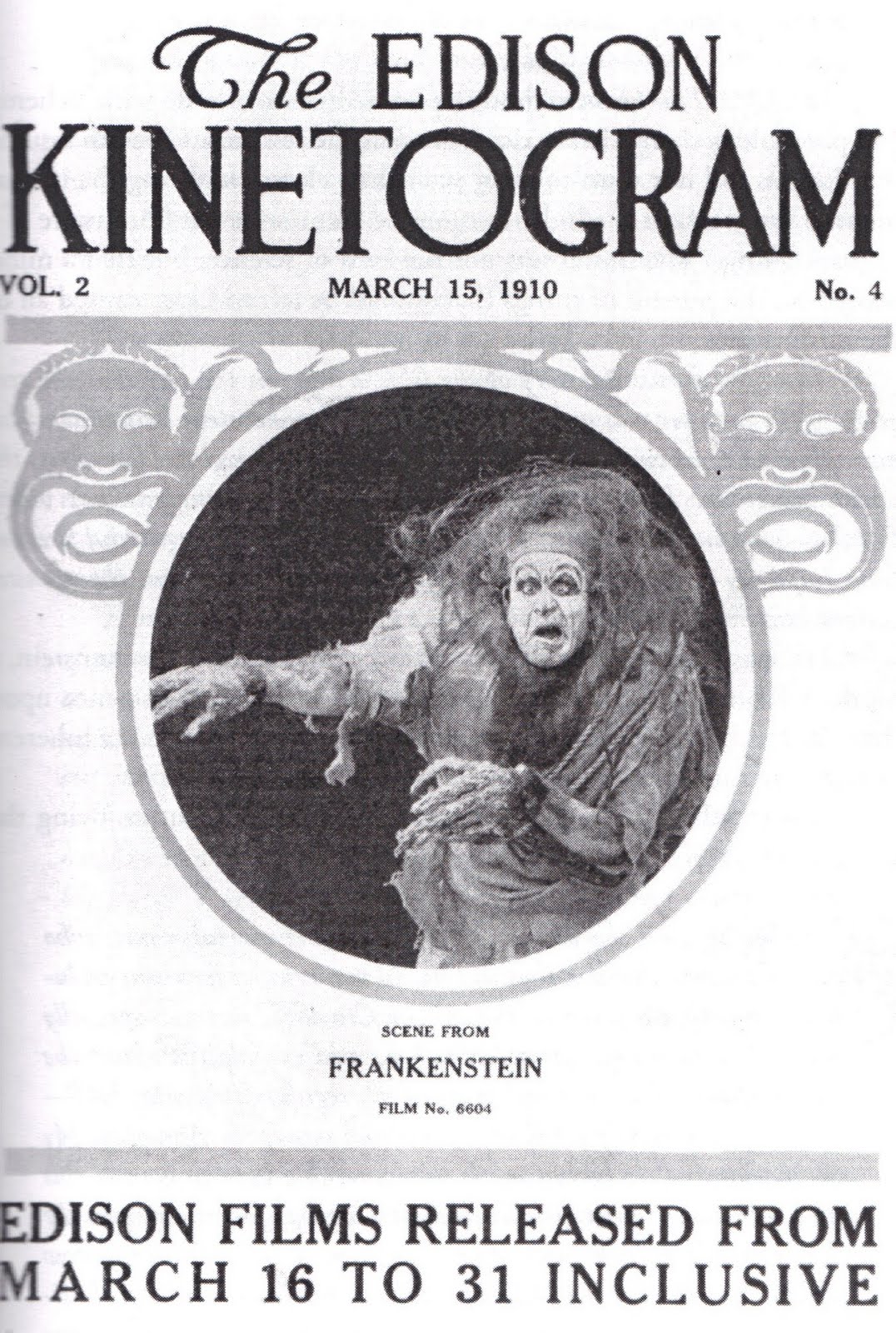
Film history buff that I am, I immediately thought of this image from the 1910 version of Frankenstein produced by the Edison company.


As I said, no editorial comment on Ron Paul intended, but the pose similarity is too strong not to note.

Monday, December 19, 2011

Why No Animated Feature Award?

Howard Fine of the New York Film Critics Circle writes about why the group declined to give an award this year for the best animated feature.

"To me, the key word in that award title is "feature." It's not an award strictly for animation -- it's for the whole movie, which happens to be animated. And I'm hard-pressed to think of an animated film this year that could make that claim, among the 18 recently announced as the animated titles that qualified for this year's Oscar.

"Because it's not about the animation -- it's about what's being animated. If the script is dumb or flat or just plain not funny (and, like it or not, the vast majority of animated films are comedies aimed at children), I don't care how spectacular it is visually -- it's not cutting it."

Monday, December 12, 2011

The Oscar Race

I'm interested in this year's Oscar race for Best Animated Feature because my perception, right or wrong, is that it was a weak year.

The various film critic organizations have begun to weigh in on their bests of the year, and Rango seems to be off to an early lead. The Boston, L.A. and S.F. critics have picked it as the best animated feature. The N.Y. film critics chose Tintin, though Richard Corliss of Time also picked Rango for his 10 best list.

It's interesting that with critics from three major cities accounted for, there isn't a Pixar or DreamWorks film mentioned.

Saturday, December 10, 2011

Brad Bird and Ignorance

No, I'm not implying that Bird is ignorant. But a great many of the reporters who interview him about Mission: Impossible - Ghost Protocol, which Bird directed, definitely are. Here's an article in the N.Y. Times about Bird and it contains this paragraph:
"Plenty of live-action directors have successfully taken on animated movies, including Gore Verbinski (“Rango”) and Tim Burton (“Corpse Bride”). But the flow almost never goes in reverse — if you can name a successful example you have movie historians beat — making Mr. Bird’s chance at bat a fascinating one for Hollywood to watch. A similar attempt will come in March, when Andrew Stanton, the director of Pixar’s “Finding Nemo” and “Wall-E,” unveils his live-action space saga, “John Carter.”"
So the writer has no knowledge of film or animation history. He doesn't know that Tim Burton's first job was as a Disney artist. He has no knowledge of Walt Disney(!), let alone Frank Tashlin, Gregory La Cava or George Pal. And he's unaware of Rob Minkoff or Frederick Du Chau.

I don't have exact numbers, but I think that more animation film makers have moved to live action than the reverse.

It's going to be painful reading this swill in the coming weeks.

UPDATE: A writer in the Philippines knows more about animation directors crossing over into live action than the N.Y. Times.

Wednesday, December 07, 2011

NFB Hothouse 8 Now Open for Submissions

The National Film Board of Canada holds an annual hothouse, where emerging Canadian animators are offered a 12 week internship at their facility in Montreal. The next hothouse will take place from March 5 to May 25, 2012 and submissions on the theme of sheep dreams must be in by January 24.

The complete details are here. By following links on the left, you can see the films that have been created during previous hothouse sessions.

Monday, December 05, 2011

Hank Ketcham Animation

This is something I've been meaning to do for a long time.

The 1976 paperback collection, Dennis the Menace: Short Swinger, contains a flipbook that appears to be done by Hank Ketcham. The registration, however, is horrible. I bought a cheap copy of the book on Ebay and pulled it apart, registered it to the best of my ability and then shot it. The character is less than an inch and a half high and the pulp paper was surprisingly hard to see through on my lightbox, so the registration still leaves something to be desired.

Here it is exactly as it is in the book, on 2's.


Here it is with my retiming to make it read better:


Ketcham got his start in the animation business, working for Walter Lantz and then Disney before he enlisted in the navy during World War II. After the war, he concentrated on magazine cartooning before selling Dennis the Menace to newspapers.

After the war, Ketcham really blossomed as a designer. His style, using a pen, was expressive and elegant. With Dennis, he handled the daily panel while handing off the Sunday strip and the comic books to assistants such as Owen Fitzgerald, Al Wiseman and Lee Holley, terrific cartoonists all. Ketcham's influence is still felt in Jaime Hernandez's work.

The animation above shows that Ketcham remembered the basics, but there are weak spots. The stitching on the ball doesn't rotate when it rolls farther from Dennis. I focused on registering Dennis and discovered that the position of the ball isn't controlled well. The timing works for a flipbook, but it needed more room than the 63 images in the book for the timing to work on screen.

I wonder what motivated Ketcham to try animation again? Was it an attempt to help sell a Dennis animated series? Was he influenced by Walt Kelly, who animated a short for Pogo? Or was it just a lark? In any case, I hope that the video versions of the flipbook show off the animation better than the print version.

Tuesday, November 29, 2011

Studio Ghibli Retrospective

UPDATE: Here's a link to the schedule at the IFC Center.

A major Studio Ghibli retrospective will soon be starting at IFC in New York City and will travel to Los Angeles, Chicago, Washington D.C, Toronto, Boston, San Francisco, Seattle and other cities in 2012. The films will be projected in 35mm. Here's a list of what will show and the dates for IFC:

STUDIO GHIBLI FILMS – IFC CENTER – DEC 16 TO JAN 12

Title
Director (Producer)
Versions Year RT


Nausicaä of the Valley of the Wind
Hayao Miyazaki (Isao Takahata)
Subtitled and dubbed (Uma Thurman, Shia LeBouf, Edward James Olmos, Mark Hamill) 1984 116 min


Castle in the Sky
Hayao Miyazaki (Isao Takahata)
Subtitled only 1986 126 min


My Neighbor Totoro
Hayao Miyazaki (Toru Hara)
Subtitled and dubbed (Dakota Fanning, Elle Fanning, Tim Daly, Frank Welker) 1988 86 min


Kiki’s Delivery Service
Hayao Miyazaki (Hayao Miyazaki)
Subtitled and dubbed (Kirsten Dunst, Phil Hartman, Janeane Garofalo, Debbie Reynolds) 1989 102 min


Only Yesterday
Isao Takahata (Toshio Suzuki)
Subtitled only 1991 118 min


The Ocean Waves
Tomomi Mochizuki (Nozomu Takahashi)
Subtitled only, digital only 1993 72 min


Porco Rosso
Hayao Miyazaki (Toshio Suzuki)
Subtitled and dubbed (Michael Keaton, Cary Elwes, Brad Garrett, David Ogden Stiers) 1992 94 min


Pom Poko
Isao Takahata (Toshio Suzuki)
Subtitled and dubbed (J.K. Simmons, Brian Posehn, Tress MacNeille, John DiMaggio) 1994 119 min


Whisper of the Heart
Yoshifumi Kondo (Toshio Suzuki)
Subtitled and dubbed (Ashley Tisdale, Cary Elwes, Harold Gould, Brittany Snow) 1995 111 min


Princess Mononoke
Hayao Miyazaki (Toshio Suzuki)
Subtitled and dubbed (Billy Crudup, Claire Danes, Gillian Anderson, Minnie Driver, Billy Bob Thornton, Jada Pinkett Smith, John DiMaggio) 1997 134 min


My Neighbors the Yamadas
Isao Takahata (Toshio Suzuki)
Subtitled and dubbed (James Belushi, Molly Shannon, Tress MacNeille) 1999 111 min


Spirited Away
Hayao Miyazaki (Toshio Suzuki)
Subtitled and dubbed (Daveigh Chase, Jason Marsden, Michael Chiklis, Susan Egan) 2001 125 min


The Cat Returns
Hiroyuki Morita (Toshio Suzuki)
Subtitled and dubbed (Anne Hathaway, Cary Elwes, Peter Boyle, Elliott Gould, Tim Curry, Andy Richter, Kristen Bell, Avril Lavigne) 2002 75 min


Howl’s Moving Castle
Hayao Miyazaki (Toshio Suzuki)
Dubbed (Christian Bale, Lauren Bacall, Billy Crystal) 2004 119 min


Ponyo
Hiroyuki Morita (Toshio Suzuki)
Dubbed (Cate Blanchett, Matt Damon, Liam Neeson, Tina Fey) 2008 101 min

For more details, go here.

Tuesday, November 22, 2011

Mini History Lesson

Profiles in History is having an auction entitled Icons of Animation on December 17. While the majority of items are out of my price range (maybe all of them actually), you can download a catalog of the auction for free.

Even if you're not in the market to buy, the catalog is a mini history lesson by itself. It contains art from Disney, MGM, Warner Bros, Fleischer and Hanna Barbera. There is work by Bill Tytla, Fred Moore, Carl Barks, Bob Clampett, Virgil Ross, Irv Wyner, Mary Blair, Preston Blair, Gustav Tenggren, Charles Schulz, etc. There are worse ways to spend time than by paging through the download and admiring so much beautiful stuff.

(link via Disney History)

Tuesday, November 15, 2011

The Genius That Was Pocoyo


If you've ever worked on a TV series, you know the limitations. The budgets are tight and the schedules are short. There is always the danger of attempting something too ambitious for TV or letting the limitations restrict everyone's creativity. Either way, the end result is mediocrity.

Usually, the first casualty of TV schedules and budgets is the animation itself. Whether it is subcontracted to a low wage studio or not, it still takes a lot of time to get done. Shows often throw the animation overboard, relying instead on the scripts, the audio tracks and the designs to keep the audience entertained.

Occasionally, though, somebody decides otherwise. Pocoyo is a pre-school cgi show made in Spain. The creators, Guillermo GarcĂ­a CarsĂ­, Luis Gallego and David Cantolla, made conscious design choices that free them up to move the characters. What are they?
  • No backgrounds
  • Little to no dialogue
  • A limited number of characters
Most TV series will have the characters go into new environments at least occasionally. That requires design and in cgi also requires modelling, texturing and lighting. By eliminating backgrounds all together, there's a significant time and money saving.

Many pre-school shows just use a narrator. It makes it easier to create versions of the show in different languages in that there is only a narration track to replace and it can be done with only one performer, not a cast. The lack of dialogue also forces the animators to communicate visually.

By limiting the number of characters, once the design, modeling and rigging of the characters is done, that's it for the series. No new neighbors, visitors, villains, etc.

As the design, modeling, rigging and texturing jobs are limited in scope, the money normally spent on them can be put into performance. The Pocoyo characters move in distinct ways. Their rigging is excellent, resulting in playful shape changes and funny movements.

In addition to these creative choices, the show has something that's hard to write into a budget or schedule: charm. It's just fun to watch. There are pre-school shows I find deathly boring or puerile. Pocoyo is a show that doesn't need apologies. It works for pre-schoolers, for their parents and certainly for animators.

Two other things are worth mentioning. Where many North American shows now default to 11 minute episodes, Pocoyo is roughly 7 minutes per episode. That gives the show a snappy pace where other shows feel padded to fill their running times. The other thing is that for years, the conventional wisdom was that holds don't work in cgi. Pocoyo proves they do. It's not the cgi that makes holds feel dead, it's the designs and style of movement. Pocoyo's designs are cartoony enough and the movement stylized enough that holds work. That's another money-saver, too.

The first season is the best. Unfortunately, when it came time to do another season, somebody decided to "improve" the series. While Pocoyo is a perfect example of "less is more," somebody decided that less wasn't enough. Characters were added and so were environments. Instead of Pocoyo and friends living in limbo, they now visited cliché environments like the sea bottom and outer space, making it just another pre-school show.

While the original vision lasted, however, Pocoyo showed that there are artistic choices that can overcome TV's budgets and schedules. As TV budgets continue to shrink, animation doesn't have to be sacrificed unless the producers want it to be.

Wednesday, November 09, 2011

Bil Keane R.I.P

Bil Keane, cartoonist of the comic strip The Family Circus and the father of Disney animator Glen Keane, passed away on Tuesday at the age of 89. Details here.

Monday, November 07, 2011

A Discussion of the Kirby Copyright Decision

I'm sure some of you have your eyes glaze over every time I bring up Jack Kirby or copyright. However, I keep mentioning it as intellectual property, more than factories or natural resources, has become one of the most valuable assets in the world today.

The decision against the Kirby estate in its attempt to recover copyrights on many of the Marvel characters is a warning to anyone who creates for a living.

At the Center for Cartoon Studies, a graduate school program in comics located in Vermont, Stephen R. Bissette, cartoonist, publisher and creator rights advocate, discussed the Kirby decision with lawyer Oliver Goodenough, a professor at the Vermont Law School. The audio runs an hour and covers issues like nepotism, work-for-hire, risk, ethics and the history of employer-employee relations in the comic book field. I recommend it highly.

Maybe Not So Weak?

I haven't seen this film, but Movie Morlocks, the official blog of Turner Classic Movies, has a review and stills from the French animated feature A Cat in Paris. It looks like a film I'd like to see, though I have no idea if it will get a North American release outside of Los Angeles. In any case, I will keep an eye out for it.

Sunday, November 06, 2011

A Weak Year for Animation?

The following 18 films have been submitted to the Academy of Motion Picture Arts and Sciences in the category of Best Animated Feature. With 18 submissions, there can be five nominees.

The Adventures of Tintin
Alois Nebel

Alvin and the Chipmunks: Chipwrecked
Arthur Christmas
Cars 2
A Cat in Paris
Chico & Rita
Gnomeo & Juliet
Happy Feet Two
Hoodwinked Too! Hood vs. Evil
Kung Fu Panda 2
Mars Needs Moms
Puss in Boots
Rango
Rio
The Smurfs
Winnie the Pooh
Wrinkles

I have to admit to not having seen many of these films and some of them have not yet been released. Many of them are sequels or spin-offs. At least three contain motion capture (Tintin, Happy Feet 2 and Mars Needs Moms). And none have a strong buzz, at least so far as I've heard.

While it is great that this many animated features are being made, both from an employment and audience standpoint, it's disheartening that this year's Oscar winner will likely be something that won't stand the test of time.

My guess for the five nominations are: Cars 2, Tintin, Rango, Rio and Winnie the Pooh. The latter will be there only to maintain some visibility for hand drawn animation. The eventual winner will depend a lot on the critical and box office reception of Tintin. Should that film be a hit, I expect it to win, regardless of the fact that I think it's completely wrong-headed. If it doesn't have a strong showing, I would guess the winner will be either Cars 2 or Rango.

The nominations will be announced on January 24.

Sunday, October 30, 2011

Upcoming Toronto Events


On November 4 at the NFB (150 John Street), the Toronto Student Animation Festival will screen. The doors open at 6:00 and the screening runs from 6:30 to 8:30. Admission is $10. John Bissylas, a local high school teacher, created a festival several years ago to showcase the animation of high school students. This screening, however, will feature work from older students from around the world.


On November 10, there will be an industry event to raise funds and awareness for the Toronto Animated Arts Festival International. It's an animation festival that will take place next June at the Bell Lightbox downtown. Admission to the fundraiser is $15 in advance and $20 at the door and the event takes place at the Vogue Supperclub, 42 Mowat Avenue in Liberty Village.

You Can't Go Home Again


Børge Ring called the above to my attention. It's a 2005 Tom and Jerry, co-directed by Joe Barbera. In some ways, it does a remarkably good job of duplicating the look and feel of the Hanna-Barbera Tom and Jerry cartoons of the 1940s and '50s. However, in other ways, it doesn't, and surrounded by those things that work, the lapses stand out even more.

Børge pointed out that Bill Hanna's timing just isn't there and that this cartoon inadvertently shows the importance of Hanna's contribution. He's right. For instance, the gag at 3:05 where Tom hurtles into the garbage truck is timed too slowly. Hanna never would have had the extended pause between Tom landing and the jaws closing. Furthermore, the jaws would have closed faster. That wouldn't have been true to life, but it would have been funnier.

Like the opening titles, a collision of Warner Bros. and MGM fonts, some of the character poses look to be from Warner Bros. rather than MGM. Jerry's look to the audience at 2:36 smacks of Chuck Jones. Jerry's pose at 1:36 has the look of a Robert McKimson cartoon. Tom's look to the camera at 3:26, with his eyes merging, is also more reminiscent of Warners.

The music can't compare to the exuberance of Scott Bradley's scores.

There are good things here. The characters stay on model. The animators have captured the way Tom scrambles off screen, including the subtle stretch in his mid-section, and have also captured the way Hanna and Barbera had characters shooting and rebounding into holds. As I said above, because so much of this is right, what's wrong stand out and that is why you can't go home again.

Revivals work in the theatre because the originals only exist in memory. There is no expectation that a revival will duplicate the look and feel of the original because the original is not there for comparison. In film and TV, though, the originals are not only there, they are often front and center, showing right next to attempts at a revival. The comparisons are inescapable.

Creative works are not only the product of people, they're also the products of a time and place. As the world keeps changing, it is impossible to recreate something from the past. While artists often wish to duplicate what they love, they can only approximate it. Paradoxically, the closer they get to it, the more they've succeeded in doing nothing more than an good imitation. And since the originals are everywhere to begin with, is an imitation necessary?

From a corporate standpoint, it's another cartoon to add to the library. From an artistic standpoint, it's a dead end. What could this budget and these creators, including 94 year old Joe Barbera, have come up with if they tried something new?

Thursday, October 27, 2011

Chuck Jones' Comic Strip

Comic Book Resources has an interview with Dean Mullaney and Kurtis Findlay, who have edited Chuck Jones: The Dream that Never Was, a collection of the comic strip Crawford that Jones did in the late 1970s. The book will be available in December.

I remember reading the strip and clipped a few of them before I lost interest. One of the ironies of Jones' career is that he received more attention and opportunity when his work was in decline than he did when he was at his peak. Crawford suffers from the cuteness that infected much of his post-Warner Bros. work and the coarsening of his drawing that also occurred then.

I will definitely look this book over when it is published for the opportunity to see unpublished work and to compare my current impression with my memories of the strip, but I don't believe that Crawford is a hidden treasure that will add anything to Jones' reputation. This is not Peanuts or Calvin and Hobbes. If it was, the strip never would have been cancelled and would be better known today.

Saturday, October 22, 2011

Another Loomis Reprint

The second volume of the reprinting Andew Loomis's art instruction books is now available. I've seen copies in stores, though Amazon won't release it until Oct. 25.

Loomis was a commercial illustrator in the days when mass circulation magazines were full of painted illustrations accompanying fiction. He also authored a series of art instruction books that are still much sought after, even 6 decades after first being published. The books were out of print for years and copies commanded over $100 apiece on used book sites. Titan Books (who are also publishing The Simon and Kirby Library; the next volume is of their crime comics and due out momentarily) have undertaken to reprint Loomis. This volume follows Figure Drawing for All It's Worth. While art styles have changed since Loomis's day, the fundamentals don't change. Anyone interested in learning to draw will benefit from Loomis's books.

Friday, October 21, 2011

Those Animated Lectures


By now, I assume everybody has experienced at least one of the lectures illustrated/animated by cartoon drawings on a whiteboard. They are done by Andrew Park, a British artist who listens to each audio entry 50 times before completing his art.

Here's an article on Park, detailing his approach to making these pieces.

Screen Captures

From Galloping Gaucho

From Peter Pan

Disneyscreencaps.com features thousands of screen captures from shorts, features, and made for DVD films. It also includes work from Pixar and Dreamworks.

I don't know if there's any rhyme or reason for the particular captures. It doesn't appear that they were selected by an animator. For all I know, the captures were done by an automated process. In any case, if you're looking for a handy visual reference from any of the films they've covered, it may be quicker than hauling out the DVD.

Thursday, October 13, 2011

Walt's People Volume 11

You would think that by volume 11 of Walt's People, a series of books composed of interviews with people who worked with and for Walt Disney, that editor Didier Ghez would be down to interviewing the grandson of the janitor who emptied the wastebasket of Milt Kahl's inbetweener. Nothing could be farther from the truth. Editor Ghez continues to come up with interviews of historical importance filled with fascinating anecdotes and production details.

The contents of volume 11 are:

Foreword: John Canemaker
Didier Ghez: Ruthie Tompson
Christopher Finch & Linda Rosenkrantz: Walt Pfeiffer
John Culhane: Shirley Temple
John Culhane: I. Klein
Peter Hansen: Basil Reynolds
Christopher Finch & Linda Rosenkrantz: Eric Larson
John Culhane: John Hubley
Robin Allan: Jules Engel
Darrell Van Citters: Ed Love
Darrell Van Citters: Mike Lah
JB Kaufman: Frank Thomas
Dave Smith: Carl Nater
John Culhane: John Hench
John Canemaker: Ward Kimball
Dave Smith: Ward Kimball
Didier Ghez: Frank Armitage
Robin Allan: Ray Aragon
Didier Ghez: Ray Aragon
Gord Wilson: Jacques Rupp
David Tietyen: George Bruns
John Canemaker: Dale Oliver
John Canemaker: Iwao Takamoto
John Canemaker: Richard Williams
Charles Solomon: Brad Bird
Alberto Becattini: Don R. Christensen
Jim Korkis: Tom Nabbe
Dave Smith: Roger Broggie
Didier Ghez: David Snyder
Didier Ghez: Carl Bongirno
John Culhane: Daniel MacManus
John Culhane: Ted Kierscey
John Canemaker: Glen Keane
Didier Ghez: Joe Hale
Jérémie Noyer: Mark Henn
Christian Ziebarth: Andreas Deja and Mark Henn
Didier Ghez: Ed Catmull

This is yet another book I've got to add to my overburdened shelf. Copies can be ordered from Xlibris for those living in the U.S. and from Amazon for those living in the U.S. and elsewhere.

Guess Whose Eyes

Go here, for an interactive version of the above. And go here if you want a print.

(Link via Boing Boing)

Monday, October 10, 2011

Warner Bros. Animated Coming Attractions


In addition to voicing the Loony Tunes characters for animated cartoons, Mel Blanc also voiced them on records for children. Warner Bros. has now created new cgi animation to go with one of those records.

I previously mentioned Sam Register's address to Mipcom Jr, a TV market in Europe. Above is the video of that address and at 27:03, you can see a clip of the Daffy Duck animation done to the Mel Blanc record. You can also see a clip of Thundercats at 19:33 and the cgi Green Lantern at 23:39.

Disney Live Action Reference


Someone known as lostvocals4 has taken live action footage from Operation Wonderland, a live action promotional piece that Disney made for Alice in Wonderland, and synched it up with the finished film.

Disney was shooting live action reference footage at least as early as Snow White and the Seven Dwarfs. That procedure continued in the 1950s, especially because the budgets were tighter and the films had to be made more efficiently. Ed Wynn was filmed as the Mad Hatter and Jerry Colonna was filmed as the March Hare, with Kathryn Beaumont as Alice. What's interesting is that the audio from the reference footage was used as the final audio in the film.

The artists on screen, in order of their first appearance, are Les Clark, Fred Moore (at left) with John Lounsbery, and Ward Kimball.

If you want to see the entire Operation in Wonderland, which contains additional live action reference for the Walrus's dance and the march of the playing cards, you can see it here and here. Look for Walt Disney manning the animation camera. I doubt that he did that much after the 1920s.

(Link via Drawn.)

The Rauch Brothers Interviewed

Left to right: Mike and Tim Rauch.
"The key is to try and be as honest and true to the story as possible."
- Mike Rauch
I admire the work of the Rauch brothers enormously as their work, based on documentary audio recordings done by Storycorps, is built on emotional truth. That's something too often lacking in modern animation.

The brothers are interviewed by Jeremy Helton, talking about their history, their influences and their process. There are also photo comparisons between real people and settings and the designs that the brothers have created from them.

You can see four video interviews with the brothers here and a selection of their work here.

Friday, October 07, 2011

Steve Jobs as Walt Disney

Left to right: Ed Catmull, Steve Jobs, John Lasseter. Image lifted from the Pixar website.

It's been a few days since Steve Jobs passed away and I've had some time to gather my thoughts. It occurs to me that Jobs was like Walt Disney in that they shared traits common to visionary entrepreneurs.

Walt Disney didn't create animation. He wasn't responsible for every advance that came from his studio. And while there were others in animation who broke ground, the public identified the animation medium with Walt Disney. Disney went through a bankruptcy and several setbacks (the loss of Oswald the Rabbit and the defection of staff), but still managed to overcome the problems and continue to pursue his goals.

Steve Jobs didn't create personal computers. He wasn't responsible for every advance that came from Apple. Certainly there are others who broke ground in computing, but Jobs was the very public face of computers as lifestyle enhancers. Jobs was tossed out of the company he co-founded with Steve Wozniak, but during that period, he bought Pixar from George Lucas and created a second success before returning to Apple, where his second stint may have been more influential than his first.

I don't doubt that somebody would have made a cgi feature had Pixar not existed, but as we can see from films like Beowulf, cgi films might have been extensions of the visual effects world more than the animation world. As there have been animated films in every medium that were duds, who knows if that first cgi feature would have had the impact on audiences and on the marketplace if the film hadn't been Toy Story?

Pixar was not a sure thing. There were many technical problems to be solved and it was uncertain how an audience would react to an hour and a half of computer graphics. Jobs supported Catmull and Lasseter's goals, resulting in one of the most successful animation companies in history. Jobs' importance to animation history is secure for that alone.

So Jobs, like Disney, pursued his goals though they were risky. They both overcame setbacks to innovate in several fields. They both enhanced the lives of their audiences and were feted for it. That last item is a key point. Business schools may one day examine the careers of Michael Eisner or Robert Iger and take lessons from them, but the public won't. Jobs, like Disney, worked on a public stage, combining vision with showmanship. There are many successful business people, but few have the vision of these two men and fewer still have a vision that the public willingly embraces.

Animation is lucky to have crossed paths with both men.

(One of the best summations of Jobs' career I've read is an obituary written by animation fan and technology writer Harry McCracken for Time magazine.)

Wednesday, October 05, 2011

Steve Jobs R.I.P.

Steve Jobs, founder of Apple and savior of Pixar, has lost his battle with pancreatic cancer. The official announcement is here.

Jobs was also a major shareholder in Disney after he sold Pixar to Disney. While he clearly prepared Apple to continue without him, we'll have to see who inherits his Disney shares. In any case, John Lasseter and Ed Catmull have lost an ally and Robert Iger's hand is no doubt strengthened.

Men like Jobs are rare and he will be missed. There was no one in the computer or electronics field to compare with him.

Sunday, October 02, 2011

A Clay Animated Batman?

Those of you interested in what's happening with the Looney Tunes characters, Thundercats and the animated version of Green Lantern should read coverage of Sam Register's keynote speech to MIP Jr, a European TV market for children's programming.

One of the revelations in the article is that Warner Bros. is teaming up with Aardman Animation to make clay animated Batman shorts. There's also a cgi Batman series coming in 2013.

Some Ottawa Festival Thoughts

Everyone who attends the Ottawa Festival (or any other large event for that matter) is going to have an individual opinion. It's impossible at Ottawa to see every screening and attend every presentation, so opinions will vary based on what a person experienced. What follows are my thoughts, based on being there for just the weekend and the programs I chose to attend.

It's a shame that the animator picnic is not included in the weekend pass, as it is now the only venue at the festival where everyone is together. When the festival used the National Arts Centre, it was a central place for everyone to meet. This is my second year attending since the National Arts Centre is no longer used, and my feeling that the festival is spread over too great a distance remains. The individual venues are nice, but the lack of a real hub makes it tougher to find people and lessens word of mouth for any hot films.

I saw The Bug Trainer, a European documentary on Ladislas Starewitch, the stop motion animator. I didn't know much about him personally, so I was grateful to the film for filling me in, but I wish that the film, which only ran an hour and was most likely made for TV, had showcased more of his animation. Perhaps Europeans are more familiar with his films and didn't need to be reminded, but I've seen only a few Starewitch works and would have liked to see more.

John Canemaker

John Canemaker's presentation on Joe Ranft and Joe Grant was a highlight for me. Canemaker knew both men, so there was a personal dimension to the talk, which included artwork that isn't in his book Two Guys Named Joe. The Joe's emphasis on entertainment value was a contrast to much of what is screened at Ottawa. Canemaker mentioned that his next book was on Herman Schultheiss, an effects animator at Disney, who kept an extensive notebook about how the effects of the time were achieved, such as the snowflakes in "The Nutcracker Suite" section of Fantasia.

I always attend the screenings of children's films as I find them to be more satisfying than the films in competition. This year, my favorite was Princess' Painting, a German short by Johannes Weiland and Klaus Morschheuser about a Princess who receives automatic praise for superficial work and how she discovers that her priorities are wrong.

Saturday had several panel discussions set up by Tom Knott to give guidance to aspiring animation artists. I was on a panel about web portfolios chaired by Richard O'Connor of Ace and Son Moving Picture Company that also featured Knott, Brooke Keesling of The Cartoon Network, and Cal Arts instructor Fran Krause. Some solid information was passed along during this panel. The following panel, which I stayed for, was a collection of directors including Jan Pinkava, Marv Newland, Joanna Priestly, Isaac King and Jessica Borutski.

Left to right: Marv Newland, Jan Pinkava

Saturday night, I attended two competition screenings. The only film that I'd like to see again is Joost Lieuwma's Things You'd Better Not Mix Up from the Netherlands. The film was funny, something you'd think wouldn't be in short supply at an animation festival, but you'd be wrong.

Sunday, I saw two presentations from Disney-Pixar. The first was Enrico Casarosa screening the Pixar short La Luna, which will be released next year with Brave. The film is charming and clearly comes from a personal place for Casarosa. That personal connection is what separates the film from some other Pixar shorts and too much Disney these days.

The second presentation was of the Winnie the Pooh feature and the short The Ballad of Nessie. Pooh directors Steve Anderson and Don Hall were there to talk about the film after the screening. While they made it a point to go back to the original shorts for the design of the film, they talked about reworking the characters of Owl and Rabbit to make them carry more of the comedy. Personally, I felt that those characters were pushed too much, to the detriment of Tigger. Originally, Tigger's hyperactivity and wackiness was a strong contrast to the staid nature of the other characters. Now Tigger is only one of many broad characters. I also thought that the animators on Tigger (Andreas Deja) and Rabbit (Eric Goldberg) were miscast. Goldberg should have been given Tigger and Deja Rabbit.

Nessie also looked backwards to the Disney design of the 1940s and '50s. Johnny Appleseed was referenced for design.

Both the feature and short lacked the personal connection of La Luna. They were well crafted, but seemed to me to be imitation Disney rather than stories that needed to be told. By coincidence, the day after I returned from the festival, I was reading Art and Fear by David Bayles and Ted Orland and came across this quote:
In the first third of [the twentieth] century, Edward Weston, Ansel Adams and a few fellow travelers turned the then-prevailing world of soft focus photographic art upside down. They did so by developing a visual philosophy that justified sharply-focused images, and introduced the natural landscape as a subject for photographic art. It took decades for their viewpoint to filter into the public consciousness, but it sure has now: pictures appearing in anything from cigarette ads to Sierra Club books owe their current acceptance to those once-controversial images. Indeed, that vision has so pervasively become ours that people photographic vacation scenery today often do so with the hope that if everything turns out just right, the result will not simply look like a landscape, it will look like an Ansel Adams photograph of the landscape.

This too will pass, of course. In face, artistically speaking, it has passed. The unfolding over time of a great idea is like the growth of a fractal crystal, allowing details and refinements to multiply endlessly -- but only in ever-decreasing scale. Eventually (perhaps by the early 1960's) those who stepped forward to carry the West Coast Landscape Photography banner were not producing art, so much as re-producing the history of art. Separated two or three generations from the forces that spawned the vision they championed, they were left making images of experiences they never quite had. If you find yourself caught in similar circumstances, we modestly offer this bit of cowboy wisdom: When your horse dies, get off.
If drawn Disney animation is to survive, the artists are going to have to find their own voices, not "making images of experiences they never quite had." Time to find another mount.

As I said above, this is only my experience of the festival. For other viewpoints, see Jerry Beck, Richard O'Connor (1, 2, 3 and 4) and Michael Valiquette.