When it rains (or is that snows?), it pours. Three entries in one afternoon...
Anyway, Splinedoctors has posted a podcast interview with Brad Bird.
Thursday, February 15, 2007


Money From Web Video
Scott Kirsner, the author of the Cinematech blog, has an article in the N.Y. Times about people who have been earning money from the videos they upload to various websites. This link will take you to a Cinematech entry that links to Kirsner's chart of video sites that pay for content and his book The Future of Web Video.
There's been discussion on other sites about an animation studio running a contest where they invite content submissions and keep the rights to all entries. Anyone producing content right now is foolish not to place it with one of these video sites. You maintain full ownership of your work. You have the potential to see some cash from it. Best of all, if your work proves popular with an audience, you may attract industry interest and you are negotiating from a position of strength.
The big players in film and TV are not looking for creative properties, they're looking for an audience. They're stuck having to guess what creative properties will attract that audience. If you can attract your own audience, you've beaten the system.
There's been discussion on other sites about an animation studio running a contest where they invite content submissions and keep the rights to all entries. Anyone producing content right now is foolish not to place it with one of these video sites. You maintain full ownership of your work. You have the potential to see some cash from it. Best of all, if your work proves popular with an audience, you may attract industry interest and you are negotiating from a position of strength.
The big players in film and TV are not looking for creative properties, they're looking for an audience. They're stuck having to guess what creative properties will attract that audience. If you can attract your own audience, you've beaten the system.
Halas and Batchelor
 This is a new book that I was completely unaware of. Halas and Batchelor were, for years, the leading British animation studio. They were the first British studio to do a feature, Animal Farm, and did other features as well, including one of a Gilbert and Sullivan operetta called Ruddigore. The book also includes a DVD, though I'm not sure what the contents are.
Animators will probably be familiar with the book Timing for Animation by Harold Whitaker and John Halas. Whitaker was one of the leading animators at the studio.
Here's the link to Amazon in Canada and in the U.S. Neither has a cover image, which I nicked from Bud Plant.
I haven't seen this and have no idea how good it might be. If anyone already has a copy, please leave a comment with your impressions.
Wednesday, February 14, 2007
Criticism
I'm close to crossing the finish line on my thesis, which is why things have been somewhat quiet here. However, I've come across two pieces of jazz criticism that make me reflect on animation.
Gary Giddins' book Natural Selection contains a piece on Billie Holiday entitled "On Her 90th Birthday." It opens with this:
I deeply regret that so little writing of this sort exists about animation, but what's worse, I suspect that more such writing would exist if only animation was good enough to inspire it.
Gary Giddins' book Natural Selection contains a piece on Billie Holiday entitled "On Her 90th Birthday." It opens with this:
"We live under the sway of artists who haunt our lives, who take hold at an early age and never let go; they inform us of our progress in the world as our perceptions of them change. Faulkner once said that Don Quixote had to be read three times, in childhood, adulthood, and old age, because it is really three books and aspects of it are available only in stages. Over time, we bring more connections to works of art - connections that belong to us, not necessarily to the work or the artist."Over at Slate.com, Clive James writes about Duke Ellington. The entire article is worth reading, but this quote really hit me.
"The alleged progession from mainstream to modern jazz, with bebop as the intermediary, had a political component as well an aesthetic one and it was the political component that made it impossible to argue against at the time, and makes it difficult even now. The aesthetic component was standard for all the arts in the 20th century: One after another they tried to move beyond mere enjoyment as a criterion, a move that put a premium on technique, turned technique into subject matter, and eventually made professional expertise a requirement not just for participation but even for appreciation. The political component, however, was unique to jazz. It had to do with black dignity, a cause well worth making sacrifices for. Unfortunately, the joy of the music was one of the sacrifices. Dignity saw enjoyment as its enemy."I find both these pieces to be elegant. They offer insights through precise, well-crafted prose. The insights, with some adjustment, can be held up against animation to see if they offer new and useful perspectives. The Giddins quote makes me consider the films that I constantly return to. The James quote raises issues about the nature of non-narrative films and films that are dominated by design.
I deeply regret that so little writing of this sort exists about animation, but what's worse, I suspect that more such writing would exist if only animation was good enough to inspire it.
Saturday, February 10, 2007
A Mickey Mystery


A fan/historian going under the internet handle The Spectre pointed out that the draft for Mickey's Birthday Party lists the Music Room as responsible for the majority of footage in the two Mickey Mouse dance sequences. Ken Muse is credited with a small amount of footage for the first scene and Riley Thomson a small amount of footage for the second. Footage attributed to the Music Room (which was really the director's room) means that the scene either had no animation or had existing animation lifted from another film.
When I did the mosaic for the film, I definitely didn't look closely enough at the draft and assumed that the credited animators were responsible for the whole thing.

In comments when I printed the mosaic, Galen Fott said that he had a drawing of Mickey that he was told was from Mickey's Surprise Party, which was a commercial that the Disney studio made for Nabisco for use at the 1939 World's Fair. Galen's drawing matches the costuming of Mickey in that cartoon, but there is no dance animation in it. Furthermore, the pose in Galen's drawing matches a frame in Mickey's Birthday Party pretty closely.
At this point, I do believe that the dance animation pre-existed Mickey's Birthday Party, but there are several unanswered questions. Was the animation originally done for Mickey's Surprise Party and cut from the film for some reason? If not, what film was the footage done for? Finally, who animated this great dance? It always looked like Ward Kimball to me before I got a look at the draft. Is it Kimball? Fred Moore? Of course, it's possible that Muse and Thomson animated the scenes for an earlier film and then added some new material to make it fit into the new film.
If there is anybody out there who can shed some light on this mystery, I'd love to hear from you.
Friday, February 09, 2007
Don Graham on Rotoscope
"The only thing an artist has is the fact that he can do something that can't be done with a machine. He should say to himself, "Am I going to let a machine work me out of a job and a profession?" That is what it is going to do, unless the artist keeps moving. It is up to him. As long as jobs have to be done, and have to be done economically, the rotoscope is the quickest way to do it, the challenge will always be there. So it is up to the artist to deliver. He must do a drawing and say, "See here - my drawing may not be perfect as far as realism is concerned, but it has a spirit the rotoscope can never give you." -Don Graham, July 26, 1937Hans Perk has posted a series of transcriptions (starting February 5) of Disney action analysis classes from 1937, while Snow White was still in production. The above quote is only one of many interesting quotes about rotoscoping in the transcripts. As Hans points out, these same issues are now relevant to the use of motion capture.
Tuesday, February 06, 2007
Jack Kirby Bio Coming in October

Today is the 13th anniversary of Jack Kirby's death, and Mark Evanier has chosen today to announce the forthcoming publication of Kirby: King of Comics from Harry N. Abrams this October.
I wrote about Kirby last August. He remains a major influence on innumerable artists, animators and film makers. Mark was lucky enough to work with Kirby and has spent the years since his death researching this biography.
But there's more. Mark, being an extremely knowledgable comics historian, is interested in minutiae that the general public would never care about, let alone understand. He's continuing to research Kirby to the nth degree and will publish a second biography a few years from now for the hardcore comics fan.
I eagerly look forward to both volumes and I'm especially pleased that Abrams is publishing the first book as they are a major publisher of art books. Kirby deserves the best.
PM on Animation
PM was a New York City newspaper that leaned heavily to the left. Kip Williams has put a collection of PM articles on flickr, which include material relating to the Disney strike (PM was pro-union) as well as some Disney war work and an article about animation done for TV in 1941 by the Douglas Leigh company.
Sunday, February 04, 2007
Marketing 101
So here's the scenario. The Superbowl attracts one of the biggest TV audiences all year. It's a marketer's dream to get their product or service in front of so many people. Disney buys time to plug their forthcoming cgi animated feature Meet the Robinsons and runs this commercial.
The family's sitting around the TV, not necessarily aware of the film until this moment. The commercial fails to answer two very basic questions. Who the heck are the Robinsons and why should we want to meet them?
The family's sitting around the TV, not necessarily aware of the film until this moment. The commercial fails to answer two very basic questions. Who the heck are the Robinsons and why should we want to meet them?
Saturday, February 03, 2007
Hypocrisy, Thy Name is Fox
This article in the Toronto Star tells the story of comedian Brian Froud and writers Daniel and Steven Shehori, who created a play called Swiss Family Guy Robinson, a re-imagining of Swiss Family Robinson starring the cast of the Fox TV series Family Guy. The play was a hit at the Toronto Fringe Festival and also enjoyed a run at the Diesel Playhouse and the college circuit.
The three contacted Andrew Goldberg, Seth McFarlane's assistant, seeking approval for the show. Goldberg told them that he didn't have the legal authority to even mention it to McFarlane until Fox approved it. The three then contacted Fox's legal department which refused permission for them to do the show. Fox did not request a copy of the script or a video of the play. They did not attempt to negotiate a royalty. They just said no.
Ironies abound here. For one thing, there is a version of MacBeth called MacHomer using the cast of The Simpsons. Fox has allowed the performance of that play, which has toured 130 cities. For another thing, one of Family Guy's standard laugh-getters is parodying other pop culture. One of the latest examples of this is the wholesale rip-off of the sequence in Anchor's Aweigh where Gene Kelly dances with Jerry the Mouse. Family Guy shamelessly rotoscoped animation by Ken Muse and Ray Patterson, pasting the character of Stewie over top of Jerry.
So here's a case where Fox says no to the kind of thing they've approved in the past while at the same time doing what they won't allow others to do. Besides turning down income, they're preventing exposure for Seth McFarlane's show and encouraging creative people to avoid working with Fox. Who's the genius who made this decision?
The three contacted Andrew Goldberg, Seth McFarlane's assistant, seeking approval for the show. Goldberg told them that he didn't have the legal authority to even mention it to McFarlane until Fox approved it. The three then contacted Fox's legal department which refused permission for them to do the show. Fox did not request a copy of the script or a video of the play. They did not attempt to negotiate a royalty. They just said no.
Ironies abound here. For one thing, there is a version of MacBeth called MacHomer using the cast of The Simpsons. Fox has allowed the performance of that play, which has toured 130 cities. For another thing, one of Family Guy's standard laugh-getters is parodying other pop culture. One of the latest examples of this is the wholesale rip-off of the sequence in Anchor's Aweigh where Gene Kelly dances with Jerry the Mouse. Family Guy shamelessly rotoscoped animation by Ken Muse and Ray Patterson, pasting the character of Stewie over top of Jerry.
So here's a case where Fox says no to the kind of thing they've approved in the past while at the same time doing what they won't allow others to do. Besides turning down income, they're preventing exposure for Seth McFarlane's show and encouraging creative people to avoid working with Fox. Who's the genius who made this decision?
Wednesday, January 31, 2007
Can We Change That?
I worked in animated TV commercials for a lot of years. The good thing about commercials was that they had relatively high budgets (at least compared to TV series) and there was a variety of designs and technical challenges.
Eventually, though, I reached a limit. One of the main reasons was dealing with people from advertising agencies and their clients. Now, you can experience the wonders of ad agency folks without having to work nights and weekends to give them what they want. Check out this website, which claims to be verbatim comments. Based on my experience, I'd say that was an accurate statement.
Eventually, though, I reached a limit. One of the main reasons was dealing with people from advertising agencies and their clients. Now, you can experience the wonders of ad agency folks without having to work nights and weekends to give them what they want. Check out this website, which claims to be verbatim comments. Based on my experience, I'd say that was an accurate statement.
Monday, January 29, 2007
Letter from Irv Spence
I've been struggling to write something for the last several days and it's just not coming together. This blog has been quiet for almost a week, which is too long, so it's time to go to the filing cabinet and pull something out.
This letter from Irv Spence was in response to questions I sent him about MGM. It was my only communication with Spence and there aren't any historical revelations here, but I like the letter for it's breezy tone and for Spence's enthusiasm. At the time he wrote this, he was approaching forty years in the business and he was still having fun. We should all be so lucky.
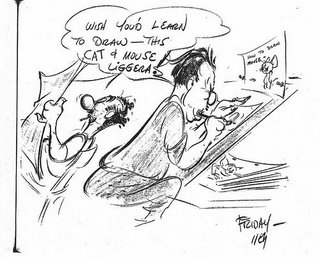
The illustration at left is from the Cartoon Diary blog, which reproduces images from Irv Spence's diary of 1944. That's Spence at the drawing board.
April 16, 1976
Dear Mr. Mayerson
Sorry about being a bit late - will explain later. Hope I can be of some help in regard to your questions about the animation business.
Speaking about Warners and MGM, the footage requirements were just about the same. However, MGM wanted more full or more Disney quality so the footage per week was about 20 or 25 ft. where as at Warners it was more like 30 or 35 ft. per week. As for the studios - MGM cartoon dept. had a much nicer setup than the old Warner bldg. I think Fred Quimby's set up was one of the best in the old days. The ideal cartoon studio. Not too big or too small.
I first went to MGM in 1938. They were doing The Captain and the Kids. I animated in those first two years for George Gordon, Friz Freleng, Hugh Harman and Rudy Ising. Then I began animating for Hanna and Barbera on the first Tom and Jerrys. Yes, Joe and Bill wanted a bit more realism in the animation on Tom and Jerry. Tex Avery wanted very extreme poses and wilder action. Sometimes Tex wanted really wild stuff - and wow! - it was great on the screen.
George Gordon left MGM after directing there, then went with John Sutherland Studios. He directed with the studio for many years then went with Quartet Films in Hollywood doing commercials for several years. Gordon did some outstanding industrial films for Sutherland. The best.
As for UPA, yes their style did influence other studios somewhat. Yes, the budgets did shrink and the animation got more stylized I suppose. Less full animation, more held poses, etc. etc.
I moved from MGM in '56. I was told the studio or rather the MGM main lot was going to discontinue making cartoons. So I made the move to commercial cartoons for TV. In 1963 I was back with my old basses Joe and Bill. Worked on The Flinstones, Johnny Quest, two features, then did commercials again for them, working with Art Babbitt. In 1969 I left Hanna and Barbera and made the big move to Ralph Bakshi. We are now animating(what I think will be a great film) a feature called the War Wizards. It's full animation and it's great fun to go all the way with animation.
Well Mark, it's nice hearing from you. Hope I've helped you somewhat. I could go on and on about this wonderful animation art. I've been doing it a long time but still enjoy it very much. It's a rewarding art form. If there's anything more, let's hear from you.
Sincerely,
Irv Spence
Oh yeah. My wife and I took a nice trip to New Zealand then came home and landed in the hospital with pneumonia. That's why you haven't gotten this reply sooner. -Irv
This letter from Irv Spence was in response to questions I sent him about MGM. It was my only communication with Spence and there aren't any historical revelations here, but I like the letter for it's breezy tone and for Spence's enthusiasm. At the time he wrote this, he was approaching forty years in the business and he was still having fun. We should all be so lucky.
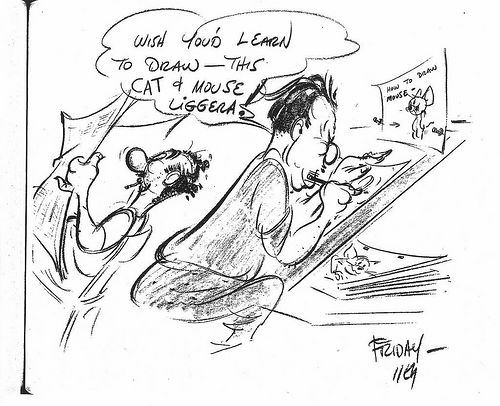
The illustration at left is from the Cartoon Diary blog, which reproduces images from Irv Spence's diary of 1944. That's Spence at the drawing board.
April 16, 1976
Dear Mr. Mayerson
Sorry about being a bit late - will explain later. Hope I can be of some help in regard to your questions about the animation business.
Speaking about Warners and MGM, the footage requirements were just about the same. However, MGM wanted more full or more Disney quality so the footage per week was about 20 or 25 ft. where as at Warners it was more like 30 or 35 ft. per week. As for the studios - MGM cartoon dept. had a much nicer setup than the old Warner bldg. I think Fred Quimby's set up was one of the best in the old days. The ideal cartoon studio. Not too big or too small.
I first went to MGM in 1938. They were doing The Captain and the Kids. I animated in those first two years for George Gordon, Friz Freleng, Hugh Harman and Rudy Ising. Then I began animating for Hanna and Barbera on the first Tom and Jerrys. Yes, Joe and Bill wanted a bit more realism in the animation on Tom and Jerry. Tex Avery wanted very extreme poses and wilder action. Sometimes Tex wanted really wild stuff - and wow! - it was great on the screen.
George Gordon left MGM after directing there, then went with John Sutherland Studios. He directed with the studio for many years then went with Quartet Films in Hollywood doing commercials for several years. Gordon did some outstanding industrial films for Sutherland. The best.
As for UPA, yes their style did influence other studios somewhat. Yes, the budgets did shrink and the animation got more stylized I suppose. Less full animation, more held poses, etc. etc.
I moved from MGM in '56. I was told the studio or rather the MGM main lot was going to discontinue making cartoons. So I made the move to commercial cartoons for TV. In 1963 I was back with my old basses Joe and Bill. Worked on The Flinstones, Johnny Quest, two features, then did commercials again for them, working with Art Babbitt. In 1969 I left Hanna and Barbera and made the big move to Ralph Bakshi. We are now animating(what I think will be a great film) a feature called the War Wizards. It's full animation and it's great fun to go all the way with animation.
Well Mark, it's nice hearing from you. Hope I've helped you somewhat. I could go on and on about this wonderful animation art. I've been doing it a long time but still enjoy it very much. It's a rewarding art form. If there's anything more, let's hear from you.
Sincerely,
Irv Spence
Oh yeah. My wife and I took a nice trip to New Zealand then came home and landed in the hospital with pneumonia. That's why you haven't gotten this reply sooner. -Irv
Tuesday, January 23, 2007
Best Animated Feature
By now, you no doubt know that the three nominees for the Best Animated Feature Oscar are Cars, Happy Feet and Monster House.
I find it odd that Arthur and the Invisibles was disqualified for not being 75% animation, yet Happy Feet and Monster House qualify. How much of those films are animated and how much are motion captured? From my perspective, motion capture is not animation, merely a technique whose look imitates animation. The Academy has decided how much animation is necessary for a film that's mixed with live action, but somehow, motion capture is not held to the same standard.
We have to be clear that the animated feature category exists for a technique and not a genre. There is no category for comedy or science fiction films. There is no category for family films, even though this year's animation nominees all fall squarely within that genre. The technique of animation is what stops these films from competing against live action films, for better or worse. Having created the category, the Academy should be vigilant about what it accepts. I would make the analogy that motion capture is like steriod use in professional sports, except that I don't think that motion capture is performance enhancing.
I don't believe much in awards except as a marketing tool, and clearly that's what the Oscars are all about. The films nominated today are the same films they were yesterday; only the perception of those films has changed. Now, they're nominees; in several weeks one will be an Academy Award winner, though it's still the same film.
However, that winning film will probably go on to earn more money on DVD and for TV sales than it would have without the award. The creative team behind that film will most likely be able to charge more for its services and may have opportunities that wouldn't have existed otherwise.
Which is exactly why it's so important that the Best Animated Feature award actually go to an animated film. I wrote here about the issue of fashion; if motion capture is perceived to be better than keyframed animation, motion capture becomes the style and keyframing's opportunities (and the opportunities of its practitioners) are diminished.
I'm not a member of the Academy but I would hope that the members of the animation branch would take this very seriously. It took roughly 60 years from Snow White and the Seven Dwarfs for animated features to grow enough in terms of releases and public acceptance to warrant an award from the Academy. It would be a shame if one of the animation industry's main marketing tools is generalized to any film that looks like animation.
I find it odd that Arthur and the Invisibles was disqualified for not being 75% animation, yet Happy Feet and Monster House qualify. How much of those films are animated and how much are motion captured? From my perspective, motion capture is not animation, merely a technique whose look imitates animation. The Academy has decided how much animation is necessary for a film that's mixed with live action, but somehow, motion capture is not held to the same standard.
We have to be clear that the animated feature category exists for a technique and not a genre. There is no category for comedy or science fiction films. There is no category for family films, even though this year's animation nominees all fall squarely within that genre. The technique of animation is what stops these films from competing against live action films, for better or worse. Having created the category, the Academy should be vigilant about what it accepts. I would make the analogy that motion capture is like steriod use in professional sports, except that I don't think that motion capture is performance enhancing.
I don't believe much in awards except as a marketing tool, and clearly that's what the Oscars are all about. The films nominated today are the same films they were yesterday; only the perception of those films has changed. Now, they're nominees; in several weeks one will be an Academy Award winner, though it's still the same film.
However, that winning film will probably go on to earn more money on DVD and for TV sales than it would have without the award. The creative team behind that film will most likely be able to charge more for its services and may have opportunities that wouldn't have existed otherwise.
Which is exactly why it's so important that the Best Animated Feature award actually go to an animated film. I wrote here about the issue of fashion; if motion capture is perceived to be better than keyframed animation, motion capture becomes the style and keyframing's opportunities (and the opportunities of its practitioners) are diminished.
I'm not a member of the Academy but I would hope that the members of the animation branch would take this very seriously. It took roughly 60 years from Snow White and the Seven Dwarfs for animated features to grow enough in terms of releases and public acceptance to warrant an award from the Academy. It would be a shame if one of the animation industry's main marketing tools is generalized to any film that looks like animation.
Monday, January 22, 2007
Prepare to Board!
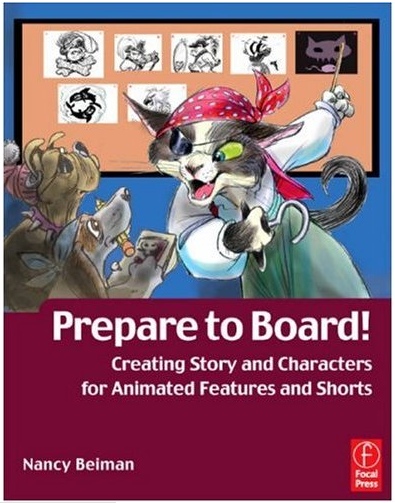 Nancy Beiman has created a commercial for her new book, Prepare to Board! The book is scheduled for release on March 2 and is up for pre-order at Amazon.com.
Nancy's career has included animating on features for Disney and Amblin' as well as stints doing character design, storyboarding, directing and children's book illustration.
She's a long-time friend of mine, so I had the opportunity to read the book in manuscript. I think that it's a solid book on writing and boarding for animation with excellent visual examples. It also features work by some of her students at the Rochester Institute of Technology.
As an added bonus, Nancy has included three previously unpublished interviews with Ken O'Connor, Ken Anderson and T. Hee, which should make the book interesting reading for animation historians as well as artists.
Saturday, January 20, 2007
Dan Haskett Sesame Street Work
This is a Sesame Street spot created by Dan Haskett. Dan is one of the most natural animators I've ever met and it's a shame that he rarely has the opportunity to animate his own thing. It seems like most of the credits I see for Dan are in the area of character design, and while he's excellent at it, nobody moves his designs as well as he does.
When I started out in the '70's in New York, Dan Haskett was miles ahead of the rest of us, and we all knew it. We all wanted to be Dan when we grew up.
Here's another piece Dan did for Sesame Street. There's a four second blackout near the start, but the piece resumes. There's some very expressive dialogue animation here.
Dan may have done other Sesame Street spots, though I can't remember for sure. If anyone knows and can find them online, please let me know and I'll link to them.
Wednesday, January 17, 2007
Dean Yeagle Design Demonstration

Dean Yeagle will be doing an on-line chalk talk via the Entertainment Art Academy on February 18 from 3-6 p.m. Pacific Time. The cost is $65 and you can find registration information here. Scroll down until you see the drawing at left.
For those not familiar with Dean, he's a long-time animation designer and animator in addition to being a regular gag cartoonist for Playboy for the last 7 years. You can see more of his work at his website.
Tuesday, January 16, 2007
Mother Goose Goes Hollywood Part 3
One of the things that fascinates me about this cartoon is the way it points both forwards and backwards in animation styles. A lot of the Disney cartoons from the 1930's do this. Specifically, I'm fascinated by the differences between Ward Kimball's work and Izzy Klein's.
Kimball, if you haven't guessed, points towards the future. He understands line of action and rhythm in a pose. If you single frame Kimball's work, the poses are very strong silhouettes and the rhythms are pleasing.
By contrast, Klein looks to the past; he started animating at the Hearst studio in the teens and his animation is just fussy. Klein does a pretty good job of capturing the acting style of Oliver Hardy, but his work is less graceful than Hardy himself.
Take a look at these two images. Both are anticipation drawings.
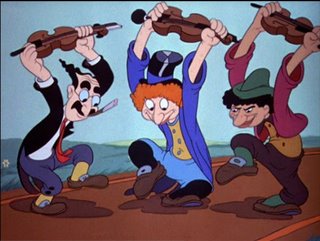
Look at the long, graceful curves in the Kimball drawing. If you look at the left side of the Groucho figure, the curve starts with the hand and travels all the way through the coat tails. If you prefer, you can follow it down the leg to the foot. Those kinds of long curves give the figures a unity and a flow and they're evident in all three characters.
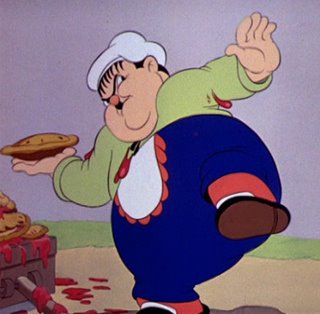 In Klein's drawing, the lines keep getting stopped by changes in direction. They're short and they tend to bump into other lines. The body parts don't feel tied together because the linework doesn't flow between them. A good assistant animator could clean-sheet this drawing, push the pose a bit and use a rhythmic line to improve this significantly.
The same lack of rhythm in Klein's individual drawings is evident in his animation. It's not enough to draw a rhythmic pose, your path of action has to be rhythmic as well. Just as Klein's lines are fighting each other, the movement of his character's parts fight each other too. The fussiness in the animation is because the poses and actions aren't tied together with rhythm.
Fred Moore didn't work on this cartoon, but Kimball's work couldn't exist without Moore's. Moore used rhythm to unify individual drawings and unify the sequence of drawings into a coherent statement. Kimball got it and Klein didn't, which is why people talk about one and not the other.
Kimball, if you haven't guessed, points towards the future. He understands line of action and rhythm in a pose. If you single frame Kimball's work, the poses are very strong silhouettes and the rhythms are pleasing.
By contrast, Klein looks to the past; he started animating at the Hearst studio in the teens and his animation is just fussy. Klein does a pretty good job of capturing the acting style of Oliver Hardy, but his work is less graceful than Hardy himself.
Take a look at these two images. Both are anticipation drawings.

Look at the long, graceful curves in the Kimball drawing. If you look at the left side of the Groucho figure, the curve starts with the hand and travels all the way through the coat tails. If you prefer, you can follow it down the leg to the foot. Those kinds of long curves give the figures a unity and a flow and they're evident in all three characters.
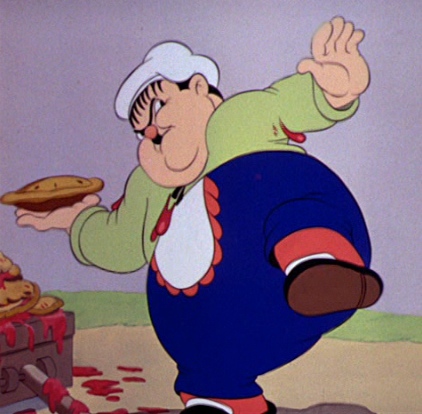 In Klein's drawing, the lines keep getting stopped by changes in direction. They're short and they tend to bump into other lines. The body parts don't feel tied together because the linework doesn't flow between them. A good assistant animator could clean-sheet this drawing, push the pose a bit and use a rhythmic line to improve this significantly.
The same lack of rhythm in Klein's individual drawings is evident in his animation. It's not enough to draw a rhythmic pose, your path of action has to be rhythmic as well. Just as Klein's lines are fighting each other, the movement of his character's parts fight each other too. The fussiness in the animation is because the poses and actions aren't tied together with rhythm.
Fred Moore didn't work on this cartoon, but Kimball's work couldn't exist without Moore's. Moore used rhythm to unify individual drawings and unify the sequence of drawings into a coherent statement. Kimball got it and Klein didn't, which is why people talk about one and not the other.
Monday, January 15, 2007
Weinman on TV Animation Design
After reading the comments here about the look of King of the Hill, Jaime Weinman has added his thoughts about the nature of prime time animation design.
Sunday, January 14, 2007
Drawing the Line
My review of Tom Sito's book Drawing the Line: The Untold Story of the Animation Unions from Bosko to Bart Simpson is up on the fps site. If you don't want to click through to read it, the short review is that it's an excellent book and worth reading.
King of the Hill Pitch
Here's the pitch trailer that Mike Judge and Greg Daniels used to sell the King of the Hill series to Fox. Jaime Weinman has also posted his thoughts on this piece.
Subscribe to:
Posts (Atom)

 Posts
Posts

