Several recent events have reminded me of the risks involved in animation.
Brenda Chapman's dismissal as director of Pixar's Brave is old news, but she recently spoke out about being fired.
Henry Selick's untitled film with Disney was cancelled, forcing the layoff of over a hundred artists at the Cinderbiter studio in the San Francisco area.
Finally, and this won't be as well known, the CEO of the Go Go Gorillas operation, Christopher Turner, is under investigation for fraud. Further details here. I've written about John Celestri in the past. John's a friend and former co-worker who was looking for an alternate financial model for animation and connected with Christopher Turner. The company was attempting to use a restaurant/arcade to fund animation. That's the reverse of the typical approach where popular cartoon characters are used to brand other enterprises like theme parks. In any case, it is doubtful that the company will be able to move forward or survive with this shadow hanging over it.
The important thing to realize is that risk is unavoidable and the above events are not the result of malice. While the people who have been affected by this will suffer, there was no intent for that to be the case. Pixar would have been better off not hiring Chapman rather than deal with the public relations problems of taking her off the film. Disney expected to release Selick's film or it wouldn't have bothered to invest in it to begin with. Time will tell if Christopher Turner was a businessman who got in over his head or whether he deliberately planned to defraud, but there are much quieter ways to steal money. Ask Bernie Madoff.
There's no shortage of studios that have lost projects in mid-production or been forced into bankruptcy by creditors. The artists at those studios have fallen victim to forces beyond their control. If Chapman and Selick, who were working for the largest animation company in the world, couldn't avoid risk, no one can.
That's the moral. No matter how solid things look, they never really are. It pays to plan for losing your job. Can you survive financially if you're laid off? Are you in touch with enough people in the industry to find your next job? Are your skills up to date so that you can easily fit into another production? If the answer to any of the above questions is "no," then you're more vulnerable to risk than you should be.
Showing posts with label John Celestri. Show all posts
Showing posts with label John Celestri. Show all posts
Sunday, August 19, 2012


Sunday, July 03, 2011
John Celestri Blog

Tuesday, January 04, 2011
Go Go Gorillas!
 I met John Celestri at Nelvana in Toronto, even though we were both New Yorkers by birth. At the time, John was animating on Rock and Rule. In the years since Nelvana, John has worked for a variety of studios including Don Bluth.
 Currently, he’s the COO of Grace Global Media Corp. which is trying a new variation on an established business model. Lots of cartoon series spin off merchandise or themed locations. Lots of brands spin off cartoon series. Go Go Gorillas! was created to simultaneously be both a retail brand and an animation series.
The first facility opened last December 3 in Danville, Kentucky. It’s 30,000 square feet housing a restaurant and indoor theme park, which contains a rock climbing wall, an arcade, mini-bowling, bumper cars, blacklight miniature golf, party rooms and an educational space for classes to use for field trips based on Kentucky’s core curriculum . The characters are the Avenging Apes of Africa, a group built around the themes of ecological and social responsibility.
The company’s goal is to expand the number of facilities and once there is a steady cash flow, build an animation studio that will create a featurette a year to explore the characters’ stories, as well as create arcade and video games for the chain. John is committed to using drawn animation for these films and to doing it all under one roof in Danville, with no outsourcing.
The website is located here and the center is located at 2900 South Danville Bypass, Danville, KY.

Saturday, May 27, 2006
More NYIT Memories
Here, courtesy of John Celestri, are more memories of his time spent at the New York Institute of Technology's animation studio.
JOHN’S BLOG MEMORIES OF NYIT: PART 2
Growing up in Brooklyn during the 1950s, my childhood was full of day-and-night dreams of being powerful like Popeye, Mighty Mouse, and Superman. Oh, what I wouldn’t have given to be able to fly through the air, leap over buildings in a single bound, or be able to pound the neighborhood bully by simple swallowing a mouthful of spinach.
These fantasies were fueled by images I’d seen in the old Terrytoons and Fleischer/Paramount cartoons broadcasted over the local TV airwaves. From the ages of 5 through 12, I was glued to the screen of my family’s old black and white Sylvania, soaking it all in. And when I wasn’t watching Popeye, Mighty Mouse, or Superman cartoons, I was reading their comic books and copying their images onto whatever paper I could find, using whatever pencils I could get from my father, who was a mechanical draftsman.
It was at NYIT that I met some of the artists who created those images of power---power I so desperately wanted to have coursing through my tiny, childhood muscles.
When I first started working at NYIT, I expected to meet animators, but I didn’t realize they were responsible for some of my most cherished childhood fantasies. I was just excited about getting a break at learning the business. Back then, animation fandom wasn’t as developed as it has become since, so I didn’t know that Johnny Gent was the best Popeye artist and could animate a punch better than anyone in the business.
I knew about Bill Tytla and Freddy Moore, having studied their work on old super-8 millimeter sound versions of sequences from Disney cartoons released for home viewing during the late 1960s-early 1970s. But the plain fact of the matter was that I’d been more of a comic book fan and could pick out a comic book artist’s style just by glancing at the line work on the printed page. So I was shocked and surprised to see the name “Boring” on the folder of one of the first TUBBY THE TUBA scenes I was given to inbetween.
The name wasn’t written in the animator’s area of the folder, but rather in the layout section. I looked at the layout drawings in the folder and recognized the familiar sketchy line that I’d seen inked by brush in my favorite Superman comic books of the 1950s. Could this be the same Wayne Boring, whose images of Superman I strained to copy back when I could barely control my pencil? If so, what the heck was he doing in this out-of-the-way place on Long Island and why had he stopped drawing Superman? These were the questions of a person who had no idea of the realities of life as an animation or comic artist. But I didn’t ask --- again, I was too excited at not only getting the chance to draw and learn the animation business, but also getting paid to do it. The other reason was that in those days older artists were looked upon with respect, and I didn’t think it my place to question his choice of jobs. On the other hand, why wouldn’t Wayne Boring work on TUBBY, after all it was turning out to be the single biggest source of employment for the New York animation industry, both union and non-union talent. (A side note: the union strike at NYIT gave me my second real break --- but that’s a story for another time.)
Anyway, I asked the head assistant animator to point out Wayne Boring. I took it from there, politely introducing myself as a long-time fan. I didn’t know it, but Wayne was already past retirement age --- a youthful-looking 70 years old. He was short in height and had a certain military air about him, walking with a slight rolling gate that reminded me of sailors on shore leave. I found out during our few conversations that I was right, he’d been in the Navy and referred to himself as being a Chief Petty Officer.
In that introductory meeting of ours, I brought along two pages I’d chosen from all the hundreds of Superman drawings in Wayne’s style I’d copied from comic books when I was 11 or 12 years old. I just wanted him to know that he’d had a dramatic influence on my life.
“Yep, Johnny Boy,” Wayne said, “I recognize my poses.”
From that point on, Wayne always addressed me as “Johnny” or “Johnny Boy” when we’d pass each other in the hallway or outside the studio building. He was the silent type who kept to himself, going out alone for lunch and staying at his desk, working on layout drawings.
I didn’t pester Wayne about his days drawing Superman --- I picked up a strong impression that he didn’t want to talk about it. I figured after a little while of getting to know him, I might find the opportunity to broach that subject. I never had that chance.
Four weeks after I met Wayne Boring at NYIT, he left. I knew nothing about his impending departure until that final Friday afternoon, when I heard about it in conversation with several other artists. I immediately went to Wayne’s office, which he shared with storyboard artist George Singer, to say goodbye.
Wayne was alone and he and I shook hands, exchanging good wishes. Then just as I was about to leave to return to my desk, Wayne slide a drawing out from under his desk blotter and presented it to me. “For you, Johnny.”
It was a pencil sketch on Bristol board of Superman in his classic heroic fists-on-hips pose.
Wayne said, “Don’t tell anyone I did this for you. You never bothered me for a drawing, like all the rest here have.”
That Superman sketch is still one of my most prized possessions.
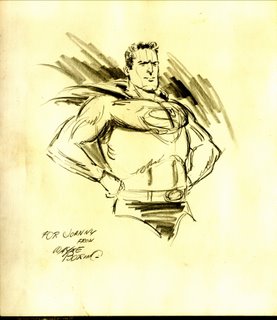
(Click on the image for a larger view.)
JOHN’S BLOG MEMORIES OF NYIT: PART 2
Growing up in Brooklyn during the 1950s, my childhood was full of day-and-night dreams of being powerful like Popeye, Mighty Mouse, and Superman. Oh, what I wouldn’t have given to be able to fly through the air, leap over buildings in a single bound, or be able to pound the neighborhood bully by simple swallowing a mouthful of spinach.
These fantasies were fueled by images I’d seen in the old Terrytoons and Fleischer/Paramount cartoons broadcasted over the local TV airwaves. From the ages of 5 through 12, I was glued to the screen of my family’s old black and white Sylvania, soaking it all in. And when I wasn’t watching Popeye, Mighty Mouse, or Superman cartoons, I was reading their comic books and copying their images onto whatever paper I could find, using whatever pencils I could get from my father, who was a mechanical draftsman.
It was at NYIT that I met some of the artists who created those images of power---power I so desperately wanted to have coursing through my tiny, childhood muscles.
When I first started working at NYIT, I expected to meet animators, but I didn’t realize they were responsible for some of my most cherished childhood fantasies. I was just excited about getting a break at learning the business. Back then, animation fandom wasn’t as developed as it has become since, so I didn’t know that Johnny Gent was the best Popeye artist and could animate a punch better than anyone in the business.
I knew about Bill Tytla and Freddy Moore, having studied their work on old super-8 millimeter sound versions of sequences from Disney cartoons released for home viewing during the late 1960s-early 1970s. But the plain fact of the matter was that I’d been more of a comic book fan and could pick out a comic book artist’s style just by glancing at the line work on the printed page. So I was shocked and surprised to see the name “Boring” on the folder of one of the first TUBBY THE TUBA scenes I was given to inbetween.
The name wasn’t written in the animator’s area of the folder, but rather in the layout section. I looked at the layout drawings in the folder and recognized the familiar sketchy line that I’d seen inked by brush in my favorite Superman comic books of the 1950s. Could this be the same Wayne Boring, whose images of Superman I strained to copy back when I could barely control my pencil? If so, what the heck was he doing in this out-of-the-way place on Long Island and why had he stopped drawing Superman? These were the questions of a person who had no idea of the realities of life as an animation or comic artist. But I didn’t ask --- again, I was too excited at not only getting the chance to draw and learn the animation business, but also getting paid to do it. The other reason was that in those days older artists were looked upon with respect, and I didn’t think it my place to question his choice of jobs. On the other hand, why wouldn’t Wayne Boring work on TUBBY, after all it was turning out to be the single biggest source of employment for the New York animation industry, both union and non-union talent. (A side note: the union strike at NYIT gave me my second real break --- but that’s a story for another time.)
Anyway, I asked the head assistant animator to point out Wayne Boring. I took it from there, politely introducing myself as a long-time fan. I didn’t know it, but Wayne was already past retirement age --- a youthful-looking 70 years old. He was short in height and had a certain military air about him, walking with a slight rolling gate that reminded me of sailors on shore leave. I found out during our few conversations that I was right, he’d been in the Navy and referred to himself as being a Chief Petty Officer.
In that introductory meeting of ours, I brought along two pages I’d chosen from all the hundreds of Superman drawings in Wayne’s style I’d copied from comic books when I was 11 or 12 years old. I just wanted him to know that he’d had a dramatic influence on my life.
“Yep, Johnny Boy,” Wayne said, “I recognize my poses.”
From that point on, Wayne always addressed me as “Johnny” or “Johnny Boy” when we’d pass each other in the hallway or outside the studio building. He was the silent type who kept to himself, going out alone for lunch and staying at his desk, working on layout drawings.
I didn’t pester Wayne about his days drawing Superman --- I picked up a strong impression that he didn’t want to talk about it. I figured after a little while of getting to know him, I might find the opportunity to broach that subject. I never had that chance.
Four weeks after I met Wayne Boring at NYIT, he left. I knew nothing about his impending departure until that final Friday afternoon, when I heard about it in conversation with several other artists. I immediately went to Wayne’s office, which he shared with storyboard artist George Singer, to say goodbye.
Wayne was alone and he and I shook hands, exchanging good wishes. Then just as I was about to leave to return to my desk, Wayne slide a drawing out from under his desk blotter and presented it to me. “For you, Johnny.”
It was a pencil sketch on Bristol board of Superman in his classic heroic fists-on-hips pose.
Wayne said, “Don’t tell anyone I did this for you. You never bothered me for a drawing, like all the rest here have.”
That Superman sketch is still one of my most prized possessions.

Sunday, May 14, 2006
N.Y. Institute of Technology, Part 1
NYIT in Westbury, Long Island, is a school that had an animation studio attached to it for a while. While the studio and its films are not widely remembered, a lot of very interesting people passed through the place.
John Celestri is a fellow New Yorker, though I didn't meet him until we were both in Toronto. He was at NYIT in the '70's and I've asked him to share some of his memories.
John’s Blog Memories of NYIT: Part 1
Both Mark Mayerson and I have separately come to the understanding that historically what went on at the New York Institute of Technology during the mid- to late-1970s was the hidden ending to both the Paramount and Terrytoon studios.
I was on staff there from March of 1975 to May of 1976.
My additional observation is that it was also the hidden birth of computer animation as we know it today. The fact is that Tubby the Tuba was put into production so that Dr. Alexander Schure (who basically owned and ran NYIT) could study the process of putting together an animated feature and see what technical problems needed to be surmounted by a computer. As Tubby was being produced by a crew of semi-retired animators headed by Chuck Harriton and John Gentilella, a separate crew on the far side of the Long Island campus (headed by young Edwin Catmull) was busy experimenting with ways to draw and color pictures on a computer screen.
(Here's a paper by Ed Catmull on the problems of computer assisted animation and an interview with Catmull about his time at NYIT.)
When the traditional work on Tubby was completed, a selected crew of the Paramount and Terrytoon animators were reassigned to the computer crew. Among them were John Gentilella, Dante Barbetta, and Earl James. Their task was to draw and animate objects with the tools the computer crew was developing, showing them what difficulties they had using the tools.
The eventual direct result of all this experimentation is the creation of both Disney’s CAPS system and Pixar’s CGI systems. Just the thought of this major historical connection makes my head spin.
John Celestri is a fellow New Yorker, though I didn't meet him until we were both in Toronto. He was at NYIT in the '70's and I've asked him to share some of his memories.
John’s Blog Memories of NYIT: Part 1
Both Mark Mayerson and I have separately come to the understanding that historically what went on at the New York Institute of Technology during the mid- to late-1970s was the hidden ending to both the Paramount and Terrytoon studios.
I was on staff there from March of 1975 to May of 1976.
My additional observation is that it was also the hidden birth of computer animation as we know it today. The fact is that Tubby the Tuba was put into production so that Dr. Alexander Schure (who basically owned and ran NYIT) could study the process of putting together an animated feature and see what technical problems needed to be surmounted by a computer. As Tubby was being produced by a crew of semi-retired animators headed by Chuck Harriton and John Gentilella, a separate crew on the far side of the Long Island campus (headed by young Edwin Catmull) was busy experimenting with ways to draw and color pictures on a computer screen.
(Here's a paper by Ed Catmull on the problems of computer assisted animation and an interview with Catmull about his time at NYIT.)
When the traditional work on Tubby was completed, a selected crew of the Paramount and Terrytoon animators were reassigned to the computer crew. Among them were John Gentilella, Dante Barbetta, and Earl James. Their task was to draw and animate objects with the tools the computer crew was developing, showing them what difficulties they had using the tools.
The eventual direct result of all this experimentation is the creation of both Disney’s CAPS system and Pixar’s CGI systems. Just the thought of this major historical connection makes my head spin.
Subscribe to:
Posts (Atom)

 Posts
Posts

